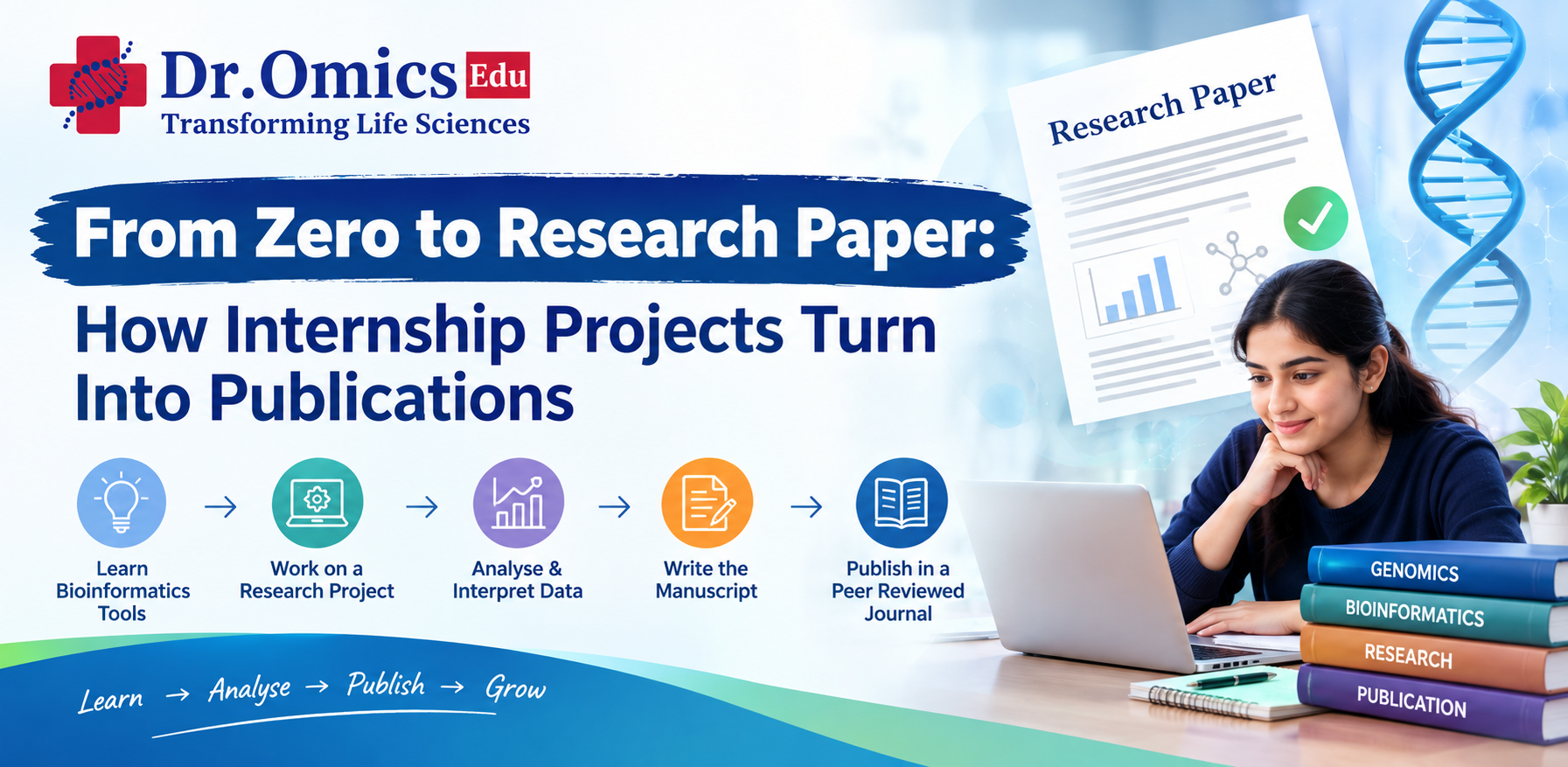
From Zero to Research Paper: How Internship Projects Turn Into Publications
Dr. Omics Edu Team ·
For many students, a bioinformatics internship begins with a simple goal: learn tools, complete a project, and gain practical experience. But a well-designed internship project can offer much more than a certificate. With the right research question, systematic analysis, scientific documentation, and mentorship, an internship project can become the foundation of a research paper.
The journey from a classroom project to a student research publication requires more than generating results. Students need to understand how research questions are developed, how analyses are documented, how results are interpreted, and how scientific findings are communicated.
This is where a project based bioinformatics internship can play an important role. Instead of treating an internship as a collection of disconnected software exercises, students can work through a complete research workflow—from identifying a biological problem to preparing a manuscript.
What Makes a Bioinformatics Internship Project Research-Oriented?
Not every internship project automatically becomes a research paper.
A typical training project may involve learning tools such as BLAST, FASTQC, HISAT2, DESeq2, Cytoscape, or other bioinformatics software. These exercises are useful for developing technical skills, but publication-oriented research requires an additional layer: a meaningful scientific question.
A bioinformatics research project generally begins with a question such as:
- Which genes are differentially expressed between two biological conditions?
- Which pathways are associated with a particular disease?
- Which genetic variants may have functional significance?
- What biological networks are associated with a particular phenotype?
- Can publicly available sequencing data provide new insights into a research question?
The key difference is that the student is not simply asking, "Can I run this tool?"
Instead, the question becomes:
"What biological question can this analysis help answer?"
That change in mindset is an important first step toward research.
Step 1: Start With a Clear Research Question
A publication-oriented internship should begin with a clearly defined research question.
For example, instead of giving a student the broad topic "RNA-seq analysis," a mentor could define a more focused project:
"Identify differentially expressed genes and enriched biological pathways associated with a specific disease condition using publicly available RNA-seq datasets."
This gives the student a scientific objective and provides a logical structure for the project.
The research question determines:
- Dataset selection
- Experimental groups
- Bioinformatics workflow
- Statistical analysis
- Visualization
- Biological interpretation
- Literature review
A focused question also makes it easier to determine whether the final results provide a meaningful contribution.
Step 2: Learn Through a Research Project
A strong research paper internship program combines training with project work.
Students first learn the concepts and tools required for their project. They can then apply those skills to a real dataset.
For example, an RNA-seq project may involve:
Public dataset → Quality control → Preprocessing → Alignment or quantification → Differential expression → Functional enrichment → Network analysis → Biological interpretation → Literature comparison
The exact workflow depends on the research question and dataset.
The important point is that every analysis step should have a scientific reason behind it.
Instead of simply reporting that "DESeq2 was used," students should understand why differential expression analysis was appropriate, what statistical assumptions are involved, and how the resulting genes should be interpreted.
Step 3: Conduct a Literature Review
A research paper does not exist in isolation.
Before interpreting results, students need to understand what is already known about the biological problem.
A literature review helps answer questions such as:
- What has already been discovered?
- Which genes or pathways are known to be associated with the condition?
- What datasets have previously been analyzed?
- What limitations exist in previous studies?
- What research gap can the current project address?
Students should learn how to search scientific literature using resources such as PubMed, Google Scholar, and other academic databases.
The goal is not to copy information from previous papers. It is to understand the scientific context in which the new analysis will be positioned.
Step 4: Generate Reproducible Results
One of the most important differences between a simple student assignment and publication-oriented research is reproducibility.
A student should maintain records of:
- Dataset accession numbers
- Reference genome versions
- Software versions
- Parameters
- Commands or scripts
- Statistical thresholds
- Analysis steps
- Output files
- Figures
- Important intermediate results
For example, if a student analyzes an RNA-seq dataset downloaded from a public repository, the accession number should be recorded.
Similarly, software versions and important parameters should be documented.
This makes it possible for the student, mentor, or another researcher to understand how the results were generated.
Step 5: Move From Results to Biological Interpretation
Generating a list of differentially expressed genes is not the end of the research project.
The more important question is:
What do these results mean biologically?
Students can use approaches such as:
- Gene Ontology enrichment
- Pathway analysis
- Protein-protein interaction analysis
- Network analysis
- Disease association analysis
- Literature-based validation
- Comparison with previously published findings
For example, if several differentially expressed genes are associated with an inflammatory pathway, the student can investigate whether previous studies have reported similar biological relationships.
This transforms a list of computational results into a scientific interpretation.
Step 6: Identify the Research Story
A research paper needs a coherent story.
Students often make the mistake of trying to include every result generated during an internship. More results do not necessarily make a stronger manuscript.
Instead, the student and mentor should identify the central finding.
A research story might look like:
Research problem → Dataset → Methodology → Key findings → Biological interpretation → Comparison with existing research → Research significance → Limitations
The manuscript should guide the reader through this sequence logically.
Step 7: Learn Scientific Writing
Technical analysis and scientific writing are two different skills.
Students may successfully complete a bioinformatics pipeline but still struggle to explain their work in manuscript format.
A typical research paper contains sections such as:
Abstract
A concise summary of the research question, methods, major findings, and conclusion.
Introduction
Explains the biological problem, existing knowledge, research gap, and objective of the study.
Materials and Methods
Describes datasets, tools, software, parameters, statistical methods, and analytical procedures.
Results
Presents the findings using appropriate text, figures, and supplementary information.
Discussion
Explains the biological meaning of the results and compares them with previous research.
Conclusion
Summarizes the main findings and their potential significance.
Learning these sections during an internship helps students understand how research is transformed into a scientific publication.
From Internship Project to Manuscript
Once the analysis is complete, the project can be evaluated for publication potential.
This does not mean every internship project will result in a paper. Publication depends on factors such as the research question, novelty, data quality, analytical rigor, interpretation, and suitability for a journal.
A useful process is:
Project completion → Internal review → Additional analysis → Literature comparison → Manuscript preparation → Mentor review → Journal selection → Submission → Peer review → Revision
This is where structured research paper assistance bioinformatics can be useful.
Such assistance should ideally focus on research methodology, scientific writing, data interpretation, figure preparation, and understanding the publication process rather than simply writing a paper for the student.
The Role of a Research Mentor
Mentorship can make a major difference in a student's research experience.
A research mentorship program can provide guidance at different stages of the project.
A mentor can help students:
- Refine the research question
- Select appropriate datasets
- Design the analysis workflow
- Troubleshoot technical problems
- Interpret results
- Identify additional analyses
- Review figures
- Improve scientific writing
- Understand journal requirements
- Respond to reviewer comments
Importantly, mentorship should encourage students to understand and perform the research rather than simply providing finished answers.
The goal is to develop independent researchers.
Co-Authorship and Internship Projects
One topic students frequently ask about is co-authorship internship opportunities.
Completing an internship does not automatically make someone an author on a research paper. Authorship generally depends on the person's actual contribution to the research and the authorship policies applicable to the project and journal.
A student who makes substantial contributions to study design, analysis, interpretation, or manuscript development may potentially qualify for authorship, depending on the circumstances.
Therefore, authorship expectations should ideally be discussed early in the research project.
Students should understand the difference between:
Internship certificate ≠ automatic authorship
and
Substantive research contribution + appropriate scholarly contribution → potential authorship, subject to applicable authorship criteria.
Transparent communication between students, mentors, and research teams can prevent misunderstandings later.
How to Choose a Journal
Journal selection is another important part of the publication journey.
Students should learn to evaluate journals based on factors such as:
- Scope
- Research area
- Article types
- Peer-review process
- Publication requirements
- Indexing and visibility
- Publication fees
- Data and reporting requirements
- Ethical policies
The objective should not simply be to find a journal that accepts the manuscript quickly.
The journal should be appropriate for the research question and quality of the study.
This is an important component of peer reviewed journal publication guidance for students entering research for the first time.
Understanding Peer Review
After manuscript submission, the paper may go through editorial assessment and peer review.
Reviewers may ask questions about:
- Research methodology
- Statistical analysis
- Dataset selection
- Biological interpretation
- Literature coverage
- Figures
- Reproducibility
- Limitations
Students should understand that reviewer comments are a normal part of academic publishing.
A manuscript may require additional analysis, clarification, restructuring, or revision before it can be accepted.
Learning how to respond professionally to reviewer comments is itself an important research skill.
Why Project-Based Training Is Valuable
Traditional classroom learning often focuses on individual concepts and tools.
A project based bioinformatics internship connects those concepts into a complete workflow.
For example, a student may learn:
Python → Linux → NGS concepts → RNA-seq → statistics → R → pathway analysis → visualization → scientific writing
Instead of learning each topic independently, the student sees how the skills work together to solve a biological research problem.
This approach can also help students understand which skills they need to strengthen before entering research or industry.
Building a Publication-Focused Internship
A well-structured bioinformatics research training program can be divided into several stages.
Phase 1: Foundation
Students learn the biological background, research question, relevant databases, and required computational concepts.
Phase 2: Technical Training
Students learn the tools and analytical methods required for the project.
Phase 3: Research Analysis
Students independently perform the analysis under mentor supervision.
Phase 4: Interpretation
Results are evaluated using biological knowledge and relevant literature.
Phase 5: Manuscript Development
Students learn how to convert their research findings into a scientific manuscript.
Phase 6: Publication Preparation
The mentor and student review the manuscript, select an appropriate journal, and prepare the submission.
This structure can transform an internship from a short-term training activity into a meaningful research experience.
What Students Should Take Away
A successful research internship should not be measured only by the number of tools a student learns.
Students should ideally finish the program knowing how to:
- Ask a researchable biological question
- Find and evaluate scientific literature
- Work with real biological datasets
- Design a reproducible analysis
- Interpret computational results
- Communicate scientific findings
- Prepare figures and reports
- Write a research manuscript
- Understand authorship and research ethics
- Navigate the peer-review process
These skills remain valuable even if the specific internship project does not ultimately become a publication.
Conclusion
The journey from zero to research paper begins long before manuscript writing. It starts with a meaningful research question, appropriate data, systematic analysis, careful interpretation, and consistent mentorship.
A well-designed research paper internship program can give students exposure to the complete research lifecycle—from learning bioinformatics tools to analyzing real datasets and communicating scientific findings.
Not every internship project will become a publication, and publication should not be treated as the only measure of a student's research experience. However, when a project has a clear research question, sound methodology, meaningful findings, and sufficient scientific contribution, it can provide a strong foundation for a manuscript.
For students interested in a student research publication, the most valuable approach is to focus first on learning how research is actually conducted. With structured bioinformatics research training, appropriate research mentorship, and hands-on project experience, an internship can become more than a certificate—it can become the beginning of a student's journey into scientific research.
