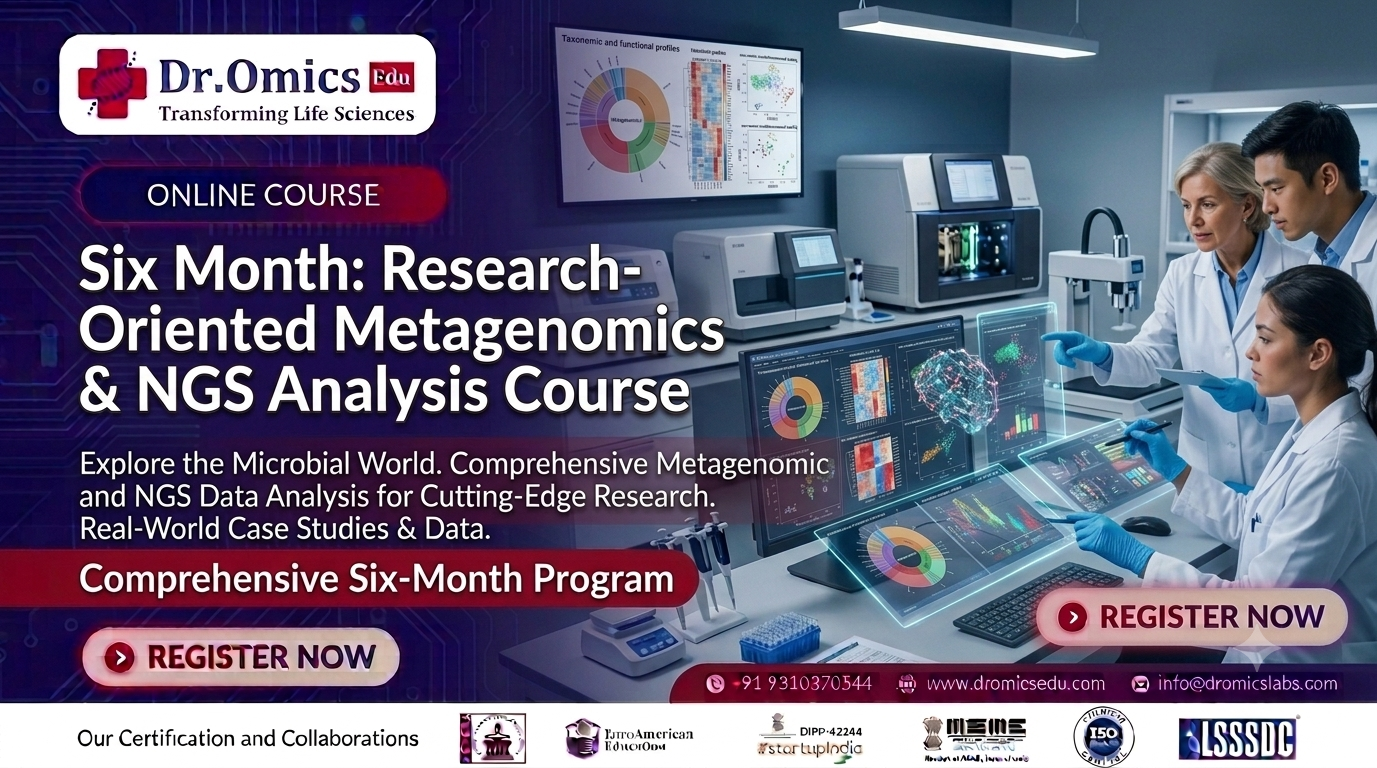
About this course
This *6-Month Advanced Genomic Research-Oriented Course* is designed to provide an in-depth, project-based learning experience that bridges the gap between biological research and computational genomics. The program focuses on developing practical expertise in **Next-Generation Sequencing (NGS), Bioinformatics, Multi-Omics, and Computational Data Analysis** through real-world research datasets.
Participants will gain hands-on experience with **genomic and transcriptomic data analysis workflows**, including sequence analysis, quality control, genome mapping, variant analysis, RNA-Seq, metagenomics, and functional annotation. The course also introduces **Python and R programming** for biological data analysis, workflow development, visualization, and research-oriented computational applications.
The curriculum emphasizes *research methodology, data interpretation, reproducible analysis, and scientific problem-solving*, enabling participants to understand how computational approaches are applied to real biological questions. Participants will work on *guided research projects* using industry-relevant tools and publicly available datasets while receiving mentorship throughout the program.
The program concludes with a *research-oriented capstone project*, where participants apply the concepts and tools learned throughout the course to investigate a genomics-related research question and generate meaningful biological insights. This course is ideal for students and aspiring researchers looking to build strong practical and research skills for *higher studies, dissertation projects, academic research, and careers in genomics and bioinformatics*.
What you will learn
Genomic Pipeline Development: Build automated workflows for Whole Genome Sequencing (WGS) and RNA-Seq.
AI in Biomedicine: Apply Supervised Learning for gene-disease association mapping and drug response prediction.
Structural Bioinformatics: Use tools like AlphaFold for AI-powered protein folding and 3D structure analysis.
Cloud Computing: Execute large-scale genomic analyses using AWS and Google Cloud Platform (GCP).
Clinical Variant Interpretation: Master the art of identifying and annotating pathogenic mutations using GATK and Ensemble.
Skills you will gain
NGS
Python
Bioinformatics
AI
MachineLearning
R-Programming
Bioconductor
Linux
CRISPR-Design
Data Mining
Certification
Available
Issued by Dr. Omics Edu
Course curriculum
11 modules
-
M1T1 = Introduction to Bioinformatics
-
M1T2 = NCBI Database Overview
-
M1T3 = Genbank Database Practical Exercises
-
M1T4 = UCSC Genome Browser Overview
-
M1T5 = UCSC Genome Browser Hands-on Exercises
-
M1T6 = Pubmed Database Introduction
-
M1T7 = Clinvar Database Overview
-
M1T8 = KEGG Database Overview and Exercises
-
M1T9 = Protein Databases (UniProt)
-
M1T10 = Protein Databases (PDB)
-
M1T11 = Online BLAST Introduction and Exercises
-
M1T12 = Standalone BLAST Setup and Exercises
-
M1T13 = Standalone BLAST Advanced Exercises
-
M1T14 = Multiple Sequence Alignment with ClustalW
-
M1T15 = Multiple Sequence Alignment with MEGA
-
M2T1 = Overview and Installation of Linux
-
M2T2 = Basic Linux Commands
-
M2T3 = Advanced Linux Commands
-
M2T4 = Package Management using Repository
-
M2T5 = Package Management using Source Code
-
M3T1 = Introduction to Python
-
M3T2= Data Types
-
M3T3= String Handling
-
M3T4= Data Structure
-
M3T5=Control Structure
-
M3T6 = Function
-
M3T7= File Handling
-
M3T8= Data Manipulation
-
M3T9= Data Visualization
-
M3T10= Biopython
-
M4T1 = Introduction and Installation of R
-
M4T2= Data Types in R
-
M4T3= Data Structure
-
M4T4= File Handling
-
M4T5=Control Structure
-
M4T6 = Function
-
M4T7= Package Management
-
M4T8= Data Manipulation
-
M4T9= Data Visualization
-
M4T10= Statistical Analysis
-
M6T1= Introduction to NGS and DNAseq
-
M6T2= Basic Terminologies in NGS
-
M6T3= Understanding of SRA database
-
M6T4= Tools installation in Linux for Variation Calling
-
M6T5= Quality control
-
M6T6= Trimming of Reads
-
M6T7= Indexing of Genome and Alignment of Reads
-
M6T8= Variation calling using GATK
-
M6T9= Variant Effect Prediction(VEP)
-
M6T10= Variation Visualization (IGV)
-
M7T1=Introduction to RNAseq and it’s basic terminologies
-
M7T2=Tools installation in Linux for Gene Expression analysis
-
M7T3=Quality control and Trimming of reads
-
M7T4=Indexing of Genome and Alignment of Reads
-
M7T5=Normalization of Data (Cufflinks)
-
M7T6=Merging of Data and Differential expression of genes
-
M7T7=Understanding of DEG results
-
M7T8=Annotation of DEG
-
M7T9=Functional and Pathway Enrichment Analysis
-
M7T10=Network Analysis
-
M8T1= Tools installation for De-novo RNAseq
-
M8T2= Tools installation for De-novo RNAseq
-
M8T3= Data downlading and Quality control
-
M8T4= Assembly Creation
-
M8T5= Abundance count estimation
-
M8T6= Generation of count matrix and DEG
-
M8T7= BLAST
-
M8T8= Understanding the DEG results
-
M8T9= Annotation of DEGs
-
M8T10= Encrichment Analysis
-
"M9T1= Introduction to metagenomics
-
"
-
M9T2= Tools installation for metagenomics
-
M9T3= Data Downloading
-
M9T4= Quality control & Trimming
-
M9T5= Data importing in Qimme2
-
M9T6= Data quality check using DADA2
-
M9T7= Phylogentic Analysis
-
M9T8= Taxonomy Analysis
-
M9T9= Krona Plot
-
M9T0= Phylogenetic tree construction
-
M10T1= Introduction to MIcroarray
-
M10T2= Introduction to Microarray
-
M10T3= Data Downloading
-
M10T4= Microarray Pipeline upto Normalization
-
M10T5= Microarray Pipeline till DEG
-
M10T6= Annotation of DEG
-
M10T7= Encrichment Analysis
-
M10T8= Network Analysis
-
M10T9= Volcano Plot
-
M10T10= Heatmap
What you need to start
-
Basic understanding of Molecular Biology and Genetics.
-
Familiarity with any programming language (Python or R is a plus but not mandatory).
-
A laptop with a minimum of 8GB RAM for running local bioinformatics simulations.
Who this course is for
-
B.Tech/M.Tech/M.Sc Students in Biotechnology, Bioinformatics, or Life Sciences.
-
Data Scientists looking to transition into the Healthcare AI and Biotech sector.
-
Research Scholars aiming to enhance their thesis with advanced Computational Genomics.
-
Medical Professionals interested in the technical side of Precision Oncology.