Course Live Advanced Dr. Omics

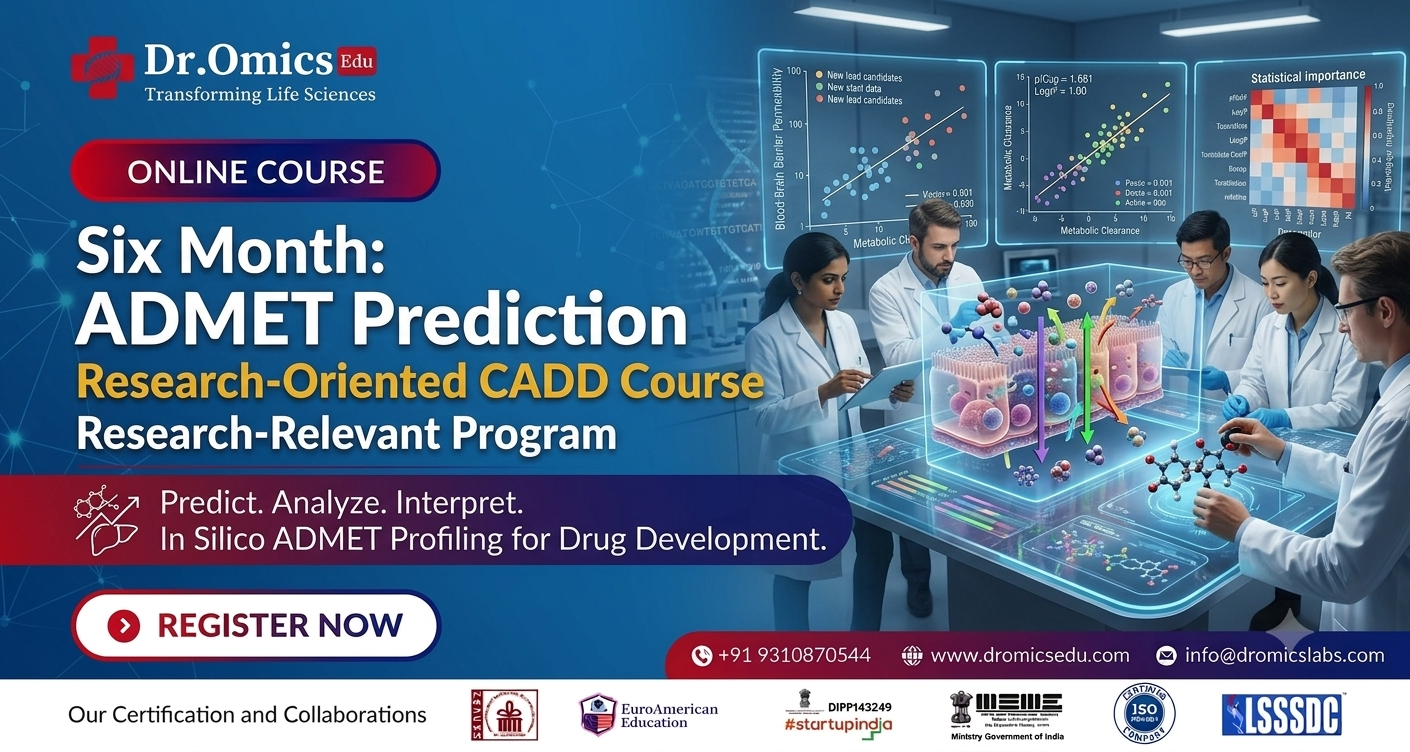
Six Month: ADMET Prediction Research Oriented CADD Course

Six Month: ADMET Prediction Research-Oriented CADD Course A Research-Oriented Course for Industry-Ready Design Professionals is a project-centric programme designed to bridge the gap between academic knowledge and industry-oriented drug discovery research.

  • 5.0/5
  • English
  • Starts 15 Sep 2026
  • Updated Aug 2026
Six Month: ADMET Prediction Research Oriented CADD Course

About this course

The 6-Month Advanced CADD Programme — A Research-Oriented Course for Industry-Ready Design Professionals is a project-centric programme designed to bridge the gap between academic knowledge and industry-oriented drug discovery research. Participants will gain advanced hands-on experience in molecular docking, virtual screening, pharmacophore modeling, QSAR, molecular dynamics simulations, molecular modeling, bioinformatics, and cheminformatics.

Throughout the programme, learners will work on real-world drug discovery datasets, research case studies, and project-based computational workflows, progressing from target identification and protein structure preparation to ligand screening, protein–ligand interaction analysis, lead optimization, and computational validation.

The programme emphasizes modern AI-driven drug discovery approaches, integrating computational tools, data analysis, and predictive modeling to support faster and more efficient drug design. Participants will also develop skills in research methodology, scientific literature analysis, result interpretation, visualization, documentation, and scientific reporting.

By the end of the programme, participants will have completed research-oriented CADD projects that demonstrate their technical expertise, analytical thinking, and ability to apply computational approaches to real-world pharmaceutical research problems.

This programme is ideal for students, researchers, and professionals aspiring to build careers in pharmaceutical companies, biotechnology organizations, computational drug discovery, research laboratories, and academia, while developing the practical skills required to become industry-ready computational drug design professionals.

What you will learn

Computer-Aided Drug Design (CADD) workflows
Molecular Docking & Protein–Ligand Interaction Analysis
Virtual Screening & Molecular Screening
Pharmacophore Modeling
QSAR & Predictive Modeling
Molecular Dynamics (MD) Simulations
Molecular Modeling & Lead Optimization
Protein Structure Preparation & Target Identification
Bioinformatics & Cheminformatics
AI/ML Applications in Drug Discovery
Drug–Target Interaction Analysis
Research Methodology & Scientific Literature Analysis
Data Visualization & Computational Result Interpretation
Scientific Documentation, Reporting & Research Presentation

Skills you will gain

Computer-Aided Drug Design (CADD) workflows Molecular Docking & Protein–Ligand Interaction Analysis Virtual Screening & Molecular Screening Pharmacophore Modeling QSAR & Predictive Modeling Molecular Dynamics (MD) Simulations Molecular Modeling & Lead Optimization Protein Structure Preparation & Target Identification Bioinformatics & Cheminformatics AI/ML Applications in Drug Discovery Drug–Target Interaction Analysis Research Methodology & Scientific Literature Analysis Data Visualization & Computational Result Interpretation Scientific Documentation Reporting & Research Presentation
Certification

Available

Issued by Dr. Omics

Course curriculum

7 modules

  • Topic 1 = Introduction to Bioinformatics
  • Topic 2 = NCBI Database Overview
  • Topic 3 M1T3 = Genbank Database Practical Exercises
  • Topic 4 M1T4 = UCSC Genome Browser Overview
  • Topic 5 M1T5 = UCSC Genome Browser Hands-on Exercises
  • Topic 6 M1T6 = Pubmed Database Introduction
  • Topic 7 M1T7 = Clinvar Database Overview
  • Topic 8 M1T8 = KEGG Database Overview and Exercises
  • Topic 9 M1T9 = Protein Databases (UniProt)
  • Topic 10 M1T10 = Protein Databases (PDB)
  • Topic 11 M1T11 = Online BLAST Introduction and Exercises
  • Topic 12 M1T12 = Standalone BLAST Setup and Exercises
  • Topic 13 M1T13 = Standalone BLAST Advanced Exercises
  • Topic 14 M1T14 = Multiple Sequence Alignment with ClustalW
  • Topic 15 M1T15 = Multiple Sequence Alignment with MEGAA

  • Topic 1 M2T1 = Overview and Installation of Linux
  • Topic 2 M2T2 = Basic Linux Commands
  • Topic 3 M2T3 = Advanced Linux Commands
  • Topic 4 M2T4 = Package Management using Repository
  • Topic 5 M2T5 = Package Management using Source Code

  • Topic 2 M3T1 = Introduction to Python
  • Topic 3 M3T2= Data Types
  • Topic 4 M3T3= String Handling
  • Topic 5 M3T4= Data Structure
  • Topic 6 M3T5=Control Structure
  • Topic 7 M3T6 = Function
  • Topic 8 M3T7= File Handling
  • Topic 9 M3T8= Data Manipulation
  • Topic 10 M3T9= Data Visualization
  • Topic 11 M3T10= Biopython

  • Topic 1 M4T1 = Introduction and Installation of R
  • Topic 2 M4T2= Data Types in R
  • Topic 3 M4T3= Data Structure
  • Topic 4 M4T4= File Handling
  • Topic 5 M4T5=Control Structure
  • Topic 6 M4T6 = Function
  • Topic 7 M4T7= Package Management
  • Topic 8 M4T8= Data Manipulation
  • Topic 9 M4T9= Data Visualization
  • Topic 10 M4T10= Statistical Analysis

  • Topic 1 M6T1 =Introduction to Drug Discovery Process
  • Topic 2 M6T2=Role of Computational Methods
  • Topic 3 M6T3= Hands-on: Chemical Structure Visualization
  • Topic 4 M6T4= Biomolecules and Their Properties
  • Topic 5 M6T5= Structure of Proteins and Ligands
  • Topic 6 M6T6= Hands-on: Protein Structure Visualization
  • Topic 7 M7T7= Molecular Visualization Tools
  • Topic 8 M6T8= Molecular Mechanics and Dynamics Simulations
  • Topic 9 M6T9= Molecular Mechanics and Dynamics Simulations (continued)
  • Topic 10 M6T10= Chemical Databases and Data Mining
  • Topic 11 M6T11= Ligand and Structure-Based Virtual Screening
  • Topic 12 M6T12= Hands-on: Chemical Data Exploration
  • Topic 13 M6T13= Advanced Virtual Screening Techniques
  • Topic 14 M6T14= Virtual Screening using Autodock Vina
  • Topic 15 M6T15= Principles of Molecular Docking
  • Topic 16 M6T16= Scoring Functions in Docking
  • Topic 17 M6T17= Hands-on: Molecular Docking
  • Topic 18 M6T18= Introduction to Molecular Dynamics
  • Topic 19 M6T19= Simulation Software (e.g., GROMACS)
  • Topic 20 M6T20= Hands-on: Analyzing MD Data
  • Topic 21 M6T21= Chemoinformatics: Data Analysis and Visualization
  • Topic 22 M6T22= Protein-Ligand Interaction Analysis
  • Topic 23 M6T23= Hands-on Protein-Ligand Interaction Analysis
  • Topic 24 M6T24= Pharmacophore Modeling and Applications
  • Topic 25 M6T25= Chemoinformatics: Data Analysis and Visualization (continued)
  • Topic 26 M6T26= Structure-Based Drug Design
  • Topic 27 M6T27= Ligand-Based Drug Design
  • Topic 28 M6T28= Hands-on Structure-Based and Ligand-Based Drug Design
  • Topic 29 M6T29= ADMET in Drug Development
  • Topic 30 M6T30= Course Conclusion

  • Topic 1 M7T1= Basics of Machine Learning
  • Topic 2 M7T2= Supervised, Unsupervised, and Reinforcement Learning
  • Topic 3 M7T3= Hands-on: Learn the Basics with scikit-learn Library in Python
  • Topic 4 M7T4= Data Cleaning and Feature Selection
  • Topic 5 M7T5= Handling Molecular Data
  • Topic 6 M7T6= Hands-on: Use Pandas and NumPy for Data Preprocessing
  • Topic 7 M7T7= Regression and Classification Algorithms
  • Topic 8 M7T8= Deep Learning in Drug Discovery
  • Topic 9 M7T9= Hands-on: Implement Machine Learning Models using scikit-learn
  • Topic 10 M7T10= Hands-on: Implement Machine Learning Models using TensorFlow/Keras
  • Topic 11 M7T11= Predicting Drug-Target Interactions
  • Topic 12 M7T12= QSAR Modeling
  • Topic 13 M7T13= Hands-on: Apply Machine Learning to Real Datasets with RDKit
  • Topic 14 M7T14= Hands-on: Apply Machine Learning to Real Datasets with Cheminformatics
  • Topic 15 M7T15= Structure-Activity Relationship (SAR) Analysis
  • Topic 16 M7T16= Hands-on: Use RDKit for SAR Analysis
  • Topic 17 M7T17= De Novo Drug Design using ML
  • Topic 18 M7T18= Explore De Novo Design Tools
  • Topic 19 M7T19= Advanced Machine Learning Techniques in Drug Design
  • Topic 20 M7T20= Integration of Omics Data in Drug Discovery
  • Topic 21 M7T21= Clinical Trial Design and Data Analysis
  • Topic 22 M7T22= Ethical Considerations in Drug Design and Machine Learning
  • Topic 23 M7T23= Real-World Applications
  • Topic 24 M7T24= Q&A and discussion
  • Topic 25 M7T25= Conclusion

  • Research Oriented Project

What you need to start

  • Basic knowledge of Biology, Biochemistry, Biotechnology, Pharmacy, Bioinformatics, or a related field
  • Fundamental understanding of molecular biology and biomolecules
  • Basic computer and internet skills
  • No advanced programming experience is mandatory; programming concepts will be introduced as required
  • Suitable for learners interested in computational drug discovery and pharmaceutical research

Who this course is for

  • B.Sc./M.Sc. students and graduates in Bioinformatics, Biotechnology, Biochemistry, Microbiology, Life Sciences, Pharmacy, Chemistry, and related disciplines
  • Students pursuing research projects, dissertations, or internships in drug discovery
  • Aspiring CADD, Bioinformatics, Cheminformatics, and Computational Biology professionals
  • Research scholars and early-career researchers
  • Professionals looking to transition into computational drug discovery
  • Learners seeking industry-oriented, research-focused hands-on CADD training

INR

₹40000

₹60000 33% off
USD

$540

$600 10% off

Indian learners pay in INR; international learners are billed in USD.

Active batch
Open for enrolment
14092026 - Six Month: ADMET Prediction Research-Oriented CADD Course
  • Starts 14 Sep 2026
  • Ends 15 Mar 2027
  • Timing 7:00 PM – 8:00 PM
  • Days Mon, Tue, Wed, Thu, Fri
  • Platform MS Teams
This course includes
  • Format Live
  • Level Advanced
  • Language English
  • Modules 7
  • Access 1 year
  • Certificate Yes
  • Provider Dr. Omics
  • 6-Month Research-Oriented CADD Programme
  • Live
  • interactive
  • mentor-guided training
  • Hands-on computational drug discovery workflows
  • Real-world datasets and research case studies
  • Project-based learning from target identification to computational validation
  • Practical exposure to molecular docking
  • virtual screening
  • pharmacophore modeling
  • QSAR
  • and molecular dynamics
  • AI/ML applications in modern drug discovery
  • Research methodology and scientific literature analysis
  • Guidance on data interpretation
  • visualization
  • and scientific reporting
  • Research-oriented CADD projects
  • Project documentation and presentation guidance
  • Industry-oriented computational workflows and best practices
WhatsApp