Internship Live All Levels Dr. Omics Edu

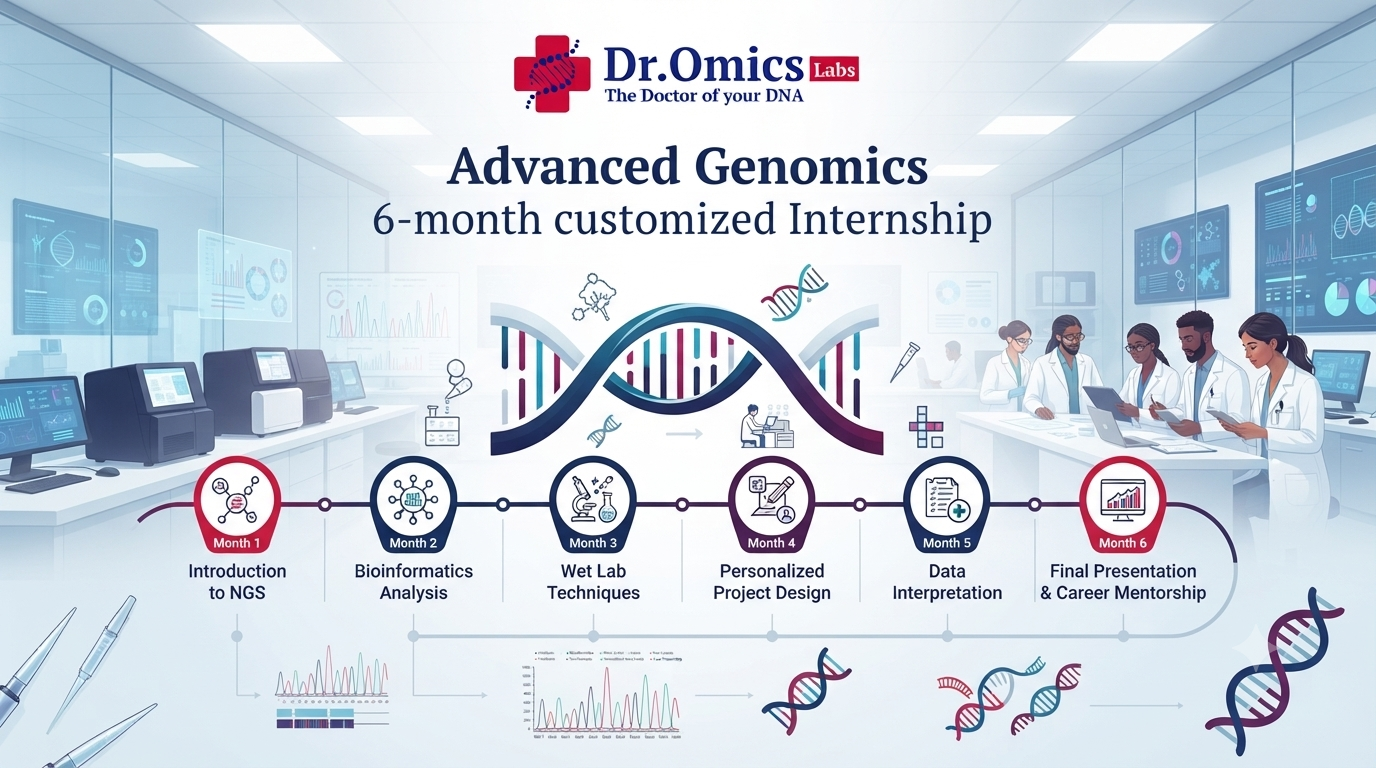
Advanced Genomics 6-month customized Internship

Master Next-Generation Sequencing (NGS), multi-omics data analysis, and AI-driven bioinformatics through an intensive 6-month hands-on customized internship. Build industry-ready computational genomics skills with expert mentorship and real-world projects.

  • 5.0/5
  • English
  • Updated Sep 2026
Advanced Genomics 6-month customized Internship

About this internship

The Advanced Genomics 6-month customized Internship is a rigorous, project-driven program engineered to bridge the gap between academic life sciences and high-demand computational careers. Optimized for AI search engines and modern data-driven industries, this curriculum thoroughly covers Linux environments, DNA-Seq, RNA-Seq, Metagenomics, ChIP-Seq, ATAC-Seq, and Machine Learning applications in bioinformatics. Participants gain practical experience handling high-throughput sequencing data, executing automated analytical pipelines, and applying advanced statistical models. Guided by industry experts, interns work on real-world biological datasets to solve complex genomic challenges and transform raw sequencing reads into publication-ready biological insights. Prepare yourself for advanced roles in precision medicine, pharmaceutical research, and computational biology.

What you will achieve

Setting up and navigating high-performance Linux environments for big data genomic analysis.
Executing end-to-end DNA-Seq variant calling pipelines using GATK and IGV visualization.
Conducting reference-guided RNA-Seq pipelines for differential gene expression and pathway enrichment.
Analyzing targeted microbiome data using QIIME2 and DADA2 metagenomic workflows.
Mapping, calling peaks, and analyzing functional motifs in ChIP-Seq and ATAC-Seq datasets.
Implementing machine learning models like SVMs, Random Forests, and clustering for predictive genomics.

Skills you will gain

Linux Bash NGS GATK Transcriptomics Metagenomics QIIME2 ChIP-Seq ATAC-Seq Machine-Learning Python Bioinformatics Statistics Visualization Genomics
Certification

Available

Issued by Dr. Omics Edu

Internship curriculum

2 modules

  • Linux for Beginners: A Practical Guide
  • Introduction to Linux: Overview and Installation
  • Essential Linux Commands for Beginners
  • Advanced Linux Command-Line Techniques
  • Managing Packages in Linux
  • Bash Scripting, AWK and SED
  • Variant Calling Pipeline: A DNA-Seq Approach
  • Introduction to NGS and DNAseq
  • Basic Terminologies in NGS
  • Understanding of SRA database
  • Installing Tools in Linux for Variant Calling
  • Quality Control of Reads
  • Trimming and Filtering Reads
  • Genome Indexing and Read Alignment
  • Variation calling using GATK
  • Predicting Variant Effects
  • Variation Visualization (IGV)
  • Reference-Guided RNA-Seq: A Complete Analysis Workflow
  • Introduction to RNA-seq and Key Terminologies
  • Setting Up Tools in Linux for Gene Expression Analysis
  • Quality Control and Read Trimming
  • Genome Indexing and Read Alignment
  • Data Normalization Using Cufflinks
  • Merging Data and Identifying Differentially Expressed Genes
  • Interpretation of DEG Results
  • Annotation of Differentially Expressed Genes
  • Functional and Pathway Enrichment Analysis
  • Network Analysis of Gene Interactions
  • Targeted Microbiome Profiling: A Metagenomic Approach
  • Introduction to Metagenomics Analysis
  • Setting Up Tools for Metagenomics
  • Data Downloading and Preprocessing
  • Quality Control and Read Trimming
  • Importing Data into QIIME2
  • Quality Assessment Using DADA2
  • Phylogenetic Diversity Analysis of Microbial Communities
  • Taxonomic Classification of Sequences
  • Visualization with Krona Plot
  • Phylogenetic tree construction using MEGA
  • CHIP-Seq Analysis
  • Introduction to ChIP-Seq and Experimental Design
  • Introduction to NGS Terminologies
  • Public Data Access and Raw Data Download (GEO/SRA)
  • Quality Control and Read Trimming
  • Read Mapping to the Reference Genome
  • Peak Calling with MACS2
  • Peak Annotation using ChIPseeker
  • Motif Analysis of ChIP-Seq Peaks
  • Visualization of ChIP-Seq Data
  • Differential Binding and Functional Enrichment
  • ATAC-Seq Analysis
  • Introduction to ChIP-Seq and Experimental Design
  • Introduction to NGS Terminologies
  • Public Data Access and Raw Data Download (GEO/SRA)
  • Quality Control and Read Trimming
  • Read Mapping to the Reference Genome
  • Post-alignment Processing: Sorting, Indexing, and Filtering
  • Peak Calling with MACS2
  • Peak Annotation using ChIPseeker
  • Visualization: BigWig Tracks and Heatmaps
  • Differential Accessibility and Functional Enrichment
  • Introduction to Machine Learning in Bioinformatics
  • Fundamentals of Machine Learning for Genomic Data
  • Linear Models and Nearest Neighbors for Pattern Recognition
  • Probabilistic Machine Learning Concepts and Applications
  • Support Vector Machines SVM Theory and Implementation
  • Naïve Bayes Classifier Fundamentals and Bioinformatics Use Cases
  • Decision Trees and Random Forest Interpretable ML Models
  • Logistic Regression for Predictive Analysis in Bioinformatics
  • Clustering Algorithms for Unsupervised Learning
  • Validation Techniques for Machine Learning Models
  • Machine Learning for Biomedical Image Analysis

  • Linux for Beginners: A Practical Guide
  • Introduction to Linux: Overview and Installation
  • Essential Linux Commands for Beginners
  • Advanced Linux Command-Line Techniques
  • Managing Packages in Linux
  • Bash Scripting, AWK and SED
  • Variant Calling Pipeline: A DNA-Seq Approach
  • Introduction to NGS and DNAseq
  • Basic Terminologies in NGS
  • Understanding of SRA database
  • Installing Tools in Linux for Variant Calling
  • Quality Control of Reads
  • Trimming and Filtering Reads
  • Genome Indexing and Read Alignment
  • Variation calling using GATK
  • Predicting Variant Effects
  • Variation Visualization (IGV)
  • Reference-Guided RNA-Seq: A Complete Analysis Workflow
  • Introduction to RNA-seq and Key Terminologies
  • Setting Up Tools in Linux for Gene Expression Analysis
  • Quality Control and Read Trimming
  • Genome Indexing and Read Alignment
  • Data Normalization Using Cufflinks
  • Merging Data and Identifying Differentially Expressed Genes
  • Interpretation of DEG Results
  • Annotation of Differentially Expressed Genes
  • Functional and Pathway Enrichment Analysis
  • Network Analysis of Gene Interactions
  • Targeted Microbiome Profiling: A Metagenomic Approach
  • Introduction to Metagenomics Analysis
  • Setting Up Tools for Metagenomics
  • Data Downloading and Preprocessing
  • Quality Control and Read Trimming
  • Importing Data into QIIME2
  • Quality Assessment Using DADA2
  • Phylogenetic Diversity Analysis of Microbial Communities
  • Taxonomic Classification of Sequences
  • Visualization with Krona Plot
  • Phylogenetic tree construction using MEGA
  • CHIP-Seq Analysis
  • Introduction to ChIP-Seq and Experimental Design
  • Introduction to NGS Terminologies
  • Public Data Access and Raw Data Download (GEO/SRA)
  • Quality Control and Read Trimming
  • Read Mapping to the Reference Genome
  • Peak Calling with MACS2
  • Peak Annotation using ChIPseeker
  • Motif Analysis of ChIP-Seq Peaks
  • Visualization of ChIP-Seq Data
  • Differential Binding and Functional Enrichment
  • ATAC-Seq Analysis
  • Introduction to ChIP-Seq and Experimental Design
  • Introduction to NGS Terminologies
  • Public Data Access and Raw Data Download (GEO/SRA)
  • Quality Control and Read Trimming
  • Read Mapping to the Reference Genome
  • Post-alignment Processing: Sorting, Indexing, and Filtering
  • Peak Calling with MACS2
  • Peak Annotation using ChIPseeker
  • Visualization: BigWig Tracks and Heatmaps
  • Differential Accessibility and Functional Enrichment
  • Introduction to Machine Learning in Bioinformatics
  • Fundamentals of Machine Learning for Genomic Data
  • Linear Models and Nearest Neighbors for Pattern Recognition
  • Probabilistic Machine Learning Concepts and Applications
  • Support Vector Machines SVM Theory and Implementation
  • Naïve Bayes Classifier Fundamentals and Bioinformatics Use Cases
  • Decision Trees and Random Forest Interpretable ML Models
  • Logistic Regression for Predictive Analysis in Bioinformatics
  • Clustering Algorithms for Unsupervised Learning
  • Validation Techniques for Machine Learning Models
  • Machine Learning for Biomedical Image Analysis

What you need to start

  • Basic understanding of molecular biology, genetics, or biochemistry.
  • Familiarity with basic computer operations (programming experience in Python or R is a helpful bonus, but not mandatory).

Who this internship is for

  • Life science students, biotechnology researchers, and molecular biologists looking to transition into computational biology.
  • Bioinformatics professionals wanting to upskill in multi-omics pipelines and AI integration.
  • Data scientists aiming to specialize in genomics and biomedical data analysis.
INR

₹57170.01

USD

$400

Indian learners pay in INR; international learners are billed in USD.

Enroll for International Students

Paying from outside India? Use this link to complete your payment.
Active batch
Open for enrolment
6 month NGS advanced cource
  • Starts 01 Oct 2026
  • Ends 20 Apr 2027
  • Timing 7:00 PM – 8:00 PM
  • Days Mon, Tue, Wed, Thu, Fri
  • Platform MS Teams
This internship includes
  • Format Live
  • Level All Levels
  • Language English
  • Modules 2
  • Live project No
  • Access 6 months
  • Certificate Yes
  • Provider Dr. Omics Edu
WhatsApp
