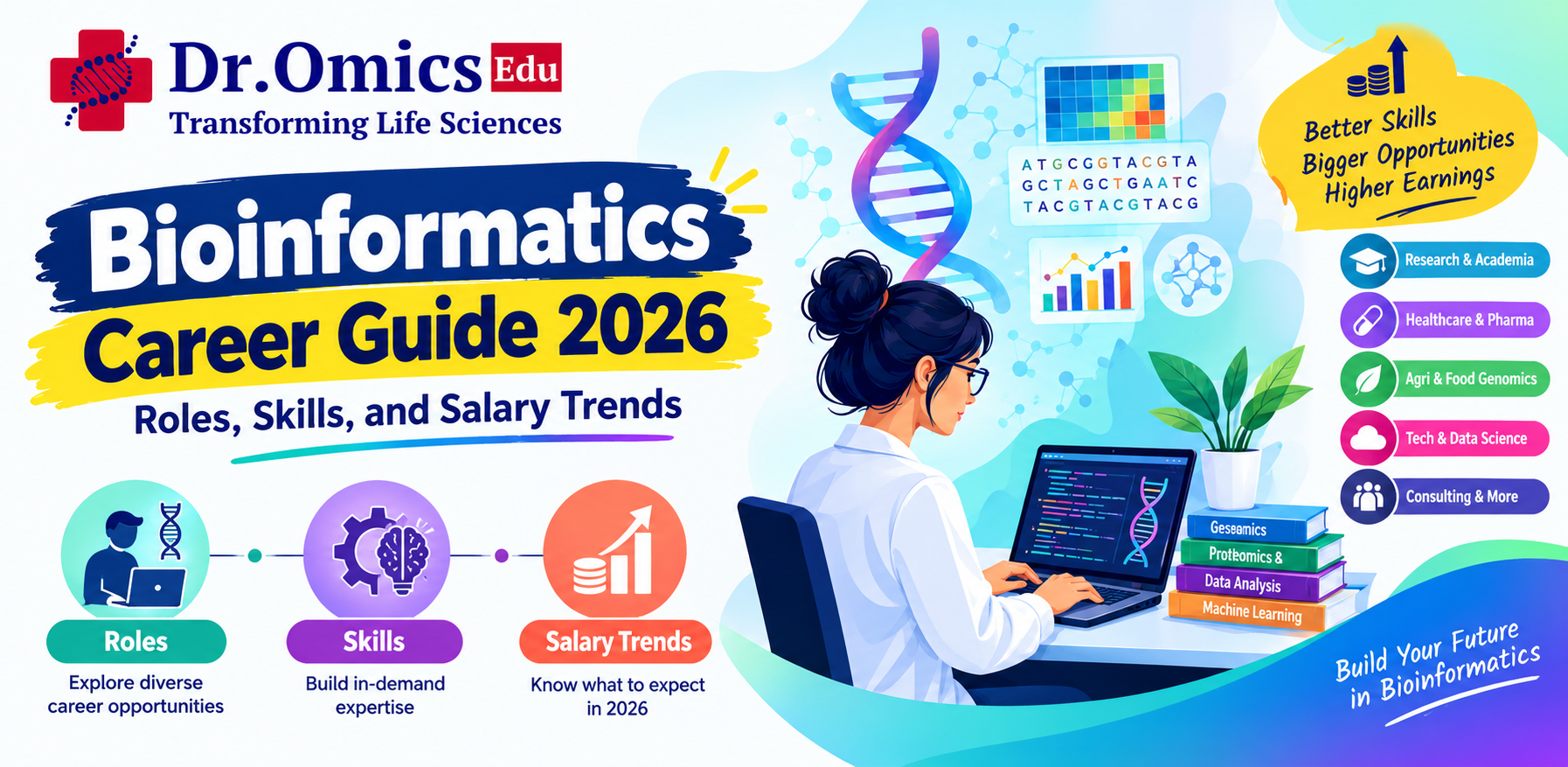
Bioinformatics Career Guide 2026: Roles, Skills, and Salary Trends
Dr. Omics Edu Team ·
Introduction
Bioinformatics has become an important field at the intersection of biology, computer science, statistics, and data science. As research generates increasing amounts of genomic, transcriptomic, and proteomic data, organizations need professionals who can analyze biological information and convert complex datasets into meaningful scientific insights. From understanding genetic diseases to discovering potential drug targets, bioinformatics supports research and innovation across healthcare, biotechnology, pharmaceuticals, agriculture, and life sciences.
For students and professionals interested in combining biology with computational skills, exploring a bioinformatics career path can open doors to diverse opportunities. In 2026, the growing importance of genomics, precision medicine, artificial intelligence, and next-generation sequencing continues to create interest in bioinformatics jobs 2026. However, building a successful career requires more than a biology degree or knowledge of programming. It involves developing practical analytical skills, understanding biological datasets, and gaining experience with real research problems.
This guide explores major bioinformatics job roles, essential skills, career opportunities, salary trends in India, and practical steps for becoming a bioinformatician.
1. Understanding the Bioinformatics Career Path
A career in bioinformatics can begin with a background in biotechnology, microbiology, genetics, biochemistry, life sciences, computer science, statistics, or bioinformatics itself. The most suitable starting point depends on a candidate’s educational qualifications and existing technical knowledge.
Students with a biology background can begin by learning Linux, Python or R, statistics, and fundamental biological data analysis. Candidates from computer science or data science can strengthen their understanding of molecular biology, genetics, genomics, and biological databases.
A typical bioinformatics career path may progress through the following stages:
- Entry-level positions: Bioinformatics Intern, Junior Bioinformatician, Research Assistant, or NGS Data Analyst.
- Intermediate positions: Bioinformatician, Genomics Analyst, RNA-seq Analyst, or Computational Biology Associate.
- Advanced positions: Senior Bioinformatician, Computational Biologist, Genomics Scientist, or Bioinformatics Pipeline Developer.
- Leadership and specialist positions: Bioinformatics Team Lead, Principal Scientist, Research Scientist, or Bioinformatics Data Science Lead.
This progression is not fixed. Career advancement depends on technical expertise, research experience, project ownership, communication skills, and the requirements of individual employers. Some professionals specialize in computational research, while others focus on software development, clinical genomics, or scientific leadership.
2. Major Bioinformatics Job Roles in 2026
The range of bioinformatics job roles has expanded as biological research becomes increasingly data-driven. Professionals can choose a specialization based on their interests and strengths.
Genomics analysts work with DNA sequencing data to identify genetic variants, study mutations, and understand genomic differences between samples. Their responsibilities may include quality control, sequence alignment, variant calling, annotation, and interpretation.
Knowledge of tools such as FastQC, BWA, SAMtools, GATK, and VEP can be useful, depending on the project and its requirements.
RNA-seq and Transcriptomics Analyst
RNA-seq analysts investigate gene expression patterns and biological pathways using transcriptomic data. They may perform read quality assessment, alignment or pseudoalignment, gene expression quantification, differential expression analysis, and functional enrichment.
Commonly used tools include STAR, HISAT2, Salmon, featureCounts, DESeq2, and edgeR. These professionals contribute to research involving disease mechanisms, treatment responses, developmental biology, and gene regulation.
Computational Biologist
Computational biologists use mathematical models, statistical methods, and programming to investigate biological questions. Their work can involve multi-omics integration, systems biology, protein analysis, evolutionary studies, and computational modelling.
This role generally benefits from strong programming, statistics, biological interpretation, and research skills.
Clinical Bioinformatician
Clinical bioinformaticians help analyze genomic information relevant to healthcare and genetic testing. Their work may include variant annotation, filtering candidate variants, interpreting evidence, and supporting clinical laboratory workflows.
These roles can require specialized knowledge of clinical genetics, quality standards, data privacy, and validated analysis procedures. Clinical interpretation and reporting must follow applicable professional and regulatory requirements.
Bioinformatics Pipeline Developer
Pipeline developers build, automate, test, and maintain reproducible workflows for biological data analysis. They work with scripting, workflow management systems, containers, cloud computing, and version control.
Useful technologies include Python, Bash, Git, Docker, Nextflow, and Snakemake. This specialization is particularly suitable for candidates who enjoy programming and software engineering.
AI and Multi-Omics Research Analyst
Artificial intelligence and machine learning are increasingly being explored for biological data analysis, including disease classification, biomarker discovery, drug discovery, and integration of genomics with transcriptomics or proteomics.
Professionals entering this area should build a foundation in statistics, Python, machine learning, data preprocessing, and biological interpretation. AI tools can support research, but their results must be evaluated carefully and validated against appropriate evidence.
3. Essential Skills Required for Bioinformatics Jobs 2026
Employers generally look for a combination of biological knowledge, computational ability, analytical thinking, and practical experience. The specific skill requirements vary by role.
Biological knowledge: Understanding genetics, molecular biology, genomics, transcriptomics, and basic molecular processes helps candidates interpret analytical results rather than simply execute software.
Programming: Python and R are widely used for data processing, statistical analysis, visualization, and automation. Bash and Linux command-line skills are particularly useful for working with sequencing datasets and remote computing environments.
Statistical analysis: Knowledge of probability, hypothesis testing, p-values, multiple-testing correction, regression, and experimental design is essential for drawing reliable conclusions from biological data.
Bioinformatics tools and databases: Candidates should become familiar with relevant tools and resources, such as NCBI, Ensembl, UCSC Genome Browser, BLAST, and analysis software for their chosen specialization.
NGS data analysis: Practical knowledge of sequencing quality control, alignment, quantification, variant analysis, or differential expression can help candidates demonstrate job readiness.
Workflow automation and cloud computing: Git, Docker, workflow managers, and cloud platforms can support reproducible and scalable analysis. These skills become especially valuable when projects involve large datasets or repeated analyses.
Communication and documentation: Bioinformaticians need to explain findings clearly, document analytical decisions, prepare reports, and collaborate with biologists, clinicians, statisticians, and software engineers.
Candidates do not need to master every tool before applying for their first position. A stronger strategy is to develop solid fundamentals and gain hands-on experience in one or two relevant areas.
4. Bioinformatics Salary India: Trends and Expectations
The bioinformatics salary India market varies considerably according to educational qualifications, technical specialization, employer type, location, and experience. There is no single salary applicable to all bioinformatics professionals, and advertised packages may differ from actual offers.
The following figures are broad illustrative annual compensation ranges for career planning in India, not verified market averages or guaranteed offers.
Experience level | Illustrative annual salary range |
Intern or trainee | ₹1.2–3 lakh |
Entry-level professional (0–2 years) | ₹2.5–5 lakh |
Mid-level professional (3–5 years) | ₹5–10 lakh |
Senior professional (6–9 years) | ₹8–16 lakh |
Specialist or team lead | ₹12–25 lakh or more |
Actual compensation can fall outside these ranges. Academic research positions, temporary projects, and smaller service organizations may offer lower packages, while specialized biotechnology companies, pharmaceutical organizations, global research teams, and computational roles may offer higher compensation.
Candidates with experience in NGS workflows, cloud infrastructure, pipeline development, advanced statistics, clinical genomics, or machine learning may qualify for specialized opportunities. However, salary growth depends on demonstrated expertise and business or research impact, not simply the number of tools listed on a resume.
When evaluating opportunities, candidates should compare the job description, fixed pay, variable components, benefits, learning opportunities, and long-term career prospects. Developing a portfolio of reproducible projects can also help demonstrate practical competence during interviews.
5. Career in Genomics: Where Are the Opportunities?
A career in genomics can lead to opportunities in biotechnology companies, pharmaceutical organizations, diagnostic laboratories, hospitals, universities, research institutes, agricultural biotechnology, and computational research teams.
Genomics professionals may contribute to genetic disease research, cancer studies, infectious disease surveillance, pharmacogenomics, population genetics, crop improvement, and personalized medicine. Transcriptomics and single-cell analysis also provide opportunities for studying cell populations, gene regulation, and disease-associated biological changes.
The growth of high-throughput sequencing and multi-omics research creates demand for professionals who can handle data efficiently, maintain reproducible workflows, and communicate biological meaning. At the same time, employers may expect candidates to understand the limitations of datasets, experimental design, statistical significance, and validation.
Research-oriented positions may require a master's degree or PhD, depending on the institution and responsibilities. Industry roles may place greater emphasis on technical skills, project experience, and the ability to deliver reliable analytical results. Reviewing current job descriptions is one of the best ways to identify the qualifications needed for a particular specialization.
6. How to Become a Bioinformatician: A Practical Roadmap
For students and early-career professionals wondering how to become a bioinformatician, a structured learning plan can make the process more manageable.
Step 1: Build the foundation. Learn molecular biology, genetics, DNA and RNA sequencing concepts, and biological databases. Understand what a biological research question looks like and how computational analysis can help answer it.
Step 2: Learn essential programming. Start with Linux command-line operations, Bash, and either Python or R. Practise reading files, processing tabular data, writing scripts, and generating visualizations.
Step 3: Develop statistical knowledge. Study descriptive statistics, probability, hypothesis testing, regression, and multiple-testing correction. Apply these concepts to biological datasets.
Step 4: Choose a specialization. Select an initial focus such as DNA-seq, RNA-seq, metagenomics, variant analysis, or computational biology. Learn the tools and analytical principles relevant to that area.
Step 5: Complete hands-on projects. Work with publicly available datasets and document the complete workflow, including quality control, processing, analysis, visualization, and interpretation. A well-explained project is often more convincing than a long list of software names.
Step 6: Create a professional portfolio. Use Git and a platform such as GitHub to showcase scripts, workflow documentation, figures, and project reports. Avoid publishing confidential data or personal information.
Step 7: Apply strategically. Search for internships, research assistantships, junior analyst roles, and entry-level industry positions. Tailor your resume to the required skills and prepare to explain your analytical decisions during interviews.
Consistency matters more than trying to learn everything at once. A focused learning plan, combined with practical work and regular review of job requirements, can help candidates make steady progress.
7. Bioinformatics Career Scope: Challenges and Future Directions
The bioinformatics career scope extends beyond traditional sequence analysis. Emerging research areas include single-cell and spatial omics, long-read sequencing, population-scale genomics, multi-omics integration, clinical variant interpretation, and AI-assisted biological discovery.
These developments create opportunities for professionals who combine biological understanding with computational depth. At the same time, the field remains competitive. Routine analysis tasks may become easier to automate, while reliable workflow design, quality control, interpretation, reproducibility, and critical thinking remain important.
Another challenge is the gap between theoretical learning and practical experience. Knowing the names of tools is not the same as understanding when to use them, how to assess their output, or how to troubleshoot unexpected results. Candidates can address this gap by completing end-to-end projects and learning to explain both the strengths and limitations of their analyses.
Long-term career development therefore requires continuous learning, domain specialization, collaboration, and adaptability. Professionals who can connect computational results to meaningful biological questions are well positioned to contribute to research and industry projects.
