Diwali Offer: Flat 15% OFF on every course Ends 10 Nov T&C
Course Live Intermediate Dr. Omics Edu

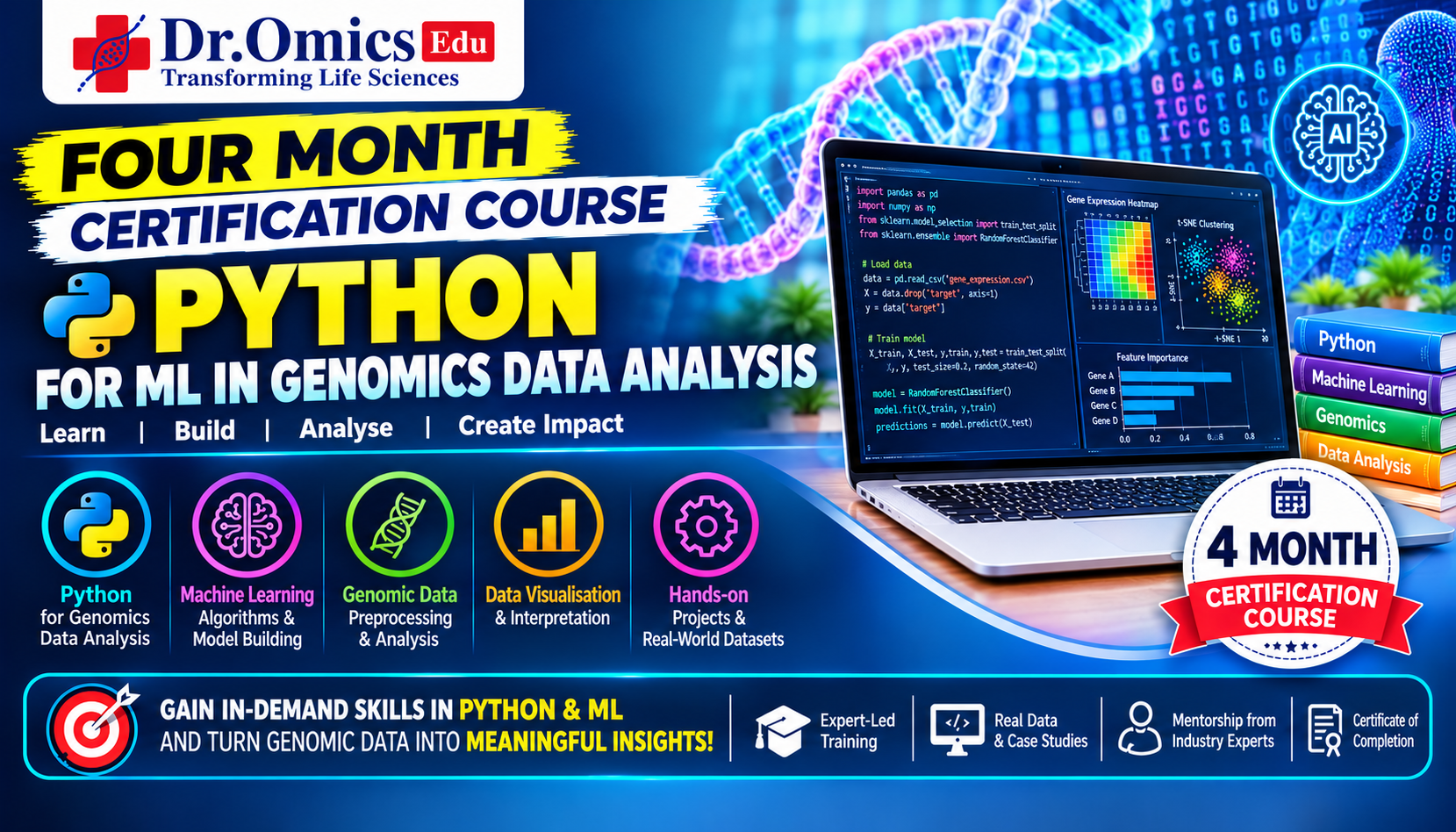
Four Month Certification Course: Python for ML in Genomics Data Analysis

A comprehensive four-month certification course covering Python programming, bioinformatics, genomics data analysis, machine learning, and AI applications, with hands-on projects using real-world genomic datasets.

  • 5.0/5
  • English
  • Updated Oct 2026
INR

₹60000

₹70000 14% off
USD

$700

$800 13% off

Indian learners pay in INR; international learners are billed in USD.

Enroll for International Students

Paying from outside India? Use this link to complete your payment.
Four Month Certification Course: Python for ML in Genomics Data Analysis

About this course

The Four-Month Certification Course: Python for ML in Genomics Data Analysis is designed to help students, life science graduates, researchers, and aspiring bioinformatics professionals develop practical skills in Python programming, genomic data analysis, machine learning, and AI-driven biological research.

The course begins with Python fundamentals, including data structures, functions, file handling, NumPy, and Pandas, before progressing to genomics and bioinformatics concepts such as DNA and RNA analysis, NGS technologies, FASTA, FASTQ, VCF files, and public genomic databases including NCBI, GEO, and Ensembl.

Participants will gain hands-on experience in genomic data processing, data cleaning, statistical analysis, and visualization using Python libraries such as Matplotlib and Seaborn. The program then introduces machine learning techniques, including logistic regression, decision trees, random forests, clustering, PCA, t-SNE, and UMAP, with applications in genomic sample classification, gene expression analysis, and feature identification.

The advanced modules cover model evaluation, cross-validation, deep learning fundamentals, CNNs for DNA sequences, transformers, and emerging AI applications in genomics and drug discovery. Participants will also learn to prepare research reports, organize Jupyter Notebooks, share code through GitHub, and communicate analytical findings effectively.

The course concludes with an end-to-end capstone project in which participants work with a genomic dataset, develop and evaluate a machine learning model, interpret the results, and present their findings.

What you will learn

By the end of this four-month certification course, participants will be able to:
Apply Python programming to biological and genomic data analysis.
Process and analyze genomic files such as FASTA, FASTQ, and VCF.
Retrieve and explore datasets from public databases such as NCBI, GEO, and Ensembl.
Perform data cleaning, statistical analysis, and visualization using Python libraries.
Build introductory machine learning models for genomic sample classification and gene expression analysis.
Apply clustering, PCA, and other dimensionality reduction techniques to biological datasets.
Understand the fundamentals of deep learning and AI applications in genomics.
Evaluate model performance, interpret results, and identify important genomic features.
Develop an end-to-end genomics machine learning project and present findings through reports and Jupyter Notebooks.

Skills you will gain

Python Programming Fundamentals NumPy Pandas Biopython Bioinformatics and Genomics Fundamentals NGS Data Concepts Genomic File Processing (FASTA FASTQ VCF) Public Biological Databases Data Cleaning Statistical Analysis Data Visualization with Matplotlib and Seaborn Machine Learning with Scikit-learn Logistic Regression Decision Trees Random Forests Clustering PCA t-SNE UMAP Feature Engineering Feature Importance Model Evaluation Cross-Validation Deep Learning Fundamentals CNNs for DNA Sequences Transformers Jupyter Notebook GitHub Genomics Machine Learning Projects Research Reporting
Certification

Available

Issued by Dr. Omics Edu

Course curriculum

17 modules

  • Day 1 – Python Basics: Installing Python and using Jupyter/Google Colab; variables, data types, operators, input and output.
  • Day 2 – Control Flow: if, else, elif, comparison and logical operators, for and while loops.
  • Day 3 – Data Structures: Lists, indexing, slicing, tuples and dictionaries for organizing biological data.
  • Day 4 – Functions & File Handling: Creating functions, parameters, return values, modules, and reading/writing text files.
  • Day 5 – Introduction to Pandas: Loading CSV files, DataFrames, filtering, selecting, sorting, sum and mean operations.

  • Day 1 – Python Basics: Installing Python and using Jupyter/Google Colab; variables, data types, operators, input and output.
  • Day 2 – Control Flow: if, else, elif, comparison and logical operators, for and while loops.
  • Day 3 – Data Structures: Lists, indexing, slicing, tuples and dictionaries for organizing biological data.
  • Day 4 – Functions & File Handling: Creating functions, parameters, return values, modules, and reading/writing text files.
  • Day 5 – Introduction to Pandas: Loading CSV files, DataFrames, filtering, selecting, sorting, sum and mean operations.

  • Day 6 – NumPy Basics: Creating arrays and performing basic array operations.
  • Day 7 – Pandas Data Handling: Merging and joining tables, grouping data and handling missing values.
  • Day 8 – Text & Strings: Searching, splitting and counting patterns in biological sequences.
  • Day 9 – Reusable Code: Organizing programs using functions and basic error handling with try/except.
  • Day 10 – Hands-on DNA Analysis: Developing a mini Python script for analyzing a simple DNA sequence.

  • Day 11 – Review & Practice: Exercises covering loops, functions and Python data structures.
  • Day 12 – Combining Data Structures: Using lists and dictionaries together to organize biological datasets.
  • Day 13 – Text-Processing Project: Building a letter/word frequency counter for sequence or text data.
  • Day 14 – Debugging Basics: Understanding common Python errors and learning how to identify and fix them.
  • Day 15 – Python Mini Project: Building a small bioinformatics project from scratch.

  • Day 16 – Introduction to Genomics: DNA, genes, genomes and the central dogma from DNA to RNA to protein.
  • Day 17 – Sequencing Technologies: Introduction to NGS, whole-genome sequencing and RNA-seq.
  • Day 18 – Genomic File Formats: Understanding FASTA, FASTQ and VCF files.
  • Day 19 – Gene Expression & Variants: Understanding gene expression data and genetic variants.
  • Day 20 – Genomics Dataset Practice: Loading and exploring a public genomics dataset using Pandas.

  • Day 21 – FASTA/FASTQ Analysis: Using Biopython to read and parse sequence files.
  • Day 22 – VCF Files: Understanding VCF structure and extracting basic variant information using Python.
  • Day 23 – Gene Expression Tables: Loading, filtering and sorting gene expression data using Pandas.
  • Day 24 – Sequence Operations: Complement, reverse complement and GC-content calculation.
  • Day 25 – Genomic File Mini Project: Parsing and summarizing a sample FASTA or VCF file.

  • Day 26 – Public Databases: Introduction to NCBI, GEO and Ensembl.
  • Day 27 – Downloading Real Data: Finding and downloading a small public genomic dataset.
  • Day 28 – Metadata: Understanding sample information and experimental design metadata.
  • Day 29 – Organizing Genomic Data: Creating clear folders and file structures for downloaded datasets.
  • Day 30 – Real Dataset Practice: Downloading and loading a public genomic dataset into Python.

  • Day 31 – Data Cleaning: Handling missing values and duplicate entries in genomic datasets.
  • Day 32 – Basic Statistics: Mean, median, standard deviation and simple data distributions.
  • Day 33 – Understanding p-values: Introduction to hypothesis testing and intuitive interpretation of p-values.
  • Day 34 – Correlation Analysis: Understanding correlation between genes or sample measurements.
  • Day 35 – Genomics Data Analysis Practice: Cleaning, analyzing and summarizing a sample dataset.

  • Day 36 – Matplotlib Basics: Creating line, bar and scatter plots.
  • Day 37 – Seaborn Basics: Creating histograms, boxplots and distribution visualizations.
  • Day 38 – Gene Expression Visualization: Understanding and creating heatmaps for expression data.
  • Day 39 – Variant Visualization: Creating basic plots to explore genetic variant data.
  • Day 40 – Visualization Mini Project: Creating 3–4 plots to summarize a genomics dataset.

  • Day 41 – Machine Learning Fundamentals: Supervised and unsupervised learning with simple examples.
  • Day 42 – Preparing Data for ML: Train/test splitting, scaling and normalization.
  • Day 43 – First ML Model: Building a basic classification model using logistic regression.
  • Day 44 – Decision Trees & Random Forest: Understanding and applying tree-based models.
  • Day 45 – ML Practice: Training and evaluating a basic classifier on a sample dataset.

  • Day 46 – Feature Engineering for Genomics: Converting gene and sequence information into ML-ready features.
  • Day 47 – Genomic Sample Classification: Using gene expression data to classify healthy and disease samples.
  • Day 48 – Imbalanced Data: Understanding class imbalance in genomic datasets.
  • Day 49 – Feature Importance: Identifying genes/features that contribute to model predictions.
  • Day 50 – Genomic ML Project: Training and reviewing a genomic sample classifier.

  • Day 51 – Clustering Basics: Grouping similar biological samples using k-means.
  • Day 52 – Hierarchical Clustering: Understanding dendrograms and hierarchical grouping.
  • Day 53 – PCA: Understanding dimensionality reduction and applying PCA to genomic data.
  • Day 54 – t-SNE & UMAP: Visualizing high-dimensional genomic datasets in two dimensions.
  • Day 55 – Clustering Practice: Clustering and visualizing genomic samples.

  • Day 56 – Model Evaluation: Accuracy, precision and recall.
  • Day 57 – Confusion Matrix: Building and interpreting confusion matrices.
  • Day 58 – Overfitting & Underfitting: Understanding model performance on new data.
  • Day 59 – Improving Models: Introduction to tuning, additional data and cross-validation.
  • Day 60 – Model Improvement Project: Evaluating and improving a genomic classifier.

  • Day 61 – Deep Learning Fundamentals: Introduction to neural networks at a high level.
  • Day 62 – CNNs for DNA Sequences: Understanding how CNNs can identify patterns in DNA sequences.
  • Day 63 – Sequence & Language Models: Introduction to RNNs, transformers and tools such as AlphaFold.
  • Day 64 – AI in Genomics: Case studies in drug discovery, diagnostics and other applications.
  • Day 65 – AI/Genomics Practice: Guided walkthrough using a simple pretrained/example model.

  • Day 66 – Writing Results: Explaining research findings clearly in non-technical language.
  • Day 67 – Building Reports: Combining plots and written explanations into a clear report.
  • Day 68 – Jupyter Notebook Presentation: Cleaning, organizing and exporting notebooks.
  • Day 69 – Sharing Code: Introduction to sharing bioinformatics code and GitHub.
  • Day 70 – Results Reporting Project: Preparing a one-page report with plots and findings.

  • Day 71 – Capstone Kickoff: Selecting a dataset and planning an end-to-end genomics ML pipeline.
  • Day 72 – Data Preprocessing & Exploration: Cleaning and exploring the selected capstone dataset.
  • Day 73 – Model Building: Developing an ML model using the capstone dataset.
  • Day 74 – Model Evaluation & Interpretation: Evaluating the model and summarizing its results.
  • Day 75 – Capstone Refinement: Reviewing results and making improvements to the project.

  • Day 76 – Final Report/Notebook: Polishing the capstone notebook or research report.
  • Day 77 – Project Presentation: Preparing slides and a concise summary of the project.
  • Day 78 – Practice & Review: Practicing the presentation with peer/instructor review.
  • Day 79 – Capstone Presentation: Presenting the complete genomics ML project.
  • Day 80 – Certification & Wrap-up: Course recap, final certification quiz and course completion.

What you need to start

  • Basic knowledge of biology, biotechnology, bioinformatics, genetics, or life sciences is recommended.
  • No advanced Python programming experience is required.
  • Basic computer literacy and familiarity with using software applications.
  • A laptop or desktop with a stable internet connection for online learning and practical exercises.
  • An interest in genomics, computational biology, data science, machine learning, or AI applications in life sciences.

Who this course is for

  • BSc, MSc, and postgraduate students in biotechnology, bioinformatics, microbiology, biochemistry, genetics, and other life science disciplines.
  • Students and graduates interested in computational biology and genomics research.
  • Bioinformatics learners who want to strengthen their Python programming and data analysis skills.
  • Researchers seeking to apply machine learning techniques to genomic and gene expression datasets.
  • Life science professionals interested in AI, machine learning, and data-driven biological research.
  • Beginners looking to develop practical skills through guided exercises and a capstone project.

INR

₹60000

₹70000 14% off
USD

$700

$800 13% off

Indian learners pay in INR; international learners are billed in USD.

Enroll for International Students

Paying from outside India? Use this link to complete your payment.

Active batch
Open for enrolment
4-month certification course in Python for ML in Genomics Data Analysis
  • Starts 16 Nov 2026
  • Ends 15 Mar 2027
  • Timing 7:00 PM – 8:00 PM
  • Days Mon, Tue, Wed, Thu, Fri
  • Platform MS Teams
This course includes
  • Format Live
  • Level Intermediate
  • Language English
  • Modules 17
  • Certificate Yes
  • Provider Dr. Omics Edu
  • Four months of structured learning across 16 weeks and 80 sessions.
  • Step-by-step Python programming and bioinformatics training.
  • Practical exercises using biological and genomic datasets.
  • Hands-on training in data analysis
  • visualization
  • and machine learning.
  • Guided mini-projects covering Python
  • genomics
  • and machine learning.
  • Exposure to public genomic databases and real-world data workflows.
  • Introduction to AI and deep learning applications in genomics.
  • Capstone project involving genomic data preprocessing
  • model development
  • evaluation
  • and interpretation.
  • Guidance on preparing Jupyter Notebooks
  • project reports
  • and presentations.
  • Introduction to GitHub for sharing and organizing code.
  • Course completion certification
  • subject to applicable course requirements.
WhatsApp