Diwali Offer: Flat 15% OFF on every course Ends 10 Nov T&C
Course Live Advanced Dr. Omics Edu

Six Month Certification Course: Python & AI/ML for Genomics Data Analysis

A comprehensive six-month certification course covering Python programming, bioinformatics, genomics data analysis, machine learning, deep learning, and AI applications, with hands-on projects using real-world genomic datasets.

  • 5.0/5
  • English
  • Updated Oct 2026
INR

₹80000

₹90000 11% off
USD

$900

$1000 10% off

Indian learners pay in INR; international learners are billed in USD.

Enroll for International Students

Paying from outside India? Use this link to complete your payment.
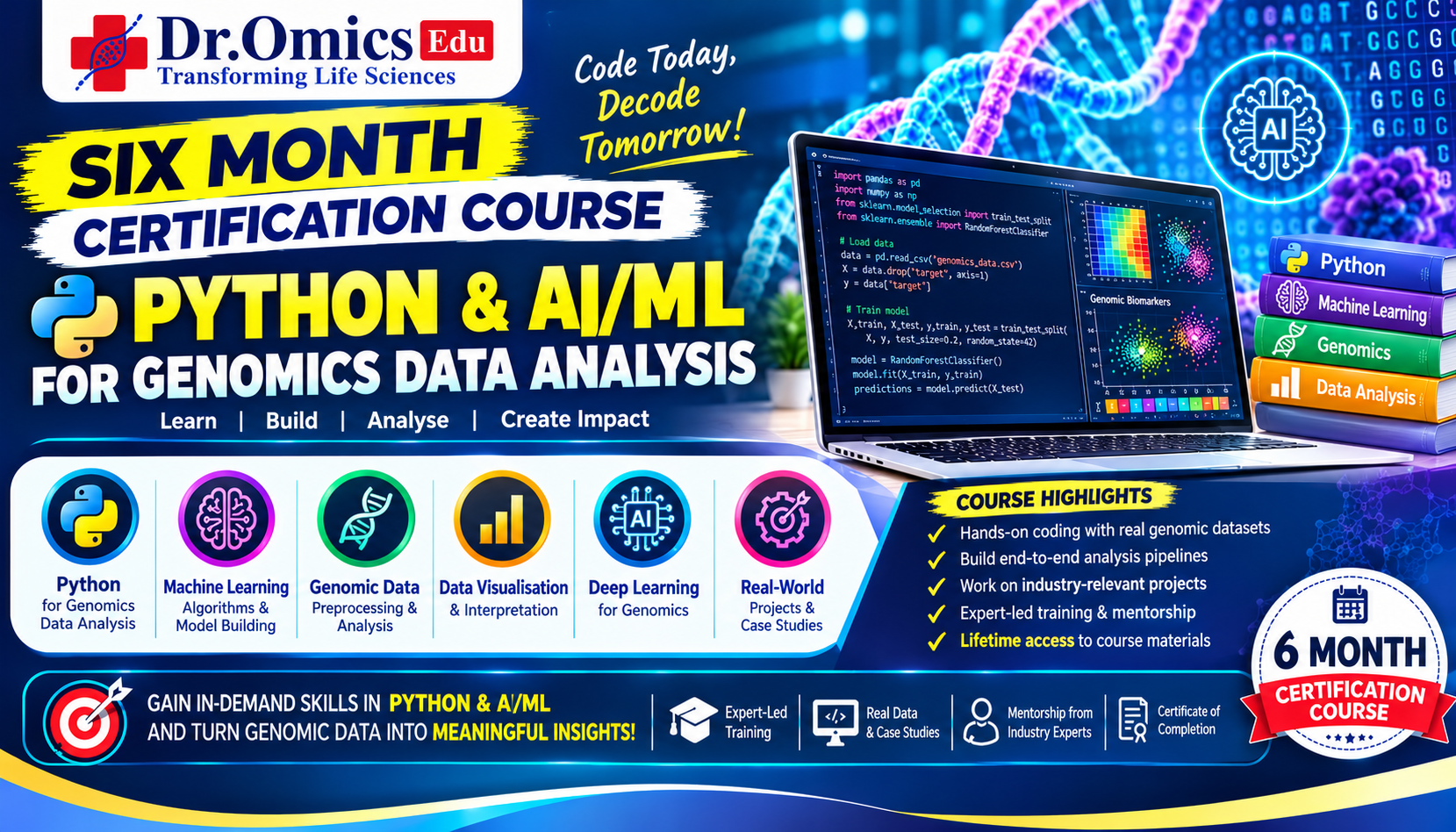
Six Month Certification Course: Python & AI/ML for Genomics Data Analysis

About this course

The Six-Month Certification Course: Python & AI/ML for Genomics Data Analysis is designed to equip students, life science graduates, researchers, and aspiring bioinformatics professionals with practical programming, data analysis, and artificial intelligence skills for modern genomic research.

The course begins with Python programming fundamentals, NumPy, Pandas, object-oriented programming, and Biopython before progressing to bioinformatics, genomics, next-generation sequencing (NGS), genomic file formats, and public biological databases such as NCBI, GEO, Ensembl, and UCSC. Participants will learn to process genomic datasets, perform quality-control assessments, conduct exploratory data analysis, apply statistical methods, and create informative visualizations.

The program introduces machine learning algorithms, including logistic regression, decision trees, random forests, support vector machines, and ensemble methods, with applications in genomic classification, gene selection, and high-dimensional biological data analysis. Advanced modules cover neural networks, convolutional neural networks (CNNs) for DNA sequences, transformers, genomic and protein language models, unsupervised learning, multi-omics integration, and explainable AI techniques such as SHAP and LIME.

Participants will also explore model evaluation, cross-validation, hyperparameter tuning, and basic machine learning deployment using APIs and Docker. Throughout the six-month program, guided practical exercises and mini-projects will help reinforce theoretical concepts and develop problem-solving skills.

The course culminates in an end-to-end capstone project in which participants select a genomic dataset, perform preprocessing and exploratory analysis, build and evaluate machine learning models, interpret results, and present their findings through a structured report or Jupyter Notebook.

What you will learn

By the end of this six-month certification course, participants will be able to:
- Develop Python programs for biological and genomic data analysis.
- Process genomic file formats, including FASTA, FASTQ, SAM/BAM, and VCF.
- Retrieve and analyze public datasets from NCBI, GEO, Ensembl, UCSC, and TCGA.
- Perform statistical analysis, exploratory data analysis, and genomic data visualization.
- Apply machine learning algorithms to genomic classification and feature-selection problems.
- Develop and evaluate machine learning models using cross-validation and hyperparameter tuning.
- Understand deep learning techniques, including neural networks, CNNs, transformers, and genomic language models.
- Apply clustering, dimensionality reduction, and introductory multi-omics analysis techniques.
- Interpret model predictions using explainable AI methods such as SHAP and LIME.
- Understand basic model deployment using APIs and Docker.
- Complete an end-to-end genomics AI/ML capstone project and present findings through a report or Jupyter Notebook.

Skills you will gain

Python Programming NumPy Pandas Object-Oriented Programming Regular Expressions Biopython Bioinformatics Genomics Fundamentals Next-Generation Sequencing (NGS) FASTA and FASTQ Processing SAM/BAM/CRAM Formats VCF Analysis Sequence Alignment Genome Annotation NCBI GEO Ensembl UCSC Genome Browser TCGA Data Cleaning Exploratory Data Analysis Statistical Analysis Hypothesis Testing Differential Expression Fundamentals Multiple Testing Correction Data Visualization Matplotlib Seaborn Plotly Machine Learning Scikit-learn Linear Regression Logistic Regression K-Nearest Neighbors Naive Bayes Support Vector Machines Decision Trees Random Forests XGBoost Fundamentals Feature Selection Lasso and Ridge Regularization Imbalanced Data Handling Cross-Validation Hyperparameter Tuning ROC-AUC Analysis Neural Networks TensorFlow/Keras or PyTorch Fundamentals CNNs for DNA Sequences RNNs LSTMs Transformers DNABERT ESM AlphaFold Concepts Clustering PCA UMAP t-SNE Multi-Omics Fundamentals Explainable AI SHAP LIME Model Deployment Fundamentals Flask or FastAPI Docker Fundamentals Jupyter Notebook GitHub Genomics AI/ML Projects Research Reporting
Certification

Available

Issued by Dr. Omics Edu

Course curriculum

24 modules

  • Installing Python and using Jupyter Notebook/Google Colab
  • Variables, data types, operators, input, and output
  • Conditional statements: if, else, and elif
  • For and while loops
  • Introduction to lists, tuples, and dictionaries
  • Practical: Calculator and basic Python programming exercises

  • NumPy arrays and basic array operations
  • Pandas DataFrames and CSV file handling
  • Filtering, sorting, grouping, and merging datasets
  • Missing-value handling and data cleaning
  • String manipulation for biological sequences
  • Practical: DNA sequence analysis using Python

  • Functions, modules, and reusable code
  • Object-oriented programming: classes, objects, and methods
  • Organizing biological data using Python classes
  • Regular expressions for sequence pattern matching
  • Debugging and error handling
  • Practical: Sequence-processing mini-project

  • Introduction to Biopython and sequence objects
  • Reading and writing FASTA files using SeqIO
  • Sequence records, annotations, and translation
  • Pairwise sequence alignment fundamentals
  • Retrieving biological sequences using NCBI Entrez
  • Practical: Automated sequence retrieval and analysis

  • DNA, RNA, proteins, and the central dogma
  • Genome structure, genes, exons, introns, and regulatory regions
  • Sanger, next-generation, and third-generation sequencing
  • SNPs, insertions, deletions, and structural variants
  • Exploring genes using UCSC and Ensembl genome browsers
  • Practical: Gene structure exploration and annotation

  • FASTA and FASTQ formats and Phred quality scores
  • SAM, BAM, and CRAM alignment file formats
  • VCF structure and variant annotations
  • Sequencing quality control and adapter trimming concepts
  • Interpreting quality control reports
  • Practical: Genomic file inspection and QC report interpretation

  • Read alignment fundamentals using BWA and Bowtie
  • Introduction to variant calling and GATK workflows
  • RNA-seq pipeline and gene expression count matrices
  • Genome annotation using GTF and GFF files
  • Understanding end-to-end genomic data processing workflows
  • Practical: Genomic pipeline walkthrough using sample outputs

  • Searching and downloading datasets from NCBI and GEO
  • Gene annotation using Ensembl and UCSC
  • Introduction to TCGA and disease genomics resources
  • Sample metadata and experimental design
  • Dataset organization and reproducible file management
  • Practical: Downloading and documenting a public genomic dataset

  • Descriptive statistics: mean, median, variance, and standard deviation
  • Probability rules and conditional probability
  • Normal, binomial, and Poisson distributions
  • Hypothesis testing fundamentals
  • t-tests and chi-square tests
  • Practical: Statistical analysis of sample biological data

  • Multiple testing correction using Bonferroni and FDR
  • Fundamentals of differential gene expression analysis
  • Correlation and linear regression
  • Effect size and statistical power
  • Selecting appropriate statistical tests for genomic studies
  • Practical: Differential expression analysis using a sample dataset

  • Advanced plotting with Matplotlib and Seaborn
  • Interactive visualization using Plotly
  • Volcano plots and Manhattan plots
  • Heatmaps and clustermaps for gene expression data
  • Creating clear, publication-style visualizations
  • Practical: Genomic visualization project

  • Planning an exploratory data analysis workflow
  • Data quality and completeness assessment
  • Univariate and bivariate analysis
  • Identifying patterns, relationships, and outliers
  • Summarizing findings from genomic datasets
  • Practical: End-to-end exploratory data analysis report

  • Supervised and unsupervised learning
  • Training, validation, and test datasets
  • Linear and logistic regression
  • Cost functions and gradient descent fundamentals
  • Bias-variance trade-off and regularization
  • Practical: Regression model development and comparison

  • K-nearest neighbors and Naive Bayes
  • Support vector machines and kernel concepts
  • Decision trees and random forests
  • Ensemble learning and introduction to XGBoost
  • Comparing algorithms for classification tasks
  • Practical: Machine learning algorithm comparison using genomic data

  • Challenges of high-dimensional genomic datasets
  • Feature selection: filter, wrapper, and embedded methods
  • Lasso-based feature selection for gene identification
  • Handling imbalanced data using SMOTE and class weighting
  • Developing feature-selected classification models
  • Practical: Genomic feature selection and classification project

  • K-fold and stratified cross-validation
  • Hyperparameter tuning using grid search and random search
  • ROC-AUC and precision-recall curves
  • Understanding overfitting, underfitting, and data leakage
  • Building reliable model evaluation workflows
  • Practical: Tuning and validating a genomic classifier

  • Perceptrons and neural network architecture
  • Activation functions and forward propagation
  • Backpropagation and gradient descent
  • Introduction to TensorFlow/Keras or PyTorch
  • Training and evaluating basic neural networks
  • Practical: Building a neural network for sample data

  • Convolutional neural networks and convolutional layers
  • One-hot encoding of DNA sequences
  • CNN architecture for motif and promoter classification
  • Model training and performance evaluation
  • Interpreting training and validation results
  • Practical: DNA sequence classification using a CNN

  • Recurrent neural networks and LSTMs
  • Attention mechanisms and transformer architectures
  • Genomic and protein language models
  • Introduction to DNABERT, ESM, and AlphaFold
  • Using pretrained models for biological prediction tasks
  • Practical: Guided pretrained genomic or protein model exercise

  • Advanced clustering using DBSCAN and Gaussian mixture models
  • Dimensionality reduction using PCA, UMAP, and t-SNE
  • Introduction to genomics, transcriptomics, and proteomics
  • Fundamentals of multi-omics data integration
  • Clustering and visualization of multidimensional biological data
  • Practical: Multi-dimensional biological data analysis project

  • Importance of interpretable machine learning in genomics
  • Permutation-based feature importance
  • Understanding and applying SHAP values
  • Introduction to LIME for explaining predictions
  • Interpreting model outputs and identifying influential features
  • Practical: Explainable AI analysis of a genomic classifier

  • Saving and loading trained models using Pickle or Joblib
  • Building prediction APIs using Flask or FastAPI
  • Introduction to Docker and application containerization
  • Overview of cloud deployment options
  • Integrating a trained model into a basic prediction workflow
  • Practical: Developing a local API for a genomic ML model

  • Selecting a genomic dataset and defining a research question
  • Data acquisition, cleaning, preprocessing, and exploratory analysis
  • Feature engineering and model development
  • Model evaluation, tuning, and interpretation
  • Refining the project based on analytical findings
  • Practical: Developing an end-to-end genomics AI/ML project

  • Finalizing the Jupyter Notebook or project report
  • Preparing presentation slides and summarizing key findings
  • Reviewing methods, results, and model performance
  • Capstone project presentation and feedback
  • Final assessment and course completion certification

What you need to start

  • A basic understanding of biology, biotechnology, genetics, bioinformatics, or related life sciences is recommended.
  • No advanced Python programming experience is mandatory; foundational programming concepts are covered.
  • Basic computer literacy and an interest in data analysis, genomics, or artificial intelligence.
  • Access to a laptop or desktop with a stable internet connection.
  • Willingness to participate in practical exercises, programming assignments, and project work.

Who this course is for

  • BSc, MSc, and postgraduate students in biotechnology, bioinformatics, microbiology, biochemistry, genetics, and life sciences.
  • Students interested in computational biology, genomics, and biological data science.
  • Bioinformatics learners seeking to strengthen Python programming and AI/ML skills.
  • Research scholars working with genomic, transcriptomic, or other biological datasets.
  • Life science graduates interested in machine learning and deep learning applications.
  • Researchers and professionals looking to incorporate data-driven methods into biological research.
  • Beginners who want structured training and guided experience through genomics AI/ML projects.

INR

₹80000

₹90000 11% off
USD

$900

$1000 10% off

Indian learners pay in INR; international learners are billed in USD.

Enroll for International Students

Paying from outside India? Use this link to complete your payment.

Active batch
Open for enrolment
Six Month Certification Course: Python & AI/ML for Genomics Data Analysis
  • Starts 16 Nov 2026
  • Ends 02 Jun 2027
  • Timing 7:00 PM – 8:00 PM
  • Days Mon, Tue, Wed, Thu, Fri
  • Platform MS Teams
This course includes
  • Format Live
  • Level Advanced
  • Language English
  • Modules 24
  • Certificate Yes
  • Provider Dr. Omics Edu
  • Six months of structured training across 24 weeks and 120 sessions.
  • Python programming and bioinformatics fundamentals.
  • Practical exercises using biological and genomic datasets.
  • Training in genomic file processing and public biological database exploration.
  • Statistical analysis
  • exploratory data analysis
  • and data visualization.
  • Hands-on machine learning model development and evaluation.
  • Introduction to deep learning and AI applications in genomics.
  • Practical exposure to clustering
  • feature selection
  • and explainable AI.
  • Introduction to model deployment
  • APIs
  • and Docker.
  • Guided exercises and topic-based mini-projects.
  • End-to-end genomics AI/ML capstone project.
  • Guidance on preparing Jupyter Notebooks
  • reports
  • and project presentations.
  • Final assessment and course completion certification
  • subject to applicable program requirements.
WhatsApp