About this course
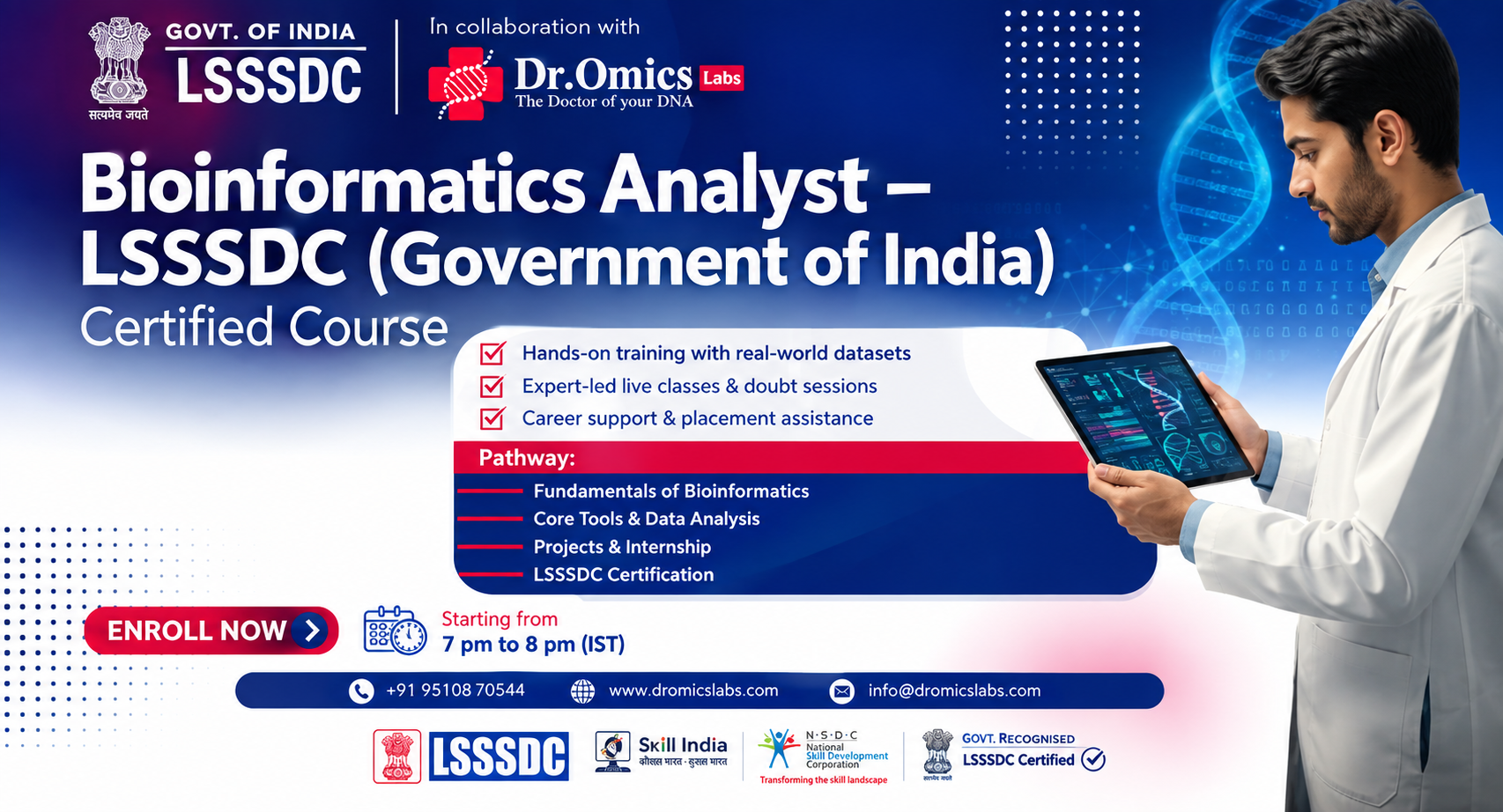
The Bioinformatics Analyst – LSSSDC (Government of India) Certified Course is a comprehensive 6-month live and interactive advanced program designed to develop industry-ready bioinformatics professionals. Aligned with the Life Sciences Sector Skill Development Council (LSSSDC) standards, the program combines biological sciences, programming, computational analysis, statistics, and modern genomics workflows.
Learners receive approximately 155 hours of live training across 19 modules, progressing from foundational bioinformatics and Linux to advanced NGS analysis, programming, machine learning, cloud computing, and cheminformatics. The curriculum includes Linux and Bash, Python and Biopython, R programming, SQL, BLAST, sequence analysis, variant calling with GATK, RNA-Seq, cancer genomics and TCGA, metagenomics using QIIME2, microarray analysis, PCR primer design, machine learning, statistics, AWS cloud computing, molecular docking, and cheminformatics.
The course emphasizes practical, hands-on learning with real biological datasets, helping participants develop the technical skills required for bioinformatics research and industry applications. Participants also receive research and publication guidance, career counselling, interview preparation, and placement assistance through the program's industry network.
Upon successful completion of the required assessment, learners receive an LSSSDC certification awarded after a third-party examination, providing formal recognition of their bioinformatics skills.
What you will learn
Apply bioinformatics concepts and databases to biological research and data analysis.
Work confidently with Linux, Bash, AWK, SED, Python, Biopython, R, and SQL.
Perform sequence analysis, BLAST, multiple sequence alignment, and primer designing.
Analyse NGS datasets using variant calling, reference-based RNA-Seq, and de novo RNA-Seq workflows.
Perform cancer genomics analysis using TCGA datasets.
Conduct metagenomics analysis using QIIME2 and analyse microarray datasets.
Apply statistical methods and machine learning techniques to biological datasets.
Use AWS cloud computing concepts for bioinformatics workflows.
Understand cheminformatics and perform molecular docking-related analysis.
Develop practical skills for bioinformatics research, industry projects, and interviews.
Build a career portfolio through hands-on projects, research guidance, and industry-oriented training.
Prepare for the LSSSDC third-party examination and certification.
Receive career counselling, interview preparation, and 100% placement assistance.
Skills you will gain
Bioinformatics & NGS Fundamentals
NCBI
UCSC
KEGG
UniProt
PDB & Ensembl
BLAST — Online & Standalone
Primer3 & Primer-BLAST
Multiple Sequence Alignment & MEGA
Linux & Bash
AWK & SED
Python & Biopython
R Programming & Data Visualization
Algorithm Development
SQL for Biological Data
GATK-Based Variant Calling
Reference-Based RNA-Seq
De novo RNA-Seq
Cancer Genomics & TCGA
Metagenomics & QIIME2
Microarray Analysis
PCR & Primer Designing
Statistics & Machine Learning
AWS Cloud Computing
Cheminformatics & Molecular Docking
Certification
Available
Issued by LSSSDC
Course curriculum
27 modules
-
Introduction to Bioinformatics and its Applications in Life Sciences
-
Types of sequencing and NGS introduction
-
Introduction to NGS applications
-
Introduction and overview of Bioinformatics & NCBI Gene Database Exploration
-
NCBI Gene Database Exploration
-
UCSC Genome Browser: Overview and Hands-on Exercises
-
Introduction to PubMed Database
-
KEGG Database: Overview and Practical Exercises
-
Overview of Expasy server
-
Protein Databases (PDB): Overview and Practical Exercises
-
ClinVar & OMIM database
-
GWAS catalog database
-
Introduction to Ensembl Database
-
Introduction to Online BLAST with Practical Exercises
-
Setting Up Standalone BLAST and Hands-on Exercises
-
Advanced Standalone BLAST Applications and Exercises
-
Multiple Sequence Alignment Using CLUSTALW
-
Multiple Sequence Alignment Using MEGA
-
Introduction to Linux: Overview and Installation
-
Essential Linux Commands for Beginners to Advanced Linux Commands
-
Managing Packages in Linux (repositories, source code and conda enviroment)
-
Bash Scripting: Variables, Conditionals & Loops
-
Bash Scripting, AWK and SED
-
Installation and Environment Setup
-
Data Types in Bioinformatics Computing
-
String Handling for DNA and Protein Sequences
-
Efficient Data Structures for Biological Data
-
Control Structures for Genome Data Processing
-
Functions for Automating Bioinformatics Tasks
-
Importing, Exporting, and Handling Biological Files
-
Data Manipulation for Sequence and Expression Analysis
-
Visualization of Genomic and Proteomic Data
-
Biopython for Sequence and Structural Analysis
-
Getting Started with R for Bioinformatics
-
Understanding Data Types in R
-
Efficient Data Structures for Genomic Data
-
Importing, Exporting, and Handling Biological Data
-
Control Structures for Data Processing in R
-
Functions for Automating Bioinformatics Workflows
-
Managing and Utilizing R Packages for Analysis
-
Sequence Analysis with Bioconductor
-
Data Manipulation for Genomic and Expression Data
-
Visualizing Biological Data with R-1 (Basic plots, PCA plot, Venn diagram)
-
Visualizing Biological Data with R-2(Heatmap, volcano plot, MA plot)
-
Introduction to NGS and DNAseq
-
Basic Terminologies in NGS
-
Understanding of SRA database
-
Installing Tools in Linux for Variant Calling
-
Quality Control of Reads
-
Trimming and Filtering Reads
-
Genome Indexing and Read Alignment
-
Variation calling using GATK
-
Predicting Variant Effects
-
Variation Visualization (IGV)
-
Docker installation
-
DNAseq pipeline in docker -1
-
DNAseq pipeline in docker -2
-
DNAseq pipeline in docker -3
-
Trimming and Filtering Reads
-
Genome Indexing and Read Alignment
-
Variation calling using GATK
-
Predicting Variant Effects
-
Variation Visualization (IGV)
-
DNAseq pipeline in docker -4
-
Introduction to RNA-seq and Key Terminologies
-
Setting Up Tools in Linux for Gene Expression Analysis
-
Quality Control and Read Trimming
-
Genome Indexing and Read Alignment using Hisat2 & salmon
-
Data Normalization Using Cufflinks and featurecounts
-
Merging Data and Identifying Differentially Expressed Genes using deseq2
-
Interpretation of DEG Results
-
Annotation of Differentially Expressed Genes using DAVID
-
Functional and Pathway Enrichment Analysis using shinyGO ,clusterProfiler & Enrichr
-
Network Analysis of gene interaction using stringDB
-
Network editing using cytoscape
-
Setting Up Tools for De Novo RNA-seq(Trinity)
-
Setting Up Tools for De Novo RNA-seq(RSEM/edgeR/Assembly-stats)
-
Data Downloading and Quality Control
-
Transcriptome Assembly creation
-
Estimating Abundance Counts
-
Generating Count Matrix and Identifying DEGs
-
Performing BLAST Analysis
-
Interpretation of DEG Results
-
Annotation of Differentially Expressed Genes
-
Enrichment Analysis of DEGs
-
Introduction to Metagenomics Analysis
-
Setting Up Tools for Metagenomics
-
Data Downloading and Preprocessing
-
Quality Control and Read Trimming
-
Importing Data into QIIME2
-
Quality Assessment Using DADA2
-
Phylogenetic Diversity Analysis of Microbial Communities
-
Taxonomic Classification of Sequences
-
Visualization with Krona Plot
-
Phylogenetic tree construction using MEGA
-
Introduction to Microarray Technology- Part1
-
Introduction to Microarray Technology-Part2
-
Data Downloading and Preprocessing
-
Microarray Processing Pipeline up to Normalization
-
Differential Gene Expression Analysis in Microarray
-
Annotation of Differentially Expressed Genes
-
Enrichment Analysis of DEGs
-
Network Analysis of Gene Interactions
-
Visualization with Volcano Plot
-
Heatmap Generation for DEG Representation
-
Introduction to Microarray Technology- Part1
-
Introduction to Microarray Technology-Part2
-
Data Downloading and Preprocessing
-
Microarray Processing Pipeline up to Normalization
-
Differential Gene Expression Analysis in Microarray
-
Annotation of Differentially Expressed Genes
-
Enrichment Analysis of DEGs
-
Network Analysis of Gene Interactions
-
Visualization with Volcano Plot
-
Heatmap Generation for DEG Representation
-
Fundamentals of Machine Learning for Genomic Data
-
Linear Models and Nearest Neighbors for Pattern Recognition
-
Probabilistic Machine Learning Concepts and Applications
-
Support Vector Machines SVM Theory and Implementation
-
Naïve Bayes Classifier Fundamentals and Bioinformatics Use Cases
-
Decision Trees and Random Forest Interpretable ML Models
-
Logistic Regression for Predictive Analysis in Bioinformatics
-
Clustering Algorithms for Unsupervised Learning
-
Validation Techniques for Machine Learning Models
-
Machine Learning for Biomedical Image Analysis
-
Introduction to Statistical Methods for Bioinformatics
-
Descriptive Statistics and Data Structures
-
Correlation and Regression Analysis for Genomic Data
-
Probability and Bayes Theorem in Bioinformatics
-
Sampling Techniques and Distribution Theory
-
Hypothesis Testing for Data Analysis
-
Statistical Tools for Data Management, Analysis, and Visualization
-
Inferential Statistics for Biological Data Interpretation
-
Interpreting Statistical Outputs for Decision Making
-
Practical Applications of Statistical Methods in Bioinformatics
-
Program Design: Principles and Methods
-
Basic Structures for Algorithm Development
-
Efficient vs Naïve Algorithms
-
Structured Programming and Divide and Conquer
-
Object -Oriented Approaches and Greedy Algorithms
-
Introduction to AWS
-
Introduction to Compute Storage Databases
-
Introduction to AWS Services and free tier acount creation
-
creation s3 bucket, Ec2 instance and connection
-
Execution of pipeline through EC2 instance
-
Basic SQL Syntax and Data Types
-
Relational Databases and Data Operations
-
SQL for Data Import, Export, and Manipulation
-
Working with SQL Files and Query Execution
-
SQL Workbench for Bioinformatics Data Analysis
-
Drug Discovery and Development Process: Understanding QSAR Principles
-
Introduction to Drug Discovery Process
-
Role of Computational Methods
-
Utilizing Biological Databases and GCP Standards
-
Chemical Structure Visualization
-
Visual Representation of Biological Processes and Structures in Data Analysis
-
Biomolecules- Properties and function
-
Molecular Docking and Molecular Dynamics
-
Pharmacophore Modeling
-
Pharmacophore Modelling applications
-
Introduction to Single-Cell Omics
-
Package installation
-
Single-Cell RNA-Seq Analysis Workflow
-
Bulk vs Single-Cell RNA-Sequencing
-
Quality Control and Preprocessing of scRNA Data
-
Normalization and Batch Effect Correction
-
Cell Clustering and Type Identification
-
Dimensionality Reduction and Data Visualization
-
Trajectory and Pseudotime Analysis
-
Cell-Cell Communication and Interaction Mapping
-
Introduction to PCR & Gene Sequence
-
Basic Primer Design
-
Primer Quality Checking
-
Primer Specificity & In-Silico PCR
-
Mini Project
-
MANAGE YOUR WORK TO MEET REQUIREMENTS
-
WORK EFFECTIVELY WITH COLLOGUES
-
BUILD AND MAINTAIN RELATIONSHIP AT
-
WORKPLACE
-
BUILD AND MAINTAIN CLIENT SATISFACTION
-
RESEARCH PUBLICATION GUIDANCE
What you need to start
-
Bachelor's degree in Life Sciences or a related field is preferred.
-
Basic understanding of biology is recommended.
-
Suitable for learners from Biotechnology, Microbiology, Biochemistry and related disciplines.
-
No prior programming experience is required; programming is introduced from the fundamentals.
-
Basic computer skills and willingness to work with biological datasets are recommended.
Who this course is for
-
Life Sciences Graduates: Biotechnology, Microbiology, Biochemistry and related graduates seeking a career in bioinformatics.
-
Research Scholars & PhD Candidates: Researchers who want practical skills in NGS, statistics, machine learning and publication-oriented analysis.
-
Data Scientists & Healthcare Professionals: Professionals looking to develop domain expertise in biological data and computational genomics.
-
Career Changers: Individuals transitioning into bioinformatics who want a structured, live and certification-oriented program.
-
Students & Early-Career Professionals: Learners seeking comprehensive, industry-oriented training and career preparation in bioinformatics.