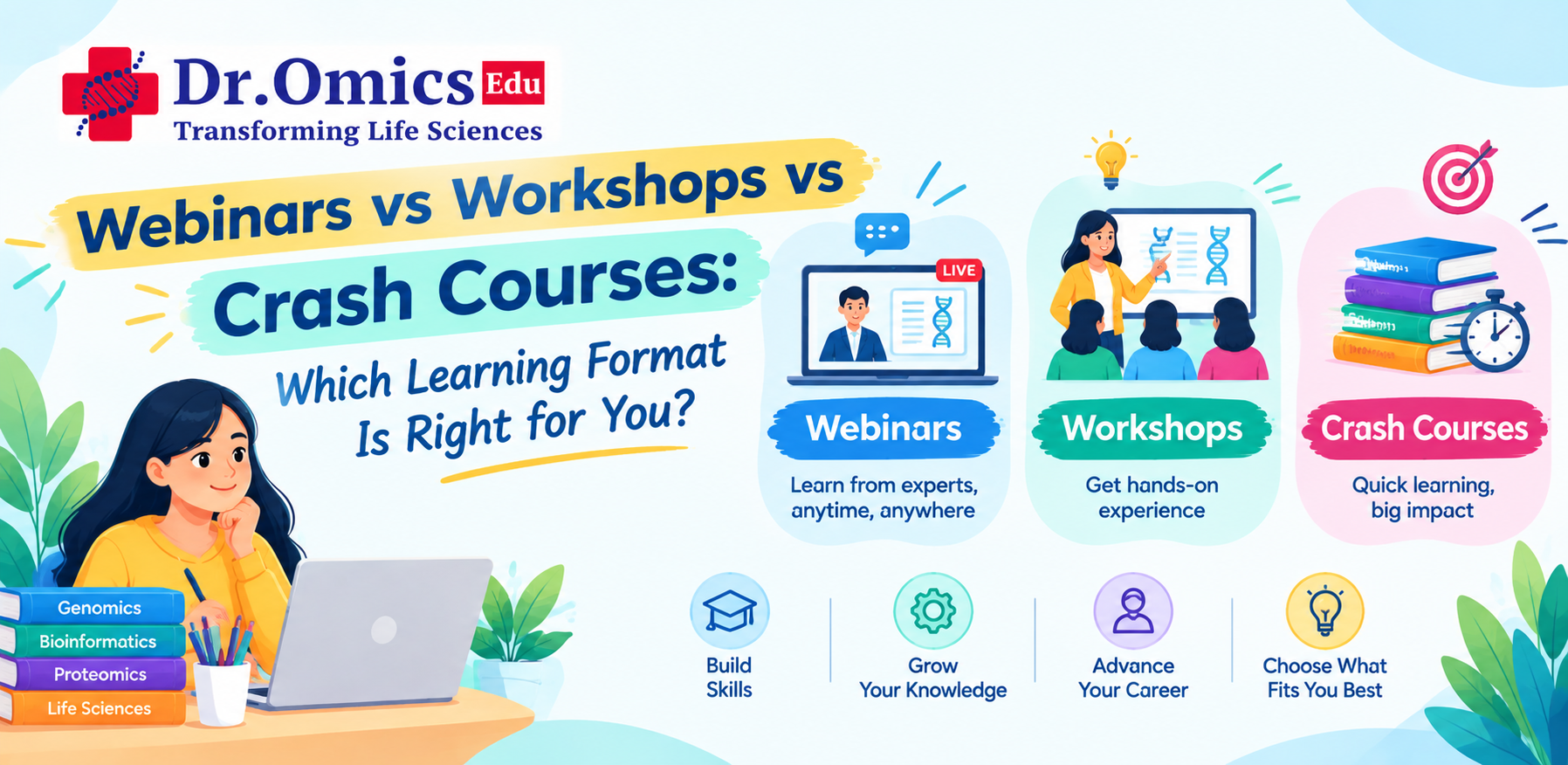
Webinars vs Workshops vs Crash Courses: Which Learning Format Is Right for You?
Dr. Omics Edu Team ·
Bioinformatics is a rapidly evolving field. New sequencing technologies, databases, computational tools, AI applications, and analysis workflows are introduced regularly. For students and professionals, continuous learning has therefore become an important part of building and maintaining bioinformatics skills.
But with so many online bioinformatics learning options, choosing the right format can be confusing.
Should you attend a webinar to understand a new topic? Should you join a hands-on workshop to learn a tool? Or would a structured crash course be more suitable for developing a complete skill?
The answer depends on your learning goal, available time, current knowledge, and the level of practical experience you want.
This bioinformatics short course guide explains the differences between webinars, workshops, and crash courses and provides a practical approach to choosing the right course format.
What Are the Three Learning Formats?
Before comparing them, it is useful to understand what each format generally offers.
1. Webinar
A webinar is usually a short, focused online session designed to introduce or explain a specific topic.
A bioinformatics webinar may cover topics such as:
- Introduction to NGS
- CRISPR-Cas9
- RNA-seq
- AI in drug discovery
- Genomic databases
- Variant interpretation
- Careers in bioinformatics
- Emerging bioinformatics tools
Webinars are particularly useful when you want to understand what a topic is, why it matters, and where it is used.
2. Workshop
A workshop is generally more practical and interactive than a webinar.
Instead of only listening to an explanation, participants may work directly with:
- Bioinformatics software
- Biological databases
- Real datasets
- Command-line tools
- R or Python
- NGS workflows
- Visualization platforms
This is where the workshop bioinformatics benefits become particularly important.
A workshop can help bridge the gap between theoretical understanding and practical application.
3. Crash Course
A crash course is typically a compact but structured learning program covering multiple concepts within a limited period.
For example, a bioinformatics crash course might cover:
Day 1: Bioinformatics fundamentals
Day 2: Biological databases
Day 3: Sequence analysis
Day 4: NGS fundamentals
Day 5: NGS data analysis
Day 6: Variant analysis
Day 7: Biological interpretation
The exact structure varies by provider.
A crash course is useful when you want a concentrated introduction to a complete topic or workflow rather than a single concept.
Bioinformatics Webinar vs Workshop
One of the most common questions students ask is about the difference between a webinar and a workshop.
The simplest distinction is:
Webinar = Learn about a topic
Workshop = Learn by doing
For example, imagine you want to learn about RNA-seq.
A webinar might explain:
- What RNA-seq is
- Why RNA-seq is used
- Basic workflow
- Applications
- Career opportunities
A workshop could take the next step:
- Download an RNA-seq dataset
- Perform quality control
- Trim reads
- Align reads
- Generate expression counts
- Perform downstream analysis
- Interpret the results
Therefore, if your goal is awareness and conceptual understanding, a webinar may be sufficient.
If your goal is practical skill development, a workshop can provide a different type of learning experience.
Crash Course vs Webinar
The crash course vs webinar comparison mainly comes down to scope and learning depth.
A webinar usually focuses on one topic or a narrow theme.
A crash course generally covers a broader learning path within a defined period.
For example:
Webinar: Introduction to Variant Annotation
Crash Course: Complete Variant Analysis Workflow
The webinar may explain concepts such as variants, VCF files, annotation, and interpretation.
The crash course may additionally introduce:
- VCF processing
- Variant calling concepts
- Annotation tools
- VEP
- Variant databases
- Visualization
- Interpretation
- Practical exercises
This makes crash courses more suitable when you want structured exposure to a larger topic.
Workshop Bioinformatics Benefits
Workshops are particularly useful for students because bioinformatics is a practical discipline.
Knowing the definition of a tool is different from knowing how to use it.
For example, a student may know that FastQC is used for sequencing quality control. However, practical training can teach the student how to:
- Obtain FASTQ files
- Run FastQC
- Read the generated report
- Identify quality issues
- Compare multiple samples
- Use MultiQC for summary reporting
- Decide what downstream preprocessing may be required
This type of experience can improve confidence when working on academic projects or research datasets.
Other workshop benefits include:
- Hands-on practice
- Instructor interaction
- Troubleshooting
- Real-data exposure
- Tool familiarity
- Workflow understanding
- Practical problem-solving
Live vs Recorded Bioinformatics Course
Another important factor is whether the course is live or recorded.
Live Learning
In a live course, participants attend a session at a scheduled time.
Advantages can include:
- Real-time interaction
- Immediate questions and answers
- Instructor demonstrations
- Live troubleshooting
- Peer interaction
- Greater accountability
Live learning can be especially useful for beginners who may need guidance while performing practical steps.
Recorded Learning
Recorded courses allow learners to study whenever they want.
Advantages include:
- Flexible timing
- Ability to pause and replay
- Self-directed learning
- Convenient revision
- No fixed schedule
Recorded learning can work well for students who already have some experience and prefer independent study.
Neither format is universally suitable for everyone. The right choice depends on how much instructor interaction and scheduling flexibility you need.
Self-Paced vs Live Learning
The self paced vs live learning decision is closely related to your learning style.
Self-Paced Learning May Suit You If:
- Your schedule changes frequently
- You prefer learning independently
- You want to repeat difficult topics
- You already have basic knowledge
- You are comfortable troubleshooting independently
Live Learning May Suit You If:
- You are new to bioinformatics
- You have difficulty learning independently
- You want immediate feedback
- You need practical guidance
- You want to ask questions during demonstrations
A combination can also be effective.
For example:
Recorded theory + live practical session + project
can provide both flexibility and instructor support.
Which Format Should a Beginner Choose?
For someone completely new to bioinformatics, jumping directly into a highly technical crash course may sometimes be overwhelming.
A gradual approach can be more comfortable:
Webinar → Workshop → Structured Course/Crash Course → Project
A webinar can help you understand the field.
A workshop can help you experience practical work.
A structured course can build systematic knowledge.
A project can help you apply everything independently.
However, this is not a fixed rule. A beginner with strong programming or biology fundamentals may be ready for a workshop or structured course immediately.
Which Format Is Better for Practical Skills?
If your primary goal is to learn how to operate tools and perform analysis, practical exposure becomes important.
Consider a workshop or hands-on crash course that includes:
- Real datasets
- Step-by-step demonstrations
- Practical assignments
- Troubleshooting
- Independent exercises
- Project work
For example, if you want to learn NGS analysis, simply watching a lecture about FastQC, alignment, variant calling, or RNA-seq will not provide the same experience as actually running those tools.
This is an important consideration when searching for the best learning format bioinformatics.
Which Format Is Better for Career Exploration?
If you are still deciding whether bioinformatics is the right career path, starting with a webinar can be a practical option.
A career-focused webinar can introduce:
- Bioinformatics career paths
- Industry applications
- Research opportunities
- Required technical skills
- Common tools
- Educational pathways
- Current trends
You can then decide whether deeper training is worthwhile.
This approach can prevent students from enrolling in a lengthy course before understanding whether the subject matches their interests.
Which Format Is Better for Learning a Specific Tool?
If your goal is to learn one particular software or database, a focused workshop can be highly useful.
For example:
Goal: Learn Cytoscape
A focused workshop could cover:
- Network concepts
- Data preparation
- Network import
- Visualization
- Node and edge attributes
- Network analysis
- Biological interpretation
Similarly, a workshop on a genomics tool could combine explanation with actual dataset analysis.
For a single-tool learning goal, a long general course may not always be necessary.
Which Format Is Better for a Complete Workflow?
If you want to understand an entire workflow, consider a structured crash course or short course.
For example:
RNA-seq Analysis
FASTQ → Quality Control → Trimming → Alignment → Quantification → Differential Expression → Functional Interpretation
A complete program can explain not only individual tools but also why each step comes before the next one.
That workflow perspective is important for research because bioinformatics is rarely about using one tool in isolation.
A Simple Decision Guide
When choosing the right course format, start with your goal.
Choose a Webinar If You Want To:
- Explore a new topic
- Understand current trends
- Learn basic concepts
- Explore career opportunities
- Decide whether you want deeper training
Choose a Workshop If You Want To:
- Learn a specific tool
- Work with real datasets
- Gain hands-on experience
- Practice a workflow
- Ask questions during practical sessions
Choose a Crash Course If You Want To:
- Learn a broader topic quickly
- Follow a structured learning path
- Cover multiple tools
- Build foundational knowledge
- Prepare for a project or internship
What Should You Check Before Enrolling?
Before selecting any online bioinformatics learning options, don't evaluate a course only by its title.
Check the following:
1. Curriculum
Does it cover what you actually want to learn?
2. Practical Component
Will you work with real datasets or only watch demonstrations?
3. Instructor Support
Can you ask questions and receive guidance?
4. Course Duration
Is the duration realistic for the amount of material being taught?
5. Tools Used
Are the tools relevant to current research or your target role?
6. Project
Does the course include an assignment or project?
7. Learning Format
Is it live, recorded, self-paced, or a combination?
8. Learning Outcome
Will you finish the program with a specific skill that you can demonstrate?
How to Choose a Bioinformatics Program Based on Your Goal
Instead of asking:
"Which course is the best?"
ask:
"What do I need to be able to do after completing this course?"
For example:
| Your Goal | Suitable Format |
|---|---|
| Understand bioinformatics | Webinar |
| Explore a new research area | Webinar |
| Learn one software tool | Workshop |
| Practice NGS analysis | Workshop |
| Learn a complete workflow | Crash course |
| Build foundational skills | Crash course |
| Learn independently | Self-paced course |
| Need continuous guidance | Live course |
| Prepare for a project | Workshop or crash course |
The right choice depends on your starting point and desired outcome.
Final Thoughts
There is no single learning format that works for every bioinformatics learner.
A webinar can provide a quick introduction and help you discover new areas. A workshop can provide hands-on experience and teach you how to work with tools and datasets. A crash course can provide a structured pathway for learning a broader topic within a limited time.
The most useful approach is to match the learning format with your objective.
If you want awareness, consider a webinar.
If you want practical experience, consider a workshop.
If you want structured and concentrated learning, consider a crash course.
For many learners, combining different formats can be particularly useful:
Webinar for awareness → Workshop for practice → Crash course for structured learning → Project for application.
Ultimately, how to choose a bioinformatics program should depend on your current knowledge, career objective, available time, preferred learning style, and the practical skills you want to develop.
The goal is not simply to collect certificates or attend more sessions. The goal is to move from understanding → practicing → applying → independently solving biological problems.
Choose the format that takes you one step closer to being able to do real bioinformatics work.
