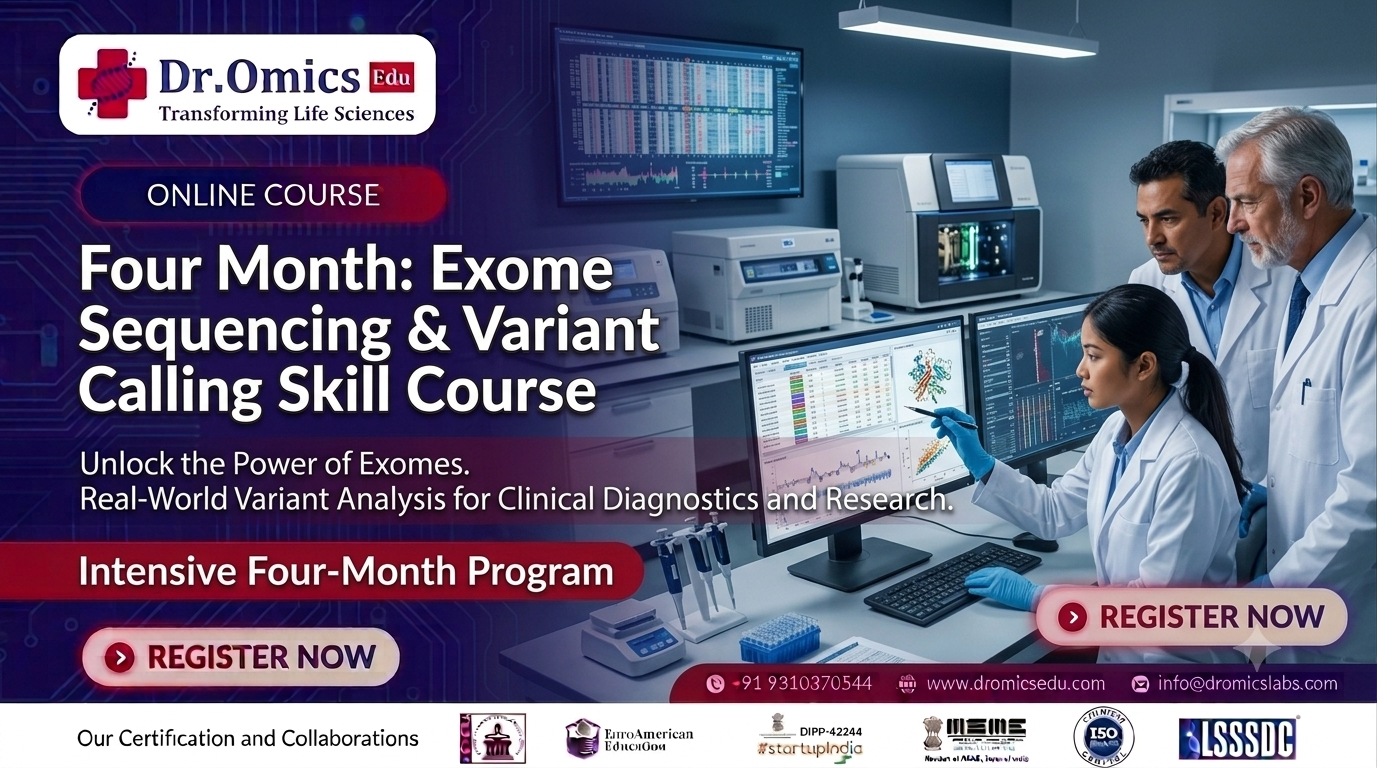
About this course
Foundations of Bioinformatics: Explore key databases and tools like GenBank, PubMed, BLAST, and Mega, bridging biotechnology with bioinformatics.
Next Generation Sequencing (NGS): Understand the role of bioinformatics in NGS, covering techniques, applications, and platforms, along with Linux basics.
Python Programming: Master Python essentials for bioinformatics, including data types, control statements, and file handling, followed by an introduction to Biopython.
R Programming and Bioconductor: Learn R programming fundamentals and its significance in bioinformatics, with a focus on Bioconductor for sequence analysis and visualization.
RNA Sequencing (RNA Seq): Gain proficiency in RNA Seq data analysis techniques, from data retrieval and quality check to mapping reads and pathway analysis.
DNA Sequencing (DNA Seq): Acquire skills in DNA Seq data analysis, covering variant calling, annotation, and visualization, alongside RNA Seq analysis.
One-Month NGS Research Project: Apply acquired skills in a practical setting, conducting research in next-generation sequencing, variant detection, and pathway analysis.
HR Session: Develop soft skills and prepare for career advancement through HR sessions covering resume building, interview skills, and professional networking.
What you will learn
Comprehensive Understanding: Master bioinformatics fundamentals, databases, and tools for biotechnology applications.
Proficiency in NGS: Excel in NGS techniques, platforms, and data analysis, complemented by Linux skills.
Programming Mastery: Achieve expertise in Python and R programming tailored for bioinformatics.
Bioconductor Expertise: Harness Bioconductor for sequence analysis, visualization, and statistical studies.
RNA and DNA Seq Analysis: Develop practical skills in RNA Seq and DNA Seq data analysis, including variant calling.
Real-world Application: Apply skills in a one-month NGS research project, gaining hands-on experience in variant detection and pathway analysis.
Skills you will gain
Comprehensive Understanding: Master bioinformatics fundamentals
databases
and tools for biotechnology applications. Proficiency in NGS: Excel in NGS techniques
platforms
and data analysis
complemented by Linux skills. Programming Mastery: Achieve expertise in Python and R programming tailored for bioinformatics. Bioconductor Expertise: Harness Bioconductor for sequence analysis
visualization
and statistical studies. RNA and DNA Seq Analysis: Develop practical skills in RNA Seq and DNA Seq data analysis
including variant calling. Real-world Application: Apply skills in a one-month NGS research project
gaining hands-on experience in variant detection and pathway analysis.
Certification
Certification: A certificate will be awarded upon course completion.
Issued by Dr. Omics Edu
Course curriculum
10 modules
-
M1T1 = Introduction to Bioinformatics
-
M1T2 = NCBI Database Overview
-
M1T3 = Genbank Database Practical Exercises
-
M1T4 = UCSC Genome Browser Overview
-
M1T5 = UCSC Genome Browser Hands-on Exercises
-
M1T6 = Pubmed Database Introduction
-
M1T7 = Clinvar Database Overview
-
M1T8 = KEGG Database Overview and Exercises
-
M1T9 = Protein Databases (UniProt)
-
M1T10 = Protein Databases (PDB)
-
M1T11 = Online BLAST Introduction and Exercises
-
M1T12 = Standalone BLAST Setup and Exercises
-
M1T13 = Standalone BLAST Advanced Exercises
-
M1T14 = Multiple Sequence Alignment with ClustalW
-
M1T15 = Multiple Sequence Alignment with MEGA
-
M2T1 = Overview and Installation of Linux
-
M2T2 = Basic Linux Commands
-
M2T3 = Advanced Linux Commands
-
M2T4 = Package Management using Repository
-
M2T5 = Package Management using Source Code
-
M3T1 = Introduction to Python
-
M3T2= Data Types
-
M3T3= String Handling
-
M3T4= Data Structure
-
M3T5=Control Structure
-
M3T6 = Function
-
M3T7= File Handling
-
M3T8= Data Manipulation
-
M3T9= Data Visualization
-
M3T10= Biopython
-
M4T1 = Introduction and Installation of R
-
M4T2= Data Types in R
-
M4T3= Data Structure
-
M4T4= File Handling
-
M4T5=Control Structure
-
M4T6 = Function
-
M4T7= Package Management
-
M4T8= Data Manipulation
-
M4T9= Data Visualization
-
M4T10= Statistical Analysis
-
M6T1= Introduction to NGS and DNAseq
-
M6T2= Basic Terminologies in NGS
-
M6T3= Understanding of SRA database
-
M6T4= Tools installation in Linux for Variation Calling
-
M6T5= Quality control
-
M6T6= Trimming of Reads
-
M6T7= Indexing of Genome and Alignment of Reads
-
M6T8= Variation calling using GATK
-
M6T9= Variant Effect Prediction(VEP)
-
M6T10= Variation Visualization (IGV)
-
M7T1=Introduction to RNAseq and it’s basic terminologies
-
M7T2=Tools installation in Linux for Gene Expression analysis
-
M7T3=Quality control and Trimming of reads
-
M7T4=Indexing of Genome and Alignment of Reads
-
M7T5=Normalization of Data (Cufflinks)
-
M7T6=Merging of Data and Differential expression of genes
-
M7T7=Understanding of DEG results
-
M7T8=Annotation of DEG
-
M7T9=Functional and Pathway Enrichment Analysis
-
M7T10=Network Analysis
-
M8T1= Tools installation for De-novo RNAseq
-
M8T2= Tools installation for De-novo RNAseq
-
M8T3= Data downlading and Quality control
-
M8T4= Assembly Creation
-
M8T5= Abundance count estimation
-
M8T6= Generation of count matrix and DEG
-
M8T7= BLAST
-
M8T8= Understanding the DEG results
-
M8T9= Annotation of DEGs
-
M8T10= Encrichment Analysis
-
M9T1= Introduction to metagenomics
-
M9T2= Tools installation for metagenomics
-
M9T3= Data Downloading
-
M9T4= Quality control & Trimming
-
M9T5= Data importing in Qimme2
-
M9T6= Data quality check using DADA2
-
M9T7= Phylogentic Analysis
-
M9T8= Taxonomy Analysis
-
M9T9= Krona Plot
-
M9T0= Phylogenetic tree construction
-
M10T1= Introduction to MIcroarray
-
M10T2= Introduction to Microarray
-
M10T3= Data Downloading
-
M10T4= Microarray Pipeline upto Normalization
-
M10T5= Microarray Pipeline till DEG
-
M10T6= Annotation of DEG
-
M10T7= Encrichment Analysis
-
M10T8= Network Analysis
-
M10T9= Volcano Plot
-
M10T10= Heatmap
What you need to start
-
Motivation to Learn: A strong desire to engage with and understand the material.
-
Basic Knowledge: Familiarity with biology and molecular biology concepts.
-
Interest in Technology: Eagerness to learn about the latest technologies in Next-Generation Sequencing (NGS).
-
Software: Free software will be utilized, so no additional software purchases are necessary.
-
Hardware: A laptop with a minimum of 4GB RAM and 100GB of hard disk space.
Who this course is for
-
Life science students and graduates, biotechnology and bioinformatics aspirants, genomics and NGS beginners, researchers seeking hands-on sequencing data analysis skills, and professionals aiming to build or advance a career in bioinformatics and genomics.