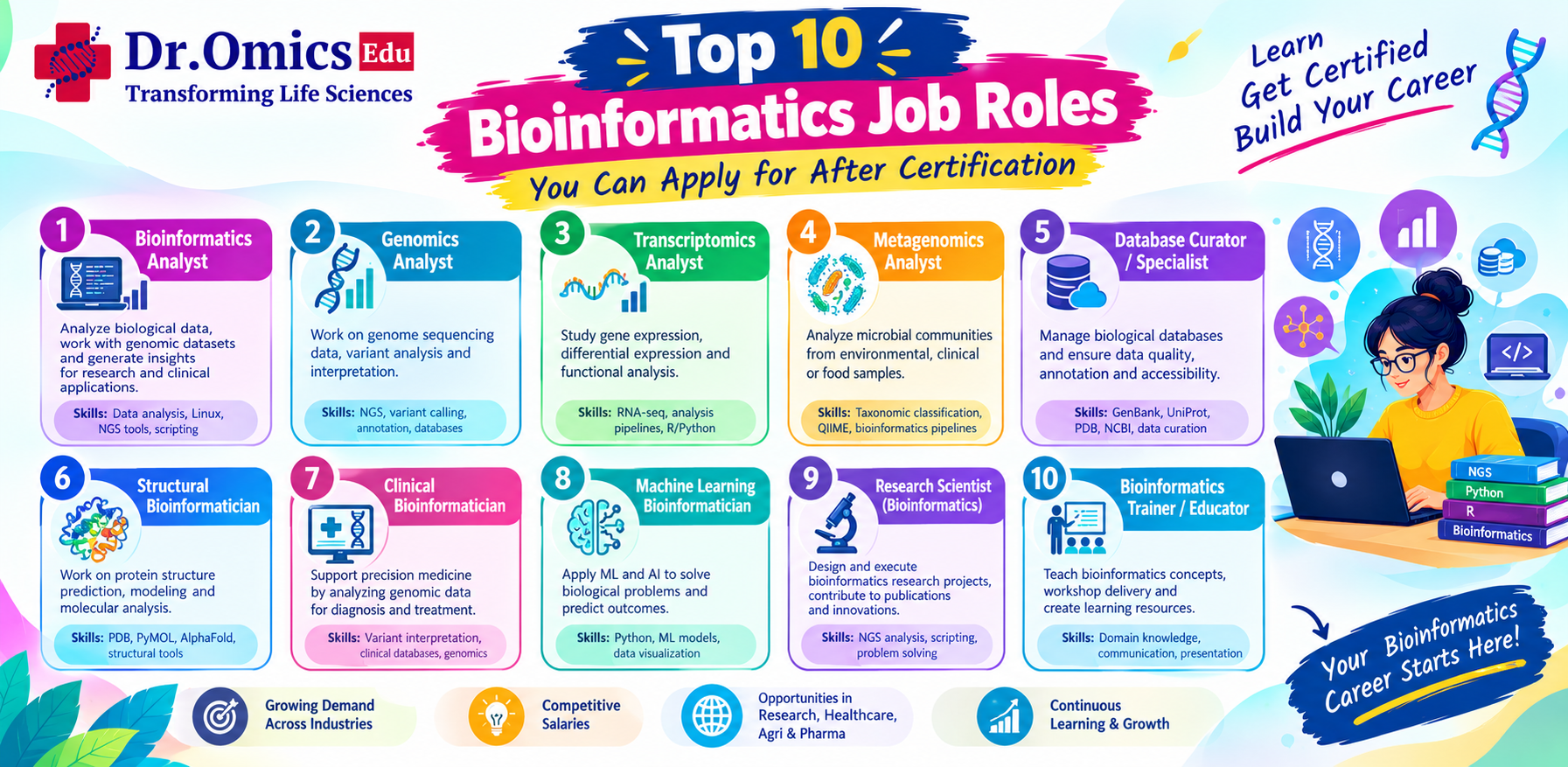
Top 10 Bioinformatics Job Roles You Can Apply for After Certification
Dr. Omics Edu Team ·
Introduction
Bioinformatics is becoming an essential part of modern biological research, healthcare, biotechnology, and pharmaceutical development. The increasing availability of genomic, transcriptomic, proteomic, and other biological datasets has created a need for professionals who can combine biological knowledge with computational and analytical skills. For students and life science graduates looking to enter this growing field, completing a bioinformatics certification can be a useful step toward developing industry-relevant skills.
However, obtaining a certificate is only the beginning. Employers typically look for candidates who can apply their knowledge to real biological problems, work with relevant software tools, interpret analytical results, and communicate findings effectively. Understanding the available bioinformatics career options can help candidates select a specialization that matches their educational background, interests, and technical abilities.
From bioinformatics analyst jobs and genomics research to clinical data interpretation and computational biology, there are several career paths to explore after certification. Some positions are suitable for fresh graduates, while others require advanced programming, research experience, postgraduate qualifications, or specialized domain knowledge.
In this blog, we explore the top 10 bioinformatics job roles you can consider after certification, the skills required for each role, commonly used tools, and practical ways to improve your employability.
A Bioinformatics Analyst is one of the most accessible career paths for candidates who have developed foundational skills through bioinformatics training or certification.
Bioinformatics analysts process biological datasets, perform computational analyses, generate visualizations, and prepare reports to support scientific research. Depending on the organization, they may work with DNA sequencing, RNA sequencing, protein sequences, gene expression data, or biological databases.
Key responsibilities:
- Process and analyse biological datasets using established workflows.
- Perform quality control, sequence alignment, and data annotation.
- Interpret results and prepare reports for research teams.
- Use statistical methods to investigate biological patterns.
- Maintain analysis documentation and organize project data.
Essential skills: Linux, Python or R, basic statistics, molecular biology, sequence analysis, and biological databases.
Common tools: BLAST, FastQC, SAMtools, R, Python, and NCBI resources.
Who should apply? Life science graduates, biotechnology students, MSc Bioinformatics graduates, and candidates with practical experience in biological data analysis.
Searching for bioinformatics analyst jobs is a practical starting point for candidates seeking their first industry or research position.
Genomics Data Analysts specialize in DNA sequencing data and genomic variation. They help researchers identify genetic differences, investigate mutations, and understand how genomic variation relates to biological traits or diseases.
Their work may involve processing next-generation sequencing (NGS) data, identifying variants, annotating genomic changes, and comparing samples across experimental groups.
Key responsibilities:
- Perform quality assessment of sequencing reads.
- Align DNA sequencing reads to a reference genome.
- Support variant calling, filtering, and annotation.
- Compare genomic variants across samples.
- Prepare results for research or diagnostic teams.
Essential skills: DNA sequencing concepts, Linux, Bash, Python or R, genome annotation, and variant analysis.
Common tools: BWA, SAMtools, GATK, VCFtools, and Ensembl Variant Effect Predictor (VEP).
Who should apply? Candidates with training in NGS analysis, genomics, genetic variation, and sequencing data interpretation.
This role is particularly suitable for candidates who enjoy working with DNA data and understanding the genetic basis of biological conditions.
RNA-seq Analysts work with transcriptomic data to investigate gene expression and understand how biological systems respond to disease, treatments, environmental changes, or developmental processes.
RNA sequencing allows researchers to measure transcript abundance and identify genes that show different expression patterns between experimental conditions. Analysts help convert raw sequencing data into interpretable results.
Key responsibilities:
- Assess RNA-seq read quality.
- Perform read alignment or transcript quantification.
- Conduct differential gene expression analysis.
- Generate gene expression plots and statistical summaries.
- Perform functional enrichment and pathway analysis.
Essential skills: RNA biology, statistics, R or Python, Linux, experimental design, and gene expression analysis.
Common tools: FastQC, STAR, HISAT2, Salmon, DESeq2, edgeR, and clusterProfiler.
Who should apply? Candidates who have completed RNA-seq training or projects involving gene expression and statistical analysis.
Practical experience with a complete RNA-seq workflow can strengthen applications for research assistant and junior transcriptomics positions.
A Clinical Bioinformatician works at the intersection of genomics, healthcare, and computational analysis. These professionals help process and interpret genetic data that may support the investigation of inherited diseases, cancer, and other clinically relevant conditions.
Their responsibilities vary by employer. Some focus on pipeline development and quality control, while others support variant interpretation, clinical laboratory workflows, or genomic reporting.
Key responsibilities:
- Analyse genomic sequencing data generated for clinical applications.
- Filter and annotate genetic variants.
- Support the interpretation of variants using relevant evidence.
- Maintain reproducible and quality-controlled workflows.
- Follow applicable data privacy, laboratory, and reporting standards.
Essential skills: Human genetics, genomics, variant annotation, clinical terminology, data quality assessment, and knowledge of relevant clinical guidelines.
Common tools and resources: VEP, ClinVar, Ensembl, IGV, and specialized clinical variant interpretation platforms.
Who should apply? Candidates with relevant genomics training, strong genetics knowledge, and an understanding of clinical data analysis requirements.
Although certification can provide foundational knowledge, clinical bioinformatics positions may require postgraduate education, supervised experience, or specific laboratory and regulatory expertise. Independent clinical interpretation and reporting may also require additional qualifications.
5. Computational Biologist
Computational Biologists use computational methods, mathematical models, statistics, and programming to investigate complex biological questions.
Unlike roles focused primarily on routine data processing, computational biology often involves developing analytical approaches, modelling biological systems, integrating datasets, and interpreting results in the context of scientific hypotheses.
Key responsibilities:
- Develop computational approaches for biological research.
- Analyse genomic, transcriptomic, proteomic, or other omics datasets.
- Build models to investigate biological processes.
- Integrate data from multiple experimental sources.
- Collaborate with experimental biologists to validate findings.
Essential skills: Programming, statistics, algorithms, molecular biology, data visualization, and scientific reasoning.
Common tools: Python, R, Bioconductor, Biopython, and relevant machine learning libraries.
Who should apply? Candidates with strong analytical skills and an interest in biological research, mathematical modelling, or multi-omics analysis.
Some junior computational biology positions may accept candidates with a relevant master's degree and strong project experience. Research-intensive and scientist-level positions frequently require a PhD or substantial research experience.
Candidates searching for computational biologist jobs should review individual job descriptions carefully because employers use this title for a wide range of responsibilities.
Metagenomics Analysts study microbial communities by analysing genetic material obtained directly from environmental or biological samples. Their work supports research in microbiome science, infectious diseases, agriculture, environmental monitoring, and biotechnology.
Depending on the project, they may analyse 16S rRNA sequencing data or shotgun metagenomic datasets.
Key responsibilities:
- Perform quality control on sequencing reads.
- Characterize microbial community composition.
- Analyse taxonomic abundance and microbial diversity.
- Investigate functional genes and metabolic pathways when supported by the data.
- Compare microbial communities across sample groups.
Essential skills: Microbiology, microbial genetics, Linux, R or Python, statistics, and sequencing data analysis.
Common tools: QIIME 2, DADA2, Kraken 2, MetaPhlAn, HUMAnN, and relevant reference databases.
Who should apply? Candidates with backgrounds in microbiology, biotechnology, environmental science, bioinformatics, or related life sciences.
A portfolio project comparing microbial communities across environmental or biological samples can demonstrate practical knowledge of metagenomics workflows.
7. Bioinformatics Pipeline Developer
Bioinformatics Pipeline Developers build, automate, test, and maintain workflows used to process biological data. Their work helps research teams analyse large datasets consistently and efficiently.
This role is particularly suitable for candidates who enjoy programming, Linux, automation, and software development alongside biological research.
Key responsibilities:
- Develop scripts to automate repetitive analysis tasks.
- Build reproducible workflows for NGS and other omics data.
- Integrate bioinformatics tools into automated pipelines.
- Troubleshoot errors and optimize computational performance.
- Document, test, and maintain analysis workflows.
Essential skills: Python, Bash, Linux, Git, workflow management, and debugging.
Common tools: Nextflow, Snakemake, Docker, Git, and relevant command-line bioinformatics software.
Who should apply? Candidates with bioinformatics certification and demonstrable scripting or pipeline development experience.
For this role, a certificate alone may not be sufficient. A practical project that processes real sequencing data from quality control through downstream analysis can help demonstrate the skills employers need.
A genomics data scientist combines statistical analysis, programming, data science, and biological knowledge to extract insights from large-scale genomic datasets.
These professionals may work on biomarker discovery, disease classification, population genetics, genomic prediction, or the integration of molecular and clinical datasets. Their work often requires more advanced analytical skills than basic data processing.
Key responsibilities:
- Analyse large and complex genomic datasets.
- Develop statistical models and predictive methods.
- Apply machine learning to biological questions.
- Integrate data from multiple sources.
- Visualize findings and communicate analytical limitations.
Essential skills: Python or R, statistics, machine learning, data visualization, genomics, and experimental design.
Common tools: pandas, NumPy, scikit-learn, R, Bioconductor, and appropriate cloud or high-performance computing platforms.
Who should apply? Candidates with a strong foundation in programming, statistics, and genomics who are willing to develop data science expertise.
This position may offer opportunities for professionals transitioning from traditional bioinformatics analysis into advanced computational research. However, employers often expect demonstrated experience in statistical modelling and machine learning, not merely familiarity with AI tools.
9. Scientific Research Assistant or Bioinformatics Research Associate
Research assistants and research associates support academic, clinical, and industry research projects. Their responsibilities depend on the research group and may include data processing, literature review, computational analysis, documentation, and preparation of research outputs.
These positions can provide valuable experience to candidates who want to develop their technical skills before moving into a specialized bioinformatics role.
Key responsibilities:
- Support ongoing genomics or computational biology projects.
- Process and analyse biological datasets.
- Maintain organized project records and analysis documentation.
- Prepare figures, reports, and research summaries.
- Collaborate with scientists and other research team members.
Essential skills: Scientific reading, biological knowledge, basic programming, statistics, data analysis, and communication.
Common tools: R, Python, Linux, BLAST, NCBI databases, and tools relevant to the research project.
Who should apply? Recent graduates, postgraduate students, and candidates with relevant project or internship experience.
Academic research positions may have specific degree requirements, and some research associate roles require a master's degree or PhD. Candidates should review eligibility criteria before applying.
10. Biotech Data Analyst
Biotech Data Analysts work with biological, experimental, operational, or research datasets to support decision-making in biotechnology and life science organizations.
The role may include analysing experimental measurements, quality control data, assay results, gene expression datasets, or other information generated during research and development. The exact responsibilities depend on the employer.
Key responsibilities:
- Clean, organize, and validate datasets.
- Perform statistical summaries and exploratory data analysis.
- Create charts, dashboards, and reports.
- Identify trends and unusual observations.
- Communicate findings to scientific or business teams.
Essential skills: Excel, SQL, Python or R, statistics, data visualization, and basic biological knowledge.
Common tools: Excel, SQL, Python, R, Power BI, and Tableau, depending on the organization.
Who should apply? Candidates who have a life sciences background and are comfortable working with data, reports, and analytical tools.
This role can be a useful entry point for candidates who want to enter biotechnology or life science analytics before specializing in advanced genomics or computational biology.
Which Bioinformatics Job Roles Are Suitable for Freshers?
Not every role requires the same level of experience. Candidates should match their skills to the responsibilities and qualifications listed in each job advertisement.
The following roles can be useful starting points for candidates exploring entry level bioinformatics jobs.
Bioinformatics Analyst: Suitable for candidates with foundational programming, biological data analysis, and database skills.
Genomics Data Analyst: Suitable for candidates who have completed practical DNA sequencing and variant analysis projects.
RNA-seq Analyst: Suitable for candidates with transcriptomics training and knowledge of differential gene expression analysis.
Metagenomics Analyst: Suitable for candidates with microbiology knowledge and hands-on experience in microbial community profiling.
Research Assistant: Suitable for candidates seeking supervised research experience and opportunities to develop analytical skills.
Biotech Data Analyst: Suitable for candidates with basic statistics, data handling, visualization, and reporting skills.
Pipeline development can also be an entry-level option for candidates with strong programming portfolios. Clinical bioinformatics and genomics data science may be accessible to some freshers, but these positions frequently require more specialized skills or qualifications.
The most important factor is not simply the job title. It is whether your current knowledge matches the actual tasks you will be expected to perform.
How to Get a Bioinformatics Job After Certification
Completing a certification can demonstrate structured learning, but employers also need evidence that candidates can apply their skills. The following steps can help improve job readiness.
1. Strengthen Your Core Skills
Start with molecular biology, genetics, statistics, Linux, and either Python or R. Build a strong foundation before attempting advanced workflows.
2. Choose a Specialization
Select an area such as DNA-seq, RNA-seq, metagenomics, clinical genomics, or pipeline development. A focused specialization can make it easier to choose projects and identify relevant vacancies.
3. Complete Real-World Projects
Use publicly available datasets to perform end-to-end analyses. For example, complete a differential gene expression analysis, annotate genomic variants, or characterize microbial diversity.
Document the input data, tools used, parameters, quality checks, results, and limitations. Demonstrating how you reached a conclusion is more valuable than presenting results without an explanation.
4. Build a Technical Portfolio
Maintain a professional GitHub repository containing scripts, workflow documentation, figures, and project summaries. Ensure that your code is understandable and that your conclusions are supported by the data.
5. Prepare a Role-Specific Resume
Highlight relevant projects, tools, programming languages, and biological knowledge. Tailor your resume to each position instead of submitting the same generic profile for every vacancy.
6. Search for Relevant Job Titles
Search company career pages, research institute websites, and professional job platforms using terms such as Bioinformatics Analyst, Junior Bioinformatician, NGS Analyst, Genomics Data Analyst, RNA-seq Analyst, and Bioinformatics Research Assistant.
Also check whether a vacancy requires a particular degree, experience level, location, or technical specialization.
7. Practise Technical Interviews
Prepare to explain your projects, justify tool selection, interpret statistical results, troubleshoot common errors, and discuss the limitations of your analysis. Employers may assess practical understanding rather than only theoretical knowledge.
Conclusion
Bioinformatics offers a wide range of career opportunities for candidates who want to apply computational methods to biological research and biotechnology. From bioinformatics analyst jobs and genomics data analysis to clinical bioinformatics, metagenomics, and pipeline development, each role provides a different way to contribute to scientific discovery.
For candidates who have completed a certification, the next step is to identify the roles that match their educational background and practical abilities. Those interested in advanced analytics may work toward becoming a genomics data scientist, while candidates interested in biological modelling can explore computational biologist jobs. Others may prefer research support, sequencing analysis, or the development of automated bioinformatics workflows.
Although certification can provide a valuable foundation, employability depends on the ability to apply knowledge, interpret results, troubleshoot problems, and communicate findings. Building practical projects, learning relevant tools, and maintaining a portfolio can help candidates demonstrate their readiness for entry level bioinformatics jobs.
Ultimately, the best choice among the available bioinformatics career options depends on individual interests, technical strengths, and long-term goals. By combining structured learning with hands-on experience and continuous skill development, aspiring bioinformaticians can take meaningful steps toward a career in the growing life sciences and biotechnology sector.
