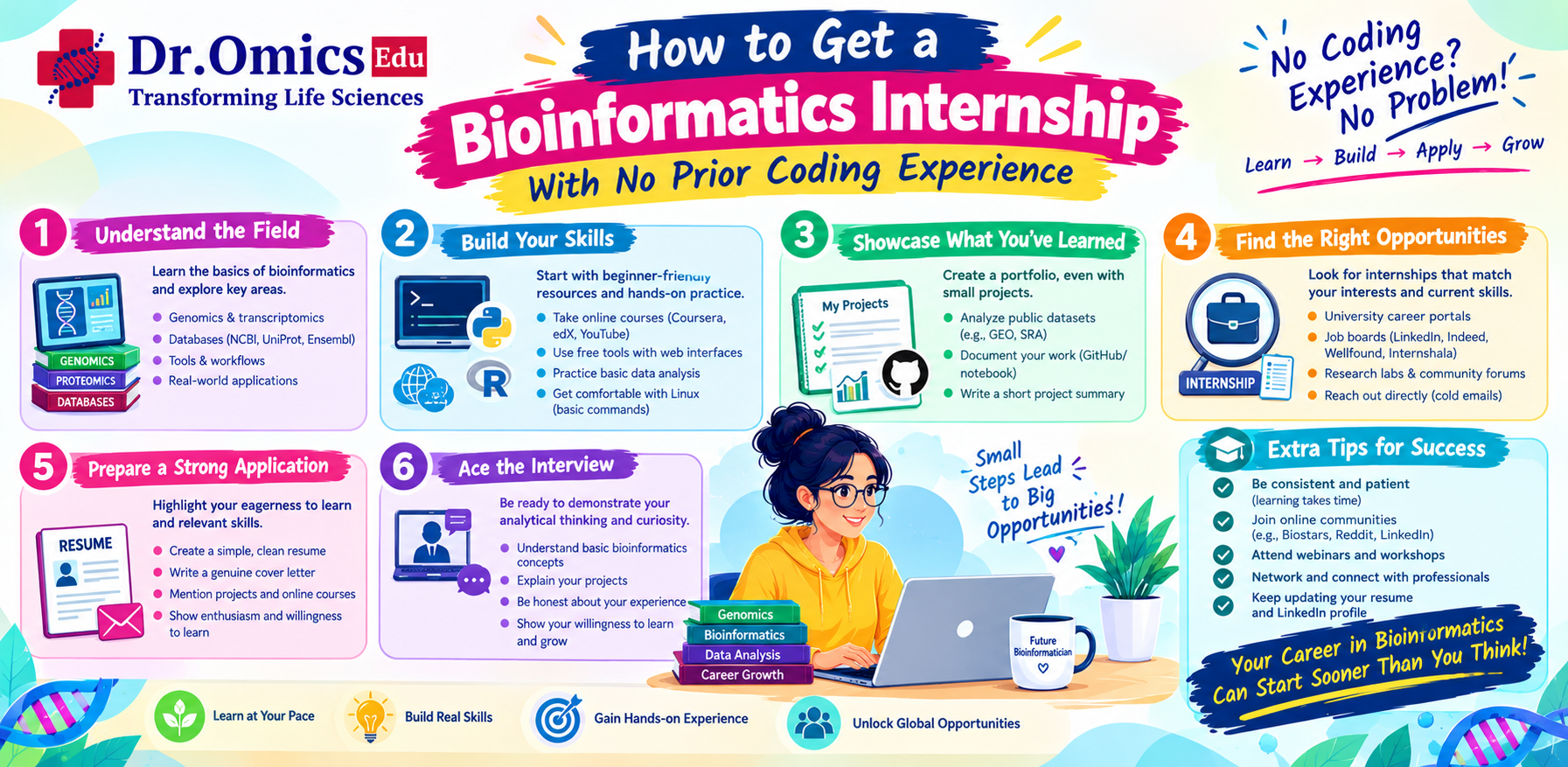
How to Get a Bioinformatics Internship With No Prior Coding Experience
Dr. Omics Edu Team ·
Introduction
Bioinformatics is an interdisciplinary field that combines biology, computer science, statistics, and data analysis to solve biological problems. It plays an important role in genomics, drug discovery, disease research, biotechnology, agriculture, and personalized medicine. As biological research generates increasingly large datasets, organizations need professionals who can process, analyse, and interpret biological information using computational methods.
For students from biotechnology, microbiology, genetics, biochemistry, zoology, and other life science backgrounds, bioinformatics offers an opportunity to expand their career options. However, many students hesitate to enter this field because they have little or no programming experience. They may assume that learning Python, R, or Linux is a prerequisite for applying to any internship.
The good news is that how to get a bioinformatics internship with no prior coding experience is a question that can be addressed with a structured learning plan. You do not need to master every programming language before getting started. Instead, focus on understanding biological concepts, learning basic computational skills, practising with beginner-friendly tools, and completing small projects that demonstrate your interest and ability to learn.
A bioinformatics internship can provide practical exposure to biological datasets, analytical workflows, scientific documentation, and research collaboration. This guide explains how beginners can prepare for an internship, which skills to learn first, how to build a project portfolio, and how to apply confidently even without a coding background.
1. Understand What Bioinformatics Interns Actually Do
Before learning programming, it is useful to understand the work performed by bioinformatics interns. Not every internship involves advanced coding or algorithm development. Responsibilities vary according to the organization, research project, and internship level.
Common internship activities include:
- Searching biological databases for gene, protein, or nucleotide information.
- Performing sequence similarity searches using BLAST.
- Learning basic Linux commands to manage biological data files.
- Conducting quality control and preliminary analysis of sequencing data.
- Exploring gene expression datasets and interpreting statistical results.
- Supporting DNA sequencing, RNA sequencing, or metagenomics workflows.
- Preparing figures, documenting methods, and writing research summaries.
Some internships focus primarily on computational research, while others combine laboratory work with biological data analysis. Beginners should look for positions that provide supervision, structured training, and tasks appropriate to their current skills.
Understanding these responsibilities helps you identify the knowledge you need before applying. It also makes the learning process less intimidating because you can start with small, manageable tasks rather than attempting to learn the entire field at once.
2. Learn the Basics of Bioinformatics Before Coding
If you have a life sciences background, your existing biological knowledge is an important advantage. Programming is a tool for answering biological questions, not a replacement for understanding biology.
Begin by revising the concepts most commonly encountered in bioinformatics projects.
DNA and RNA: Understand nucleotide sequences, complementary base pairing, transcription, and the differences between DNA and RNA.
Genes and proteins: Learn about gene structure, coding sequences, protein translation, mutations, and gene expression.
Genomes and biological databases: Understand reference genomes, gene annotations, accession numbers, and how biological records are organized.
Sequence analysis: Learn what sequence alignment, sequence similarity, and homology mean, along with the purpose of tools such as BLAST.
Genomics and transcriptomics: Become familiar with DNA sequencing, RNA sequencing, gene expression, and the general steps involved in analysing sequencing data.
You do not need to become an expert in every topic before applying. A clear understanding of the fundamentals will help you learn computational tools more effectively and explain your work during interviews.
3. Start With Beginner-Friendly Computational Skills
One of the most effective approaches is to learn computational skills in a logical order. Instead of attempting advanced programming immediately, begin with tools that help you understand how biological data is handled.
Learn Linux Command-Line Basics
Linux is widely used in bioinformatics because many analytical tools operate through the command line. Learning a few essential commands can help you manage files and inspect biological sequences without writing a program.
Start with commands such as:
- pwd — displays the current working directory.
- ls — lists files and directories.
- cd — changes the current directory.
- mkdir — creates a directory.
- cp — copies files.
- mv — moves or renames files.
- cat — displays file contents.
- head — displays the first lines of a file.
- grep — searches text for matching patterns.
- wc — counts lines, words, or characters.
For example, suppose you have a FASTA file containing DNA sequences. You can use the following command to display its first few lines:
head -n 10 sequences.fasta
Here, head displays the beginning of a file, -n 10 specifies ten lines, and sequences.fasta is the input file.
This is a simple way to inspect biological data before moving to more advanced analysis.
Learn Basic Python or R
Once you are comfortable handling files, choose one programming language to learn first.
Python is useful for file processing, automation, sequence analysis, and developing bioinformatics pipelines. R is particularly useful for statistical analysis, gene expression studies, and biological data visualization.
Beginners can start with variables, data types, lists or vectors, conditional statements, functions, and reading files. The goal is to understand basic programming logic and apply it to biological problems.
For example, the following Python script counts the number of nucleotide characters in a simple DNA sequence:
sequence = "ATGCGATACGTA"
print("Sequence length:", len(sequence))
print("A count:", sequence.count("A"))
print("T count:", sequence.count("T"))
print("G count:", sequence.count("G"))
print("C count:", sequence.count("C"))
This example introduces variables, strings, built-in functions, and output. Later, you can extend the script to process multiple sequences from a FASTA file.
You do not need to learn Python and R simultaneously. Start with one language, understand its fundamentals, and then expand your skills according to the internship requirements.
4. Learn Essential Bioinformatics Tools
After developing a basic understanding of biological data and computational concepts, begin exploring tools used in real research projects.
BLAST for Sequence Similarity Searching
BLAST is a widely used tool for comparing a nucleotide or protein sequence against sequences in a database. It can help identify similar sequences and investigate the possible identity or function of a biological sequence.
A beginner can start with the online BLAST interface before learning to run BLAST from the command line.
NCBI and Ensembl Databases
NCBI and Ensembl provide access to biological sequences, gene annotations, genomic information, and other research resources.
Practise searching for a gene, retrieving its sequence, identifying its accession number, and exploring its genomic annotation. These activities build familiarity with biological data resources commonly used in research.
FastQC for Sequencing Quality Control
FastQC helps assess the quality of high-throughput sequencing data. It generates reports describing characteristics such as sequence quality, GC content, and adapter-related issues.
You can begin by learning how to interpret a FastQC report and understanding why quality assessment is important before downstream analysis.
IGV for Genomic Data Visualization
The Integrative Genomics Viewer (IGV) allows researchers to explore genomic data, including aligned sequencing reads and variant information, in a visual interface.
Learning to navigate a genome browser can help beginners understand how sequencing data relates to genomic regions.
You do not need to master all these tools at once. Select tools relevant to your chosen internship area and focus on understanding their purpose, inputs, outputs, and limitations.
5. Build a Small Bioinformatics Project
A practical project is one of the strongest ways to demonstrate your readiness for an internship. You do not need to develop a complex pipeline or discover a new biological mechanism. A small, well-documented project can show that you understand the scientific question, follow a workflow, and interpret results carefully.
Here are three beginner-friendly project ideas.
Project 1: DNA Sequence Analysis
Use a small set of DNA sequences in FASTA format.
Your objectives can include:
- Reading and inspecting the FASTA file.
- Calculating sequence lengths and nucleotide counts.
- Calculating GC content.
- Identifying invalid or unexpected sequence characters.
- Presenting the results in a simple report.
This project is suitable for practising basic Python or R and understanding biological file formats.
Project 2: Gene Information and Sequence Retrieval
Select a well-studied gene and retrieve its sequence and annotation from a public biological database.
Your objectives can include:
- Identifying the gene and its accession number.
- Retrieving the relevant sequence.
- Exploring its biological function and annotation.
- Performing a sequence similarity search where appropriate.
- Summarizing the findings with links to the source records.
This project introduces biological databases, sequence analysis, and scientific reporting.
Project 3: Beginner-Level Gene Expression Analysis
Use a suitable public gene expression dataset to explore differences between experimental conditions.
Your objectives can include:
- Understanding the experimental design.
- Inspecting the expression matrix and sample metadata.
- Learning basic data visualization.
- Exploring differential expression analysis with an appropriate method.
- Interpreting adjusted p-values and fold changes.
For a first project, follow a documented tutorial or use a dataset with clear metadata. Make sure you understand the analysis rather than copying commands without knowing what they do.
For all projects, document the objective, dataset source, software, workflow, results, and limitations. This documentation demonstrates scientific thinking and makes it easier to discuss your work during an interview.
6. Prepare a Resume Without Prior Coding Experience
A lack of programming experience does not mean you have nothing valuable to include in your resume. The key is to present your existing strengths honestly and show evidence of your progress.
Your resume can include the following sections.
Educational background: List your degree, relevant coursework, and subjects such as genetics, molecular biology, microbiology, statistics, or computational biology.
Technical skills: Mention the tools you have actually used, even if you are a beginner. For example, basic Linux commands, introductory Python, BLAST, or biological database searches.
Academic and personal projects: Include any sequence analysis, database exploration, or beginner-level bioinformatics project you have completed. Briefly explain the objective, methods, and outcome.
Certifications and training: Include relevant courses and workshops, distinguishing completed certifications from ongoing learning.
Research and laboratory experience: Highlight relevant laboratory techniques, data handling, literature review, scientific writing, and teamwork.
Avoid listing advanced tools simply because they appear in job advertisements. Interviewers may ask you to explain how you used them. It is better to demonstrate basic competence honestly than to claim expertise you have not developed.
7. Where and How to Apply for Bioinformatics Internships
Once you have built foundational knowledge and completed a small project, begin looking for internships that match your skills.
Potential opportunities include:
- University laboratories and academic research groups.
- Biotechnology and pharmaceutical companies.
- Genomics and sequencing service providers.
- Bioinformatics training and research organizations.
- Research institutes working in genetics, microbiology, or computational biology.
- Projects involving public biological datasets and supervised computational analysis.
Search for titles such as Bioinformatics Intern, Genomics Intern, NGS Intern, Computational Biology Intern, Research Intern, and Junior Bioinformatics Trainee.
Use official organization career pages, university websites, professional networking platforms, and reputable internship portals. Review each position's eligibility criteria, expected skills, supervision arrangements, duration, and whether it is paid or unpaid.
You can also contact researchers whose work aligns with your interests. Keep your message concise and explain your educational background, the area you want to learn, and the small project or training you have completed.
For internships involving access to sensitive biological or clinical data, follow the organization's data protection and confidentiality requirements. Never share restricted datasets in a public portfolio.
8. How to Write an Internship Application Email
A clear and professional application email can help introduce your profile to a potential supervisor or employer.
Your email should briefly explain who you are, why you are interested in the opportunity, what skills you have begun developing, and how the internship aligns with your learning goals.
Example application email:
Subject: Application for Bioinformatics Internship
Dear Hiring Manager,
I am interested in applying for a bioinformatics internship at your organization. I have a background in life sciences and am currently developing my skills in biological data analysis, Linux, and introductory programming.
I am particularly interested in learning how computational tools are used to analyse genomic and other biological datasets. I have started practising sequence analysis and exploring biological databases, and I am eager to gain practical experience under the guidance of an experienced research or bioinformatics team.
I have attached my resume for your consideration. I would appreciate the opportunity to discuss any suitable internship openings.
Thank you for your time and consideration.
Kind regards,
[Your Name]
Personalize this email for each organization. Mention a relevant research project or area of expertise when possible, and attach a resume that accurately reflects your current skills.
9. Prepare for Common Bioinformatics Internship Interview Questions
You may be asked questions about biology, basic computational concepts, your learning process, and any projects you have completed.
Prepare to answer questions such as:
- What is bioinformatics, and how is it used in biological research?
- What is a FASTA file?
- What is the purpose of BLAST?
- Why is Linux useful in bioinformatics?
- What is the difference between DNA sequencing and RNA sequencing?
- What is sequence alignment?
- What does GC content tell us about a DNA sequence?
- Why is quality control important in sequencing analysis?
- Describe a bioinformatics project you have completed.
- Which computational skills are you currently learning, and how are you practising them?
If you do not know the answer to a question, explain what you understand and how you would approach learning or solving the problem. Employers offering beginner internships may value curiosity, reliability, careful reasoning, and willingness to learn.
10. A Practical 30-Day Learning Plan for Beginners
A short, structured plan can help you begin preparing without becoming overwhelmed. The following schedule assumes that you can spend approximately one to two hours per day. You can extend it if you need more time.
Week 1: Biological and computational fundamentals
Revise DNA, RNA, genes, proteins, genomes, and sequence alignment. Learn basic Linux commands and practise inspecting text files and FASTA sequences.
Week 2: Introductory programming
Choose Python or R. Practise variables, data structures, simple functions, reading files, and basic calculations using biological sequences.
Week 3: Bioinformatics tools and project work
Explore BLAST and biological databases. Complete a small sequence analysis project or another beginner-level project relevant to your preferred specialization.
Week 4: Portfolio and internship applications
Document your project, prepare your resume, write a professional application email, and identify suitable internship opportunities. Practise explaining your work and revise the concepts most relevant to the roles you plan to apply for.
At the end of 30 days, your objective is not to become an expert. It is to establish a foundation, demonstrate consistent learning, and identify the next skills you need to develop. Internship readiness will vary depending on your starting point and the requirements of individual opportunities.
Conclusion
Getting a bioinformatics internship without prior coding experience is achievable when you approach the process step by step. You do not need to master advanced programming or every bioinformatics tool before beginning. Instead, build on your biological knowledge, learn basic computational skills, practise with beginner-friendly tools, and complete small projects that demonstrate your ability to learn and solve problems.
Start with Linux and the fundamentals of Python or R, explore biological databases, and understand tools such as BLAST and FastQC. As your confidence grows, move toward a focused project in genomics, transcriptomics, or metagenomics. Document your work clearly and use it to demonstrate your interest and practical understanding when applying for internships.
Remember that a certification is a starting point rather than a guarantee of employment. Employers may consider your educational background, technical skills, project experience, communication, and ability to follow scientific workflows. A thoughtful resume, targeted applications, and consistent practice can help you compete for suitable opportunities.
Ultimately, the answer to how to get a bioinformatics internship with no prior coding experience is to start small, practise consistently, and demonstrate progress. With patience, curiosity, and a willingness to learn, you can begin building the computational and biological skills needed to move toward a career in bioinformatics.
