About this internship
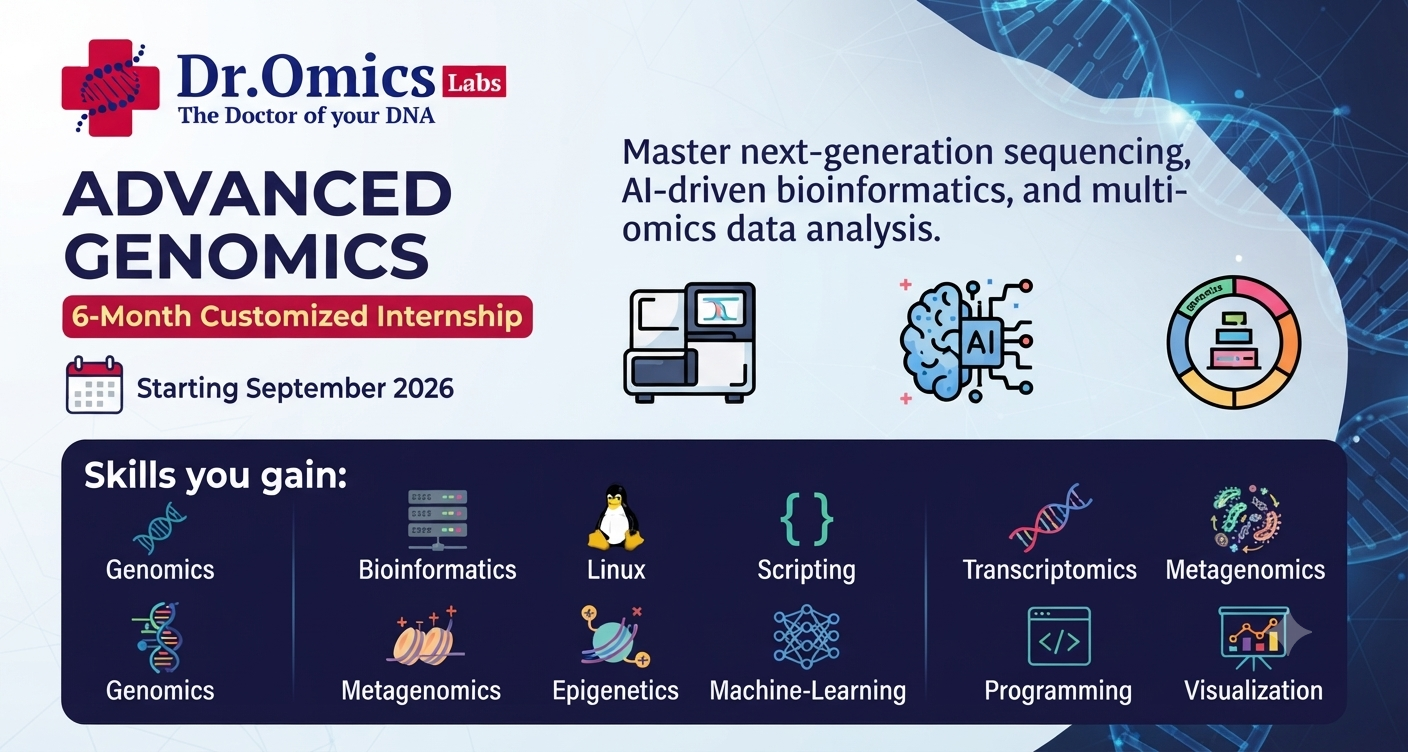
The Advanced Genomics 6-Month Customized Internship is a premier live online training program designed for life science professionals and students. Priced at an accessible fee of 37170 INR, this comprehensive curriculum bridges the gap between wet-lab biology and computational genomics. Participants will master cutting-edge artificial intelligence (AI) and machine learning (ML) models tailored specifically for genomic big data analytics. The program features intensive hands-on modules covering Linux administration, Bash scripting, and high-throughput sequencing pipelines. Dive deep into DNA-Seq variant calling, reference-guided RNA-Seq, targeted microbiome profiling, ChIP-Seq, and ATAC-Seq workflows. Leverage industry-standard tools like GATK, QIIME2, MACS2, and custom Python/ML frameworks to interpret complex biological datasets. Guided by expert mentors, you will execute real-world bioinformatics projects that simulate industry-grade research challenges. Enroll in the September 2026 cohort to future-proof your career with advanced computational biology and generative AI applications in healthcare.
What you will achieve
Building automated bioinformatics pipelines for next-generation sequencing (NGS) data analysis.
Executing variant calling and identifying disease-associated genetic mutations using GATK.
Performing differential gene expression, data normalization, and pathway enrichment analysis.
Processing targeted microbiome profiling data using QIIME2, DADA2, and Krona plots.
Analyzing epigenetic modifications and chromatin accessibility through ChIP-Seq and ATAC-Seq datasets.
Implementing machine learning models for predictive genomics, pattern recognition, and biomarker discovery.
Skills you will gain
Genomics
Bioinformatics
Linux
Scripting
Transcriptomics
Metagenomics
Epigenetics
Machine-Learning
Programming
Visualization.
Certification
Available
Issued by Dr. Omics Edu
Internship curriculum
1 module
-
Linux for Beginners: A Practical Guide
-
Introduction to Linux: Overview and Installation
-
Essential Linux Commands for Beginners
-
Advanced Linux Command-Line Techniques
-
Managing Packages in Linux
-
Bash Scripting, AWK and SED
-
Variant Calling Pipeline: A DNA-Seq Approach
-
Introduction to NGS and DNAseq
-
Basic Terminologies in NGS
-
Understanding of SRA database
-
Installing Tools in Linux for Variant Calling
-
Quality Control of Reads
-
Trimming and Filtering Reads
-
Genome Indexing and Read Alignment
-
Variation calling using GATK
-
Predicting Variant Effects
-
Variation Visualization (IGV)
-
Reference-Guided RNA-Seq: A Complete Analysis Workflow
-
Introduction to RNA-seq and Key Terminologies
-
Setting Up Tools in Linux for Gene Expression Analysis
-
Quality Control and Read Trimming
-
Genome Indexing and Read Alignment
-
Data Normalization Using Cufflinks
-
Merging Data and Identifying Differentially Expressed Genes
-
Interpretation of DEG Results
-
Annotation of Differentially Expressed Genes
-
Functional and Pathway Enrichment Analysis
-
Network Analysis of Gene Interactions
-
Targeted Microbiome Profiling: A Metagenomic Approach
-
Introduction to Metagenomics Analysis
-
Setting Up Tools for Metagenomics
-
Data Downloading and Preprocessing
-
Quality Control and Read Trimming
-
Importing Data into QIIME2
-
Quality Assessment Using DADA2
-
Phylogenetic Diversity Analysis of Microbial Communities
-
Taxonomic Classification of Sequences
-
Visualization with Krona Plot
-
Phylogenetic tree construction using MEGA
-
CHIP-Seq Analysis
-
Introduction to ChIP-Seq and Experimental Design
-
Introduction to NGS Terminologies
-
Public Data Access and Raw Data Download (GEO/SRA)
-
Quality Control and Read Trimming
-
Read Mapping to the Reference Genome
-
Peak Calling with MACS2
-
Peak Annotation using ChIPseeker
-
Motif Analysis of ChIP-Seq Peaks
-
Visualization of ChIP-Seq Data
-
Differential Binding and Functional Enrichment
-
ATAC-Seq Analysis
-
Introduction to ChIP-Seq and Experimental Design
-
Introduction to NGS Terminologies
-
Public Data Access and Raw Data Download (GEO/SRA)
-
Quality Control and Read Trimming
-
Read Mapping to the Reference Genome
-
Post-alignment Processing: Sorting, Indexing, and Filtering
-
Peak Calling with MACS2
-
Peak Annotation using ChIPseeker
-
Visualization: BigWig Tracks and Heatmaps
-
Differential Accessibility and Functional Enrichment
-
Introduction to Machine Learning in Bioinformatics
-
Fundamentals of Machine Learning for Genomic Data
-
Linear Models and Nearest Neighbors for Pattern Recognition
-
Probabilistic Machine Learning Concepts and Applications
-
Support Vector Machines SVM Theory and Implementation
-
Naïve Bayes Classifier Fundamentals and Bioinformatics Use Cases
-
Decision Trees and Random Forest Interpretable ML Models
-
Logistic Regression for Predictive Analysis in Bioinformatics
-
Clustering Algorithms for Unsupervised Learning
-
Validation Techniques for Machine Learning Models
-
Machine Learning for Biomedical Image Analysis
What you need to start
-
Basic understanding of molecular biology, genetics, and life sciences.
-
-
No prior programming experience required; beginner-friendly Linux training is included from scratch.
-
-
A computer with stable internet access for live interactive sessions and cloud/local tool setup.
Who this internship is for
-
Life science, biotechnology, and microbiology undergraduate or postgraduate students.
-
-
Bioinformatics researchers looking to upgrade their skills with modern AI/ML frameworks.
-
-
Ph.D. scholars seeking hands-on expertise in high-throughput sequencing data analysis.
-
-
Industry professionals transitioning into computational biology and genomics roles.