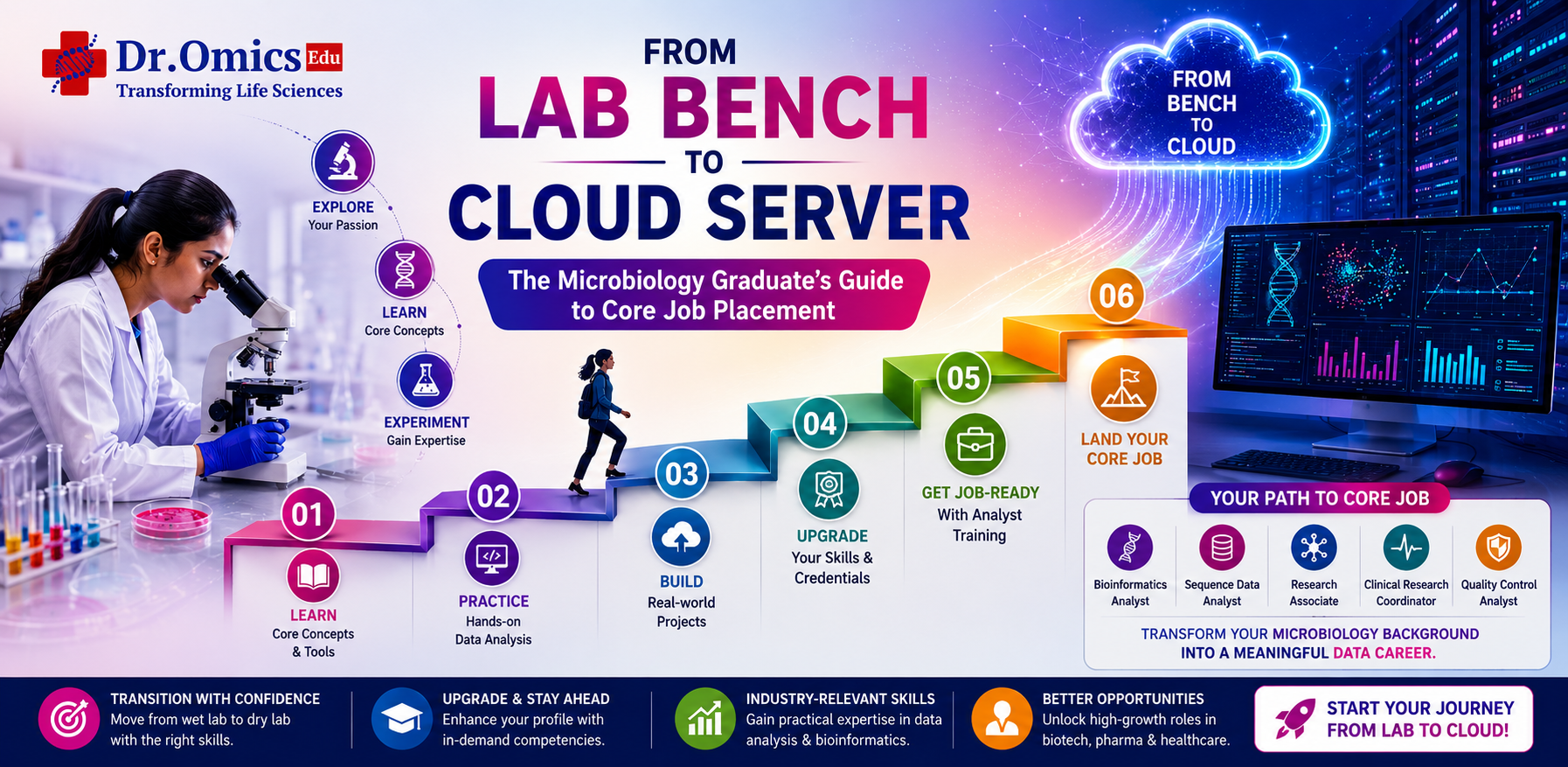
From Laboratory Bench to Cloud Server: The Microbiology Graduate's Guide to Core Job Placement
Dr. Omics Edu Team · · Updated
Meta Title: From Laboratory Bench to Cloud Server | Bioinformatics Career Guide for Microbiology Graduates
Meta Description: Discover career options for microbiology freshers and learn how transitioning from wet lab to dry lab through bioinformatics training can unlock exciting career opportunities in genomics and computational biology.
From Laboratory Bench to Cloud Server: The Microbiology Graduate's Guide to Core Job Placement
The life sciences industry is undergoing a digital revolution. While traditional microbiology skills remain invaluable, today's research and healthcare sectors increasingly rely on computational tools to analyze vast amounts of biological data. As a result, microbiology graduates are discovering exciting opportunities beyond the laboratory bench—moving into bioinformatics, genomics, and computational medicine.
If you've ever wondered whether your laboratory experience can lead to a career in data-driven biology, the answer is a resounding yes. With the right training and practical exposure, transitioning from wet lab to dry lab has become one of the smartest career moves for aspiring life science professionals.
Why the Shift from Wet Lab to Dry Lab?
Modern technologies such as Next-Generation Sequencing (NGS), metagenomics, transcriptomics, and precision medicine generate enormous biological datasets that require computational analysis. This has created a growing demand for professionals who understand both biology and data analysis.
For microbiology graduates, laboratory knowledge provides a strong biological foundation, while bioinformatics training adds the computational skills needed to interpret complex datasets. This combination is highly valued by employers across biotechnology, pharmaceutical, healthcare, and research organizations.
Who Should Attend Bioinformatics Courses?
One of the most common questions students ask is "Who should attend bioinformatics courses?"
These programs are ideal for:
- Microbiology graduates and postgraduates
- Biotechnology and Life Science students
- Biochemistry and Genetics graduates
- Research scholars and PhD aspirants
- Laboratory professionals looking to upgrade their careers
- Anyone interested in computational biology and genomics
Even students with little or no programming background can successfully learn bioinformatics through structured, hands-on training.
Career Options for Microbiology Freshers
The demand for skilled bioinformatics professionals continues to grow globally. Some promising career options for microbiology freshers include:
- Bioinformatics Analyst
- Genomic Data Analyst
- Sequence Data Analyst
- Clinical Research Coordinator
- Quality Control Analyst
- Research Associate
- Computational Biology Associate
- Scientific Data Analyst
These roles combine biological expertise with computational analysis and offer excellent career growth across academia, industry, and healthcare.
Do You Need a Computer Science Background?
A common misconception is that bioinformatics requires a computer science degree. In reality, many successful professionals have transitioned from life science backgrounds.
If you're pivoting to computational medicine without a CS degree, focus on building practical skills in Linux, Python, biological databases, and genomic data analysis. Most industry-focused training programs teach these concepts from the basics, making the transition smooth for biology graduates.
Building Job-Ready Skills
Employers today prioritize practical expertise over theoretical knowledge. Enrolling in job-ready analyst training helps students gain hands-on experience with real-world datasets and industry-standard tools.
Alongside genomic analysis, learners should also develop prerequisite competencies for structural bioinformatics, including sequence alignment, protein structure analysis, molecular visualization, and biological database navigation. These skills expand career opportunities in drug discovery, molecular modeling, and computational biology.
For professionals already working in laboratories, bioinformatics is an excellent way of upgrading traditional lab credentials. Instead of replacing laboratory expertise, computational skills complement existing knowledge and create a stronger, future-ready professional profile.
Your Journey Starts Today
The future of microbiology lies at the intersection of biology and data science. Whether you're a recent graduate, a laboratory professional, or someone looking to explore computational biology, developing bioinformatics skills can significantly expand your career opportunities.
By learning modern analytical tools, working on real-world projects, and gaining practical experience, you can confidently move from laboratory bench to cloud server and build a rewarding career in genomics, precision medicine, and computational biology.
The next generation of life science professionals won't just work in laboratories—they'll also analyze biological data, develop computational workflows, and contribute to innovations that shape the future of healthcare. Now is the perfect time to begin that journey.
