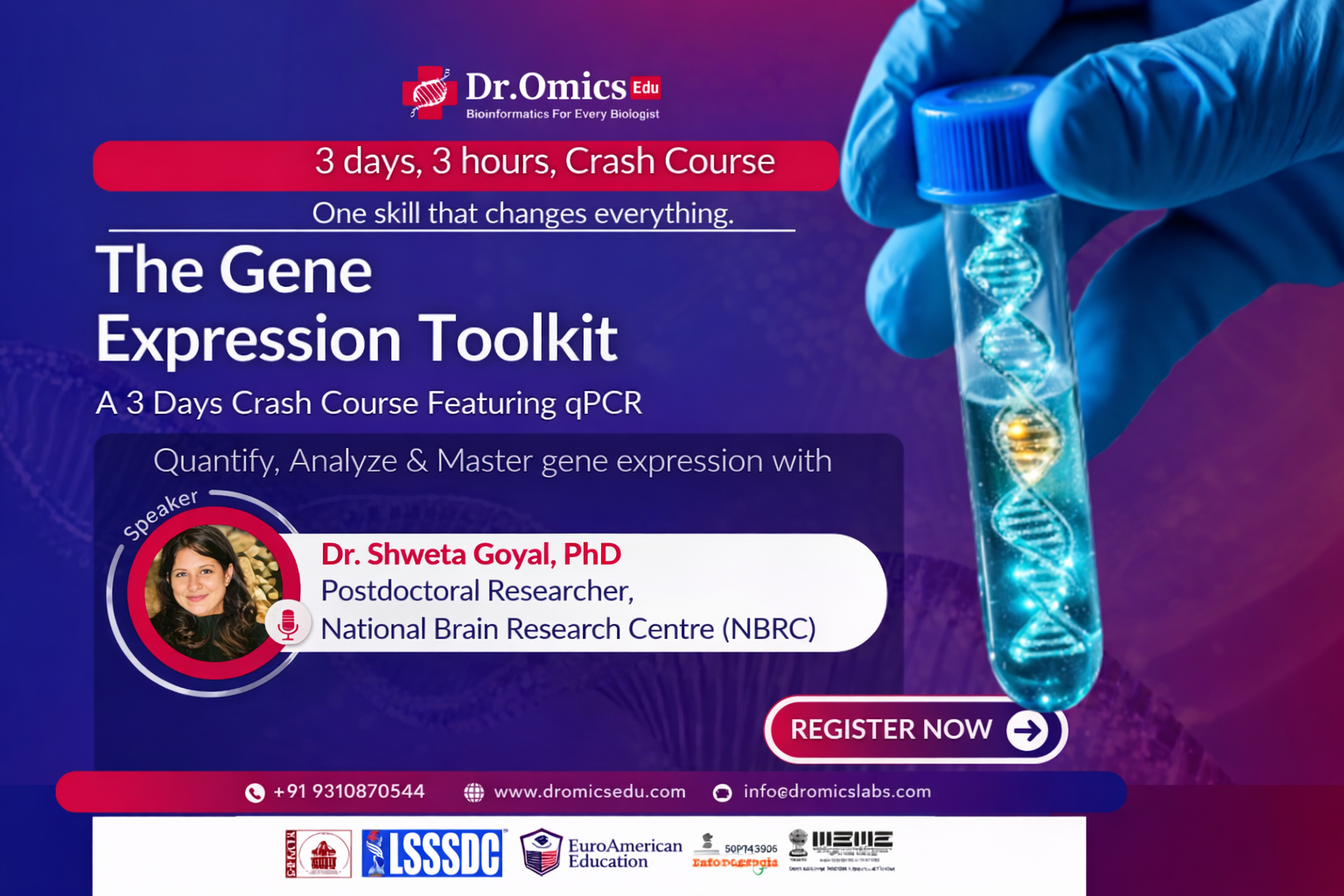
The Gene Expression Toolkit A 3 Days Crash Course Featuring qPCR
Quantify, analyze, and master cellular mechanics using precision gene expression analysis. Bridge the gap between laboratory wet-bench validation and advanced AI-driven genomic discovery pipelines.
- 5.0/5
- English
- Updated Sep 2026
₹599
$10
Indian learners pay in INR; international learners are billed in USD.
Paying from outside India? Use this link to complete your payment.
About this course
Unlock the fundamental mechanics of molecular transcriptomics with the specialized masterclass detailed in "The Gene Expression Toolkit: A 3 Days Crash Course Featuring qPCR" is a hyper-focused, 3-hour learning experience tailored for life science researchers. Led by expert speaker Dr. Shweta Goyal, PhD, a Postdoctoral Researcher from the National Brain Research Centre (NBRC), this program focuses on the core principles of quantitative polymerase chain reaction data analytics. Participants will explore practical steps for calculating relative fold changes, assessing target primer efficiency, and designing robust assay controls. The course outlines how to evaluate nucleic acid variations crucial for molecular oncology, infectious disease diagnosis, and therapeutic screening. Furthermore, it introduces how machine learning algorithms and computational biology models are automating large-scale transcriptomic screening and melting curve quality control. Dr. Omics Edu provides this direct, step-by-step pipeline to transform messy laboratory amplification values into accurate, publication-ready figures. Elevate your quantitative genetics skillset to remain competitive in modern clinical, industrial, and academic biotechnology sectors.
What you will learn
Skills you will gain
Certification
Available
Issued by Dr. Omics EduCourse curriculum
1 moduleWhat you need to start
- A basic understanding of central dogma (DNA to RNA transcription) and routine PCR amplification concepts.
- No advanced math background is required; all relative quantification statistical equations will be introduced from scratch.
Who this course is for
- Molecular Biology Students (B.Sc., M.Sc., Ph.D.) wanting to add a mandatory molecular toolkit to their resumes.
- Clinical Laboratory Technicians looking to master precision diagnostics data interpretation methods.
- Bioinformatics Analysts who need a thorough understanding of wet-lab validation data for multi-omics validation.
- Life Science Researchers aiming to optimize their gene knockdown, knockout, or overexpression validation experiments.
