About this internship
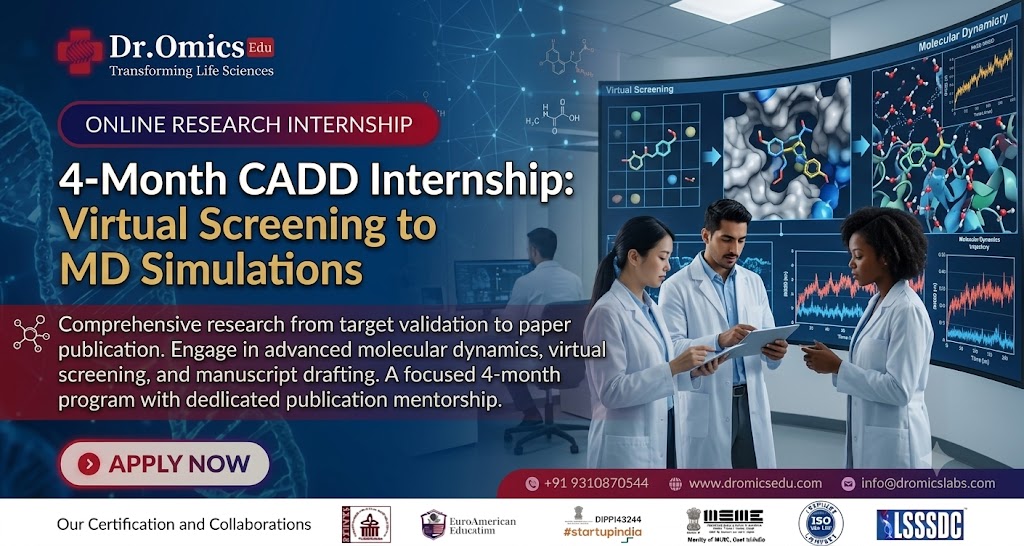
The 4 Month CADD Internship: Virtual Screening to MD Simulations at Dr. Omics Edu is a 4-month live, mentor-supervised internship in computer-aided drug design (CADD) under NEP 2020. It is an advanced pathway that carries a hit from virtual screening through to molecular dynamics validation. You work on a real dataset and a defined research question, and you finish with a docking or virtual screening project on a real drug target that you can show to an admissions panel, a guide or an employer.
In this internship you move through target and ligand preparation, structure-based virtual screening and molecular docking and pose analysis, then apply them in your own project. The programme runs live online with 7 modules, so you can ask your mentor questions as you work. It is an advanced-level internship, best suited to learners who already know the fundamentals.
What you will achieve
Target and ligand preparation
Structure-based virtual screening
Molecular docking and pose analysis
ADMET and drug-likeness filtering
Molecular dynamics simulation setup and analysis
Binding free energy and result interpretation
For careers: Computational chemist, CADD scientist, drug discovery research associate, cheminformatics analyst, and a stronger profile for pharma R&D roles or higher studies
The project work
Hands-on implementation of everything covered in the sessions
Industry-standard tools and workflows
Project documentation and a final presentation
Code review and optimisation sessions with your mentor
Skills you will gain
PDB
PubChem
AutoDock Vina
PyMOL
Discovery Studio Visualizer
SwissADME
GROMACS
Certification
Available
Issued by Dr. Omics Edu
Internship curriculum
7 modules
-
M1T1 = Introduction to Bioinformatics
-
M1T2 = NCBI Database Overview
-
M1T3 = Genbank Database Practical Exercises
-
M1T4 = UCSC Genome Browser Overview
-
M1T5 = UCSC Genome Browser Hands-on Exercises
-
M1T6 = Pubmed Database Introduction
-
M1T7 = Clinvar Database Overview
-
M1T8 = KEGG Database Overview and Exercises
-
M1T9 = Protein Databases (UniProt)
-
M1T10 = Protein Databases (PDB)
-
M1T11 = Online BLAST Introduction and Exercises
-
M1T12 = Standalone BLAST Setup and Exercises
-
M1T13 = Standalone BLAST Advanced Exercises
-
M1T14 = Multiple Sequence Alignment with ClustalW
-
M1T15 = Multiple Sequence Alignment with MEGA
-
M2T1 = Overview and Installation of Linux
-
M2T2 = Basic Linux Commands
-
M2T3 = Advanced Linux Commands
-
M2T4 = Package Management using Repository
-
M2T5 = Package Management using Source Code
-
M3T1 = Introduction to Python
-
M3T2= Data Types
-
M3T3= String Handling
-
M3T4= Data Structure
-
M3T5=Control Structure
-
M3T6 = Function
-
M3T7= File Handling
-
M3T8= Data Manipulation
-
M3T9= Data Visualization
-
M3T10= Biopython
-
M4T1 = Introduction and Installation of R
-
M4T2= Data Types in R
-
M4T3= Data Structure
-
M4T4= File Handling
-
M4T5=Control Structure
-
M4T6 = Function
-
M4T7= Package Management
-
M4T8= Data Manipulation
-
M4T9= Data Visualization
-
M4T10= Statistical Analysis
-
M6T1 =Introduction to Drug Discovery Process
-
M6T2=Role of Computational Methods
-
M6T3= Hands-on: Chemical Structure Visualization
-
M6T4= Biomolecules and Their Properties
-
M6T5= Structure of Proteins and Ligands
-
M6T6= Hands-on: Protein Structure Visualization
-
M7T7= Molecular Visualization Tools
-
M6T8= Molecular Mechanics and Dynamics Simulations
-
M6T9= Molecular Mechanics and Dynamics Simulations (continued)
-
M6T10= Chemical Databases and Data Mining
-
M6T11= Ligand and Structure-Based Virtual Screening
-
M6T12= Hands-on: Chemical Data Exploration
-
M6T13= Advanced Virtual Screening Techniques
-
M6T14= Virtual Screening using Autodock Vina
-
M6T15= Principles of Molecular Docking
-
M6T16= Scoring Functions in Docking
-
M6T17= Hands-on: Molecular Docking
-
M6T18= Introduction to Molecular Dynamics
-
M6T19= Simulation Software (e.g., GROMACS)
-
M6T20= Hands-on: Analyzing MD Data
-
M6T21= Chemoinformatics: Data Analysis and Visualization
-
M6T22= Protein-Ligand Interaction Analysis
-
M6T23= Hands-on Protein-Ligand Interaction Analysis
-
M6T24= Pharmacophore Modeling and Applications
-
M6T25= Chemoinformatics: Data Analysis and Visualization (continued)
-
M6T26= Structure-Based Drug Design
-
M6T27= Ligand-Based Drug Design
-
M6T28= Hands-on Structure-Based and Ligand-Based Drug Design
-
M6T29= ADMET in Drug Development
-
M6T30= Course Conclusion
-
M7T1= Basics of Machine Learning
-
M7T2= Supervised, Unsupervised, and Reinforcement Learning
-
M7T3= Hands-on: Learn the Basics with scikit-learn Library in Python
-
M7T4= Data Cleaning and Feature Selection
-
M7T5= Handling Molecular Data
-
M7T6= Hands-on: Use Pandas and NumPy for Data Preprocessing
-
M7T7= Regression and Classification Algorithms
-
M7T8= Deep Learning in Drug Discovery
-
M7T9= Hands-on: Implement Machine Learning Models using scikit-learn
-
M7T10= Hands-on: Implement Machine Learning Models using TensorFlow/Keras
-
M7T11= Predicting Drug-Target Interactions
-
M7T12= QSAR Modeling
-
M7T13= Hands-on: Apply Machine Learning to Real Datasets with RDKit
-
M7T14= Hands-on: Apply Machine Learning to Real Datasets with Cheminformatics
-
M7T15= Structure-Activity Relationship (SAR) Analysis
-
M7T16= Hands-on: Use RDKit for SAR Analysis
-
M7T17= De Novo Drug Design using ML
-
M7T18= Explore De Novo Design Tools
-
M7T19= Advanced Machine Learning Techniques in Drug Design
-
M7T20= Integration of Omics Data in Drug Discovery
-
M7T21= Clinical Trial Design and Data Analysis
-
M7T22= Ethical Considerations in Drug Design and Machine Learning
-
M7T23= Real-World Applications
-
M7T24= Q&A and discussion
-
M7T25= Conclusion
What you need to start
-
Basic understanding of biology or life sciences
-
Fundamental knowledge of biochemistry is beneficial
-
Interest in computational biology and drug discovery
-
Basic computer skills
-
No prior CADD experience required
-
Programming knowledge is optional but helpful
Who this internship is for
-
B.Pharm, M.Pharm, B.Sc, M.Sc, B.Tech, M.Tech and PhD students in pharmacy, chemistry, biotechnology, biochemistry or life sciences.