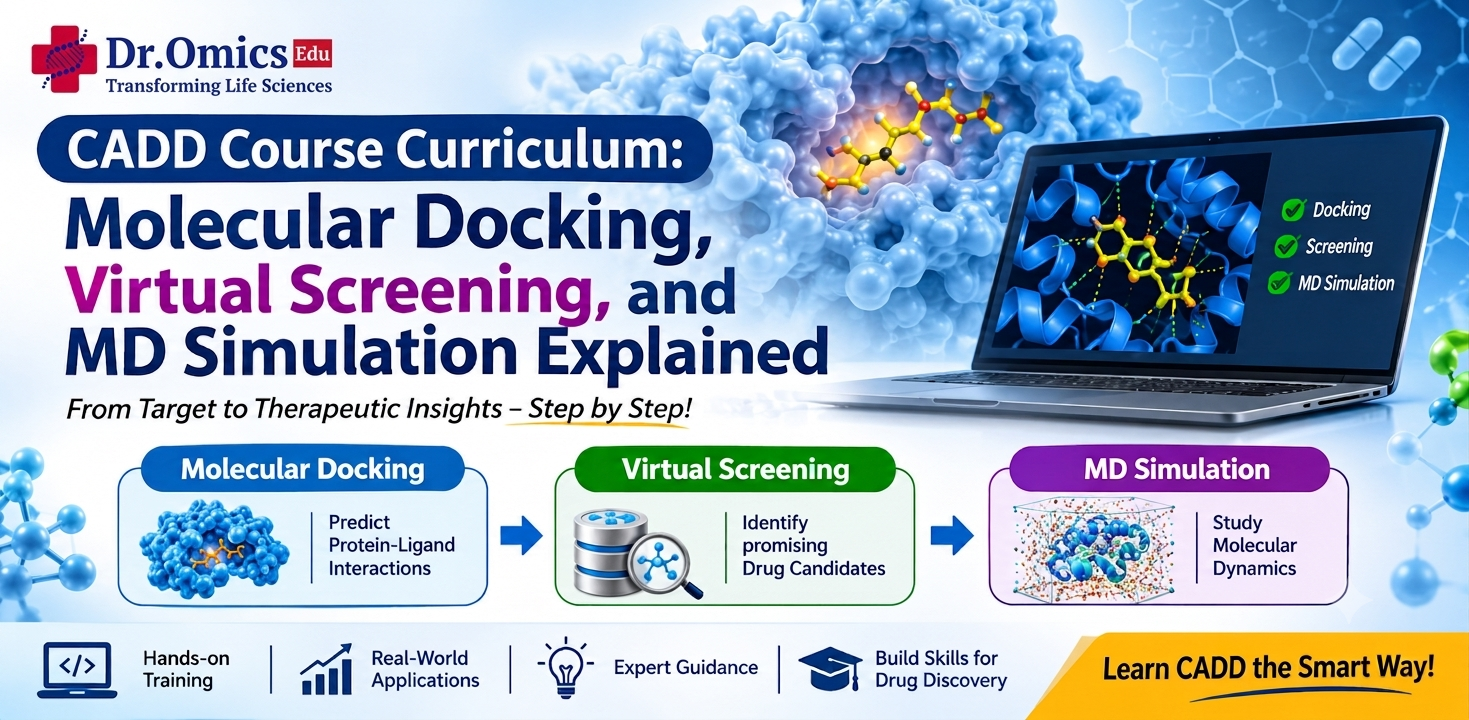
CADD Course Curriculum: Molecular Docking, Virtual Screening, and MD Simulation Explained
Priyanka Bhore ·
Introduction
Computer-Aided Drug Design (CADD) has become an essential part of modern drug discovery, helping researchers identify potential drug candidates more efficiently and cost-effectively. Traditional drug discovery involves extensive laboratory experiments, which can be time-consuming and expensive. CADD addresses these challenges by using computational methods to study molecular interactions, identify promising compounds, and predict their biological activity.
A well-structured CADD course curriculum introduces learners to important concepts such as molecular docking, virtual screening, molecular dynamics (MD) simulation, and drug-likeness evaluation. These techniques help researchers understand how small molecules interact with biological targets and support the early stages of drug development.
1. Molecular Docking: Understanding Drug–Target Interactions
Molecular docking is a computational technique used to predict how a small molecule (ligand) interacts with a biological target, usually a protein. It estimates the preferred binding orientation of a ligand within the active site of a protein and evaluates the interaction using scoring functions.
A practical molecular docking tutorial generally covers:
- Protein structure retrieval from the Protein Data Bank (PDB).
- Protein preparation, including removal of unwanted molecules and addition of hydrogen atoms.
- Ligand preparation and energy minimization.
- Identification of protein binding sites.
- Docking execution and binding affinity analysis.
- Visualization of protein–ligand interactions.
Tools such as AutoDock Vina, PyRx, and UCSF Chimera are commonly used for these activities.
An AutoDock Vina tutorial helps learners understand docking parameters, grid box selection, binding affinity scores, and interaction analysis. These skills are useful for investigating potential drug candidates against disease-associated proteins.
2. Virtual Screening: Identifying Potential Drug Candidates
Virtual screening is a computational approach used to evaluate large chemical libraries and identify compounds that may interact with a specific biological target.
In virtual screening drug design, thousands or even millions of compounds can be computationally evaluated to prioritize promising molecules for further investigation.
A typical virtual screening workflow includes:
- Selection of a suitable biological target.
- Collection of compound libraries from databases such as PubChem and ZINC.
- Ligand preparation and filtering.
- Molecular docking of selected compounds.
- Ranking compounds based on docking scores and interactions.
- ADMET and drug-likeness evaluation.
Virtual screening reduces the number of compounds requiring experimental testing and helps researchers prioritize molecules for further studies. However, docking scores alone cannot establish whether a compound will work as a drug.
3. Molecular Dynamics Simulation: Studying Molecular Stability
Molecular docking provides a predicted binding pose, but it does not fully explain how a protein–ligand complex behaves over time. Molecular dynamics (MD) simulation addresses this limitation by studying the movement of atoms and molecules under defined physical conditions.
An MD simulation course introduces learners to the principles of molecular motion, force fields, energy calculations, and simulation analysis.
GROMACS is one of the widely used open-source software packages for molecular dynamics simulations.
A practical GROMACS course may cover:
- Preparation of protein–ligand complexes.
- Selection of force fields.
- Solvation and system neutralization.
- Energy minimization.
- Equilibration using NVT and NPT ensembles.
- Production molecular dynamics simulation.
- Trajectory analysis using RMSD, RMSF, radius of gyration (Rg), and hydrogen bond analysis.
These parameters help researchers investigate structural stability, flexibility, and molecular interactions throughout the simulation period.
4. Why Learn CADD Tools and Workflows?
Practical CADD tools training provides learners with hands-on experience in computational drug discovery. Instead of learning individual software packages independently, students understand how different techniques contribute to a complete drug discovery workflow.
A comprehensive curriculum may combine molecular docking, virtual screening, ADMET prediction, pharmacophore modelling, QSAR analysis, and molecular dynamics simulation.
Conclusion
CADD integrates computational biology, structural bioinformatics, and pharmaceutical research to support modern drug discovery. Molecular docking predicts potential binding interactions, virtual screening prioritizes promising compounds, and MD simulation evaluates the dynamic behaviour of protein–ligand complexes.
Learning these techniques through practical training equips students and researchers with valuable skills for academic research, pharmaceutical development, and computational drug discovery projects. A structured CADD curriculum provides the foundation to move from understanding molecular interactions to conducting independent computational research.
