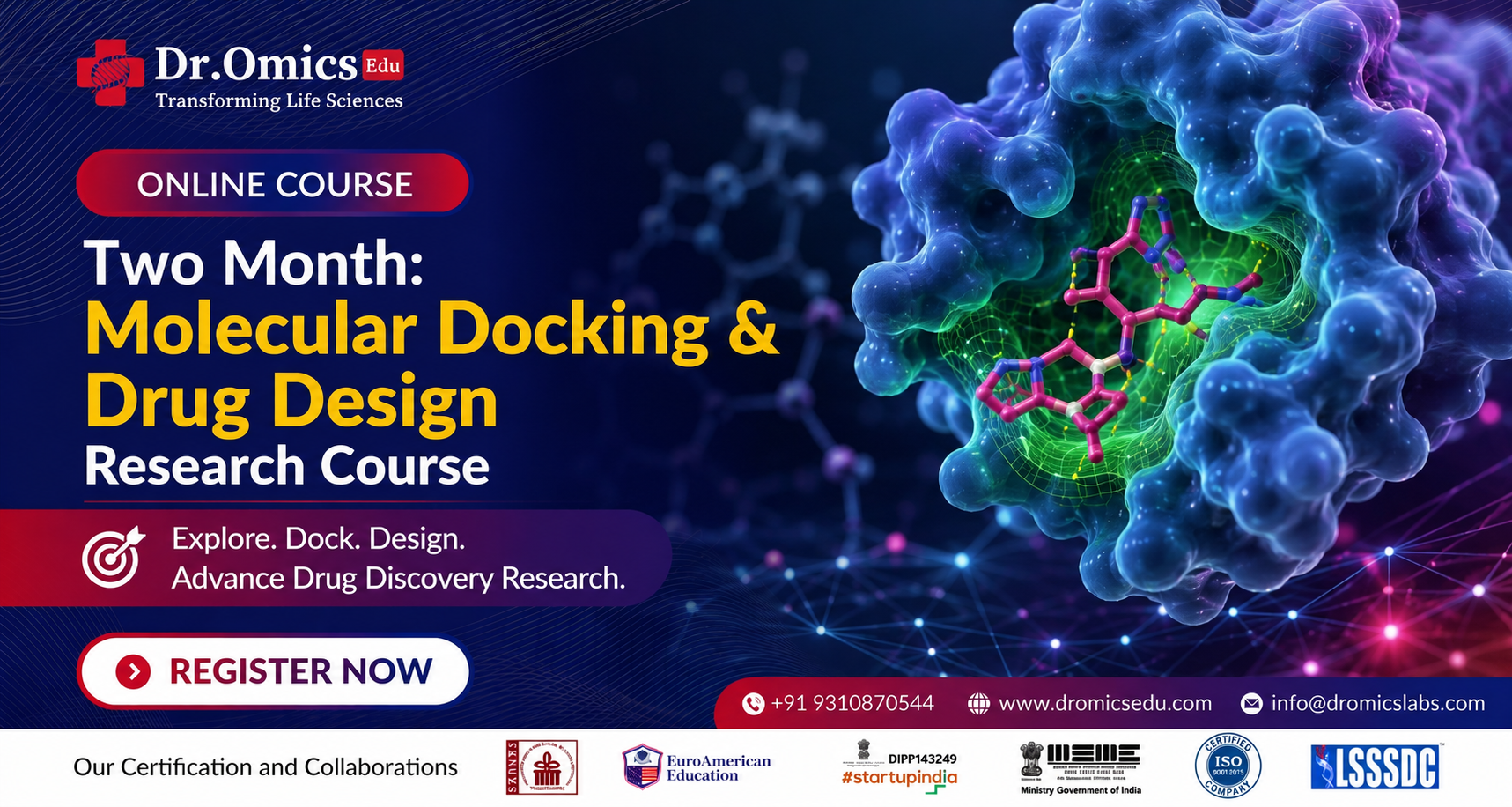
About this course
The 2-Month Advanced CADD Programme is designed for students and graduates in Life Sciences, Biotechnology, Pharmacy, Biochemistry, Microbiology, and related disciplines who want practical, research-oriented exposure to computational drug discovery. This industry-oriented programme combines theoretical concepts with hands-on training using widely adopted CADD and bioinformatics tools.
Participants learn molecular docking, virtual screening, protein preparation, ligand optimization, molecular visualization, and structure-based drug design workflows. The programme introduces real-world pharmaceutical research methodologies used in modern drug development, along with practical case studies and guided projects that strengthen analytical and research skills.
The curriculum also covers biological databases, molecular interactions, and computational techniques for identifying potential drug candidates. By the end of the programme, participants will have a strong foundation in CADD, improved research capabilities, and practical experience that supports careers in pharmaceutical research, biotechnology, computational biology, and higher studies.
What you will learn
Understand the fundamentals of Computer-Aided Drug Design (CADD).
Learn the complete drug discovery and drug development pipeline.
Explore structure-based and ligand-based drug design approaches.
Perform molecular docking using industry-standard software.
Prepare proteins and ligands for computational analysis.
Analyze protein–ligand interactions and binding affinity.
Conduct virtual screening to identify potential drug candidates.
Access and utilize biological databases such as PDB and PubChem.
Visualize molecular structures using PyMOL and related tools.
Interpret docking scores and interaction profiles.
Apply computational methods to pharmaceutical and biotechnology research.
Complete a real-world CADD project for portfolio development.
Skills you will gain
Bioinformatics
Docking
Modeling
Screening
Visualization
Pharmacology
Chemoinformatics
Databases
Proteinomics
Genomics
Simulation
Analysis
Discovery
Optimization
Validation
Research
PyMOL
Auto Dock
Swiss Dock
Drug Design
Course curriculum
2 modules
-
T1 = Introduction to Drug Discovery Process
-
T2 = Role of Computational Methods
-
T3 = Hands-on: Chemical Structure Visualization
-
T4 = Biomolecules and Their Properties
-
T5 = Structure of Proteins and Ligands
-
T6 = Hands-on: Protein Structure Visualization
-
T7 = Molecular Visualization Tools
-
T8 = Molecular Mechanics and Dynamics Simulations
-
T9 = Molecular Mechanics and Dynamics Simulations (continued)
-
T10 = Chemical Databases and Data Mining
-
T11 = Ligand and Structure-Based Virtual Screening
-
T12 = Hands-on: Chemical Data Exploration
-
T13 = Advanced Virtual Screening Techniques
-
T14 = Virtual Screening using Autodock Vina
-
T15 = Principles of Molecular Docking
-
T16 = Scoring Functions in Docking
-
T17 = Hands-on: Molecular Docking
-
T18 = Introduction to Molecular Dynamics
-
T19 = Simulation Software (e.g., GROMACS)
-
T20 = Hands-on: Analyzing MD Data
-
T21 = Chemoinformatics: Data Analysis and Visualization
-
T22 = Protein-Ligand Interaction Analysis
-
T23 = Hands-on: Protein-Ligand Interaction Analysis
-
T24 = Pharmacophore Modeling and Applications
-
T25 = Chemoinformatics: Data Analysis and Visualization (continued)
-
T26 = Structure-Based Drug Design
-
T27 = Ligand-Based Drug Design
-
T28 = Hands-on Structure-Based and Ligand-Based Drug Design
-
T29 = ADMET in Drug Development
-
T30 = Course Conclusion
-
T1 = Basics of Machine Learning
-
T2 = Supervised, Unsupervised, and Reinforcement Learning
-
T3 = Hands-on: Learn the Basics with scikit-learn Library in Python
-
T4 = Data Cleaning and Feature Selection
-
T5 = Handling Molecular Data
-
T6 = Hands-on: Use Pandas and NumPy for Data Preprocessing
-
T7 = Regression and Classification Algorithms
-
T8 = Deep Learning in Drug Discovery
-
T9 = Hands-on: Implement Machine Learning Models using scikit-learn
-
T10 = Hands-on: Implement Machine Learning Models using TensorFlow/Keras
-
T11 = Predicting Drug-Target Interactions
-
T12 = QSAR Modeling
-
T13 = Hands-on: Apply Machine Learning to Real Datasets with RDKit
-
T14 = Hands-on: Apply Machine Learning to Real Datasets with Cheminformatics
-
T15 = Structure-Activity Relationship (SAR) Analysis
-
T16 = Hands-on: Use RDKit for SAR Analysis
-
T17 = De Novo Drug Design using ML
-
T18 = Explore De Novo Design Tools
-
T19 = Advanced Machine Learning Techniques in Drug Design
-
T20 = Integration of Omics Data in Drug Discovery
-
T21 = Clinical Trial Design and Data Analysis
-
T22 = Ethical Considerations in Drug Design and Machine Learning
-
T23 = Real-World Applications
-
T24 = Q&A and Discussion
-
T25 = Conclusion
What you need to start
-
Basic knowledge of Biology or Life Sciences
-
Fundamental understanding of proteins and DNA
-
Familiarity with computers and internet usage
-
Interest in drug discovery and pharmaceutical research
-
No prior CADD experience is required
Who this course is for
-
B.Sc. Life Sciences students
-
M.Sc. Biotechnology students
-
Pharmacy students (B.Pharm & M.Pharm)
-
Biochemistry students
-
Microbiology students
-
Biotechnology graduates
-
Bioinformatics learners
-
Research scholars
-
Pharmaceutical professionals
-
Students preparing for higher education and research careers