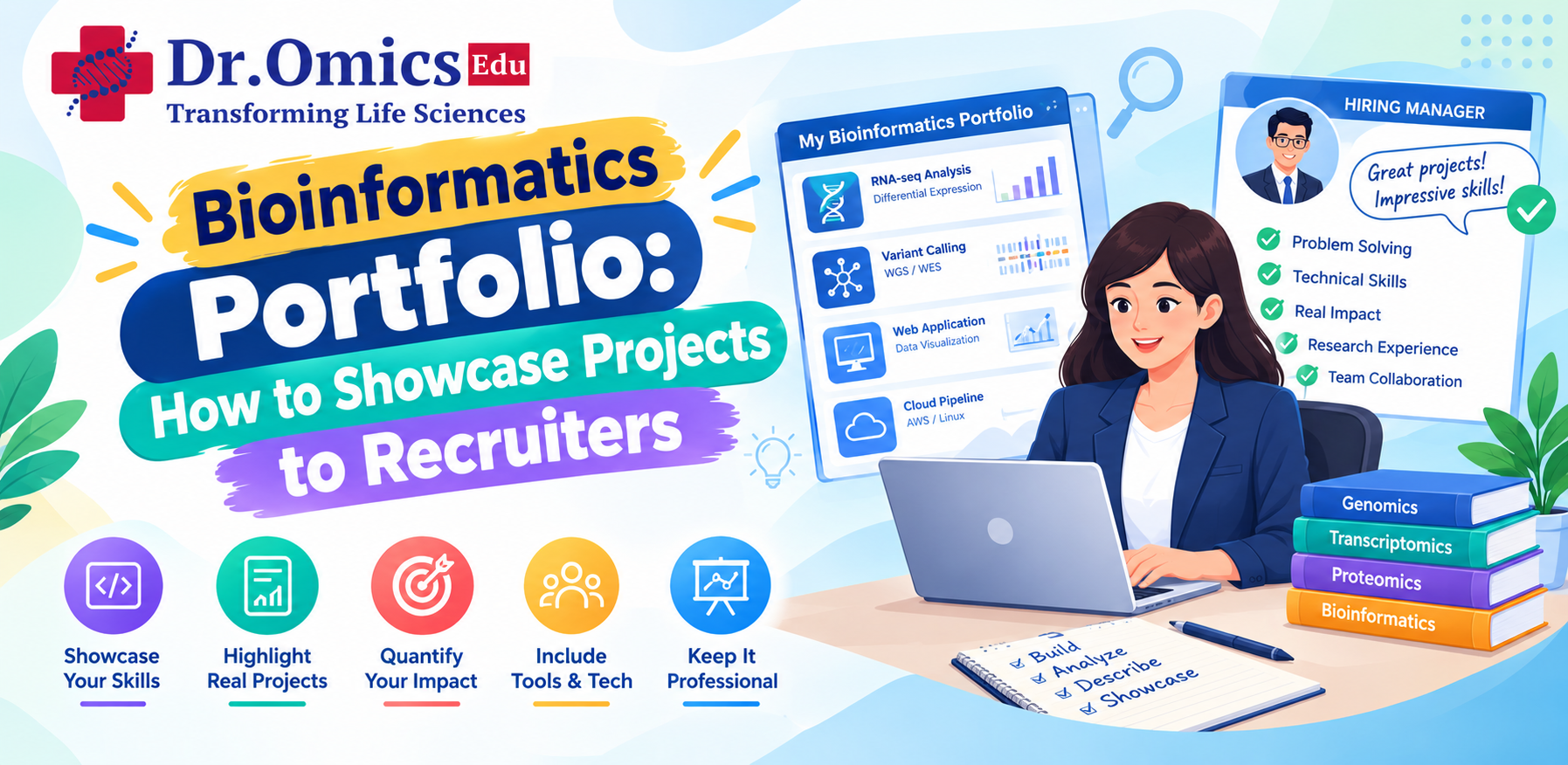
Bioinformatics Portfolio: How to Showcase Projects to Recruiters
Dr. Omics Edu Team ·
In today's competitive bioinformatics job market, having a strong resume is important, but a well-organized bioinformatics portfolio can help you stand out from other candidates. Recruiters and hiring managers want to see evidence that you can apply your knowledge to real biological datasets and solve practical problems.
A good portfolio demonstrates not only what you have learned but also what you can actually do.
Whether you are a student, fresher, researcher, or experienced bioinformatics professional, your portfolio can include NGS analysis, RNA-seq, variant analysis, Python/R projects, machine learning, structural bioinformatics, or other computational biology work.
This article explains how to build a professional portfolio and use bioinformatics projects for resume building effectively.
1. What Is a Bioinformatics Portfolio?
A bioinformatics portfolio is a collection of projects that demonstrates your technical knowledge, analytical skills, and ability to solve biological problems using computational methods.
It can include:
- NGS analysis projects
- RNA-seq analysis
- Variant analysis
- Genome assembly
- Metagenomics
- Protein analysis
- Python or R projects
- Machine-learning projects
- Data visualization
- Workflow development
- Database analysis
The purpose is not to collect as many projects as possible. Instead, your portfolio should demonstrate relevant, well-documented, and meaningful projects.
Three strong projects are often more valuable than ten incomplete projects.
2. Why Is a Portfolio Important?
A resume tells recruiters what you claim to know. A portfolio can show them what you have actually done.
For example, writing:
"Knowledge of RNA-seq analysis"
is less convincing than presenting a complete RNA-seq project showing:
FASTQ → QC → Alignment → Count Matrix → Differential Expression → Pathway Analysis
A portfolio allows recruiters to evaluate your:
- Technical knowledge
- Problem-solving ability
- Programming skills
- Data-analysis skills
- Understanding of biological concepts
- Documentation and communication
This makes a portfolio especially useful for candidates with limited professional experience.
3. What Projects Should You Include?
Choose projects according to the type of job you want.
For an NGS Analyst Role
Consider projects involving:
- Quality control
- Read alignment
- Variant calling
- Variant annotation
- BAM/VCF analysis
For an RNA-seq Role
Include projects involving:
- RNA-seq preprocessing
- Alignment or transcript quantification
- Differential expression
- PCA
- Heatmaps
- GO/pathway enrichment
For a Python/R Bioinformatics Role
Show projects involving:
- Biological data processing
- Sequence analysis
- Statistical analysis
- Data visualization
- Automation
- Machine learning
For a Clinical Bioinformatics Role
You could demonstrate experience with:
- Variant annotation
- ClinVar
- gnomAD
- VEP
- ACMG-based interpretation concepts
- Clinical variant databases
The projects should match the skills mentioned in the job descriptions you are targeting.
4. How to Select Bioinformatics Projects for Your Resume
Not every project needs to appear on your resume.
Select projects that demonstrate a specific skill relevant to the position.
For example:
Project: RNA-seq Differential Expression Analysis
Objective: Identify genes differentially expressed between disease and control samples.
Tools: FastQC, STAR, featureCounts, DESeq2, R
Key Results: Identified significantly differentially expressed genes and enriched biological pathways.
This is much stronger than simply writing:
"RNA-seq project using DESeq2."
When selecting bioinformatics projects for resume, focus on the problem, methodology, tools, and outcome.
5. Use GitHub to Showcase Your Work
GitHub is one of the most useful platforms for presenting technical projects.
A professional GitHub profile can contain multiple GitHub bioinformatics projects organized into individual repositories.
For example:
Bioinformatics-Portfolio
│
├── RNAseq-DEG-Analysis
├── Variant-Annotation
├── DNA-Sequence-Analysis
├── Protein-Analysis
└── Python-Bioinformatics
Each repository should have a clear purpose and useful documentation.
Do not upload files randomly and expect recruiters to understand your work.
6. Create a Good README File
The README is one of the first things someone may see when they open your GitHub project.
A good README should answer:
What is the project?
What biological question are you solving?
What dataset was used?
What tools were used?
What was the workflow?
What were the major results?
How can someone reproduce the analysis?
For example:
# RNA-seq Differential Expression Analysis
## Objective
Identify genes differentially expressed between
control and disease samples.
## Tools
FastQC
STAR
featureCounts
DESeq2
R
## Workflow
FASTQ → QC → Alignment → Counts → DESeq2 → Pathway Analysis
## Results
Identified significantly differentially expressed genes
and enriched biological pathways.
Good documentation can make even a small project look much more professional.
7. Add Your Code
Recruiters looking for computational roles may want to see how you write code.
Depending on the project, include:
- Python scripts
- R scripts
- Bash scripts
- Jupyter notebooks
- Workflow files
- Configuration files
Keep the code organized and use meaningful file names.
For example:
scripts/
├── quality_control.sh
├── differential_expression.R
└── pathway_analysis.R
Avoid uploading only a final result without showing how you generated it.
8. Include Visual Results
Visualizations can make a portfolio easier to understand.
For an RNA-seq project, you might include:
- PCA plot
- Volcano plot
- Heatmap
- MA plot
- Enrichment plot
For variant analysis, you could include:
- Variant distribution
- Chromosomal distribution
- Variant consequence plots
For machine-learning projects, include:
- Confusion matrix
- ROC curve
- Feature importance
- Model performance
Visual results allow recruiters to quickly understand what your analysis produced.
9. Explain the Biological Meaning
A common mistake in bioinformatics portfolios is focusing entirely on computational steps.
For example:
"I identified 1,500 differentially expressed genes."
That is only part of the story.
Explain what those genes or pathways indicate biologically.
For example:
"Pathway analysis showed enrichment of inflammatory and immune-response pathways, suggesting that these biological processes may be associated with the disease condition."
This demonstrates that you can move from data → analysis → biological interpretation.
That ability is extremely valuable when you want to showcase bioinformatics skills to recruiters.
10. Don't Upload Sensitive or Restricted Data
Always check whether the dataset can legally be shared.
For public datasets, provide the original database or accession information rather than unnecessarily uploading large raw sequencing files.
Avoid uploading:
- Confidential patient data
- Proprietary company datasets
- Personally identifiable information
- Large raw sequencing files when they are unnecessary
Instead, provide instructions explaining where the public dataset can be obtained.
11. Make Your Portfolio Recruiter-Friendly
Recruiters may spend only a short time reviewing a candidate's profile.
Make important information easy to find.
Your portfolio should clearly show:
Who you are → What you know → What you have built → What results you achieved
Keep project names descriptive.
Instead of:
Project1
Use:
RNA-seq Differential Expression Analysis
Instead of:
Python Project
Use:
Python-Based DNA Sequence Analysis
Clear naming makes your technical profile easier to understand.
12. Connect Your Portfolio With Your Resume
Your resume and portfolio should support each other.
For example, your resume might say:
RNA-seq Differential Expression Analysis
Performed RNA-seq analysis using FastQC, STAR, featureCounts, and DESeq2; identified differentially expressed genes and performed pathway enrichment.
The project title can then link to your GitHub repository.
This allows the recruiter to move directly from your resume to the actual project.
Do not list 15 projects on your resume. Select the 2–4 most relevant projects and provide deeper documentation for them in your portfolio.
13. Common Portfolio Mistakes to Avoid
Avoid these common mistakes:
Too many incomplete projects
Five unfinished repositories do not demonstrate strong practical skills.
No documentation
A recruiter should not have to guess what your project does.
Only certificates
Certificates show learning, but projects demonstrate application.
Copying tutorials without modification
Tutorial-based projects are useful for learning, but add your own analysis, biological question, or improvement.
No biological interpretation
Bioinformatics is not simply running commands. Explain what your results mean biologically.
Poor GitHub organization
Use clear repository names, folders, README files, and meaningful commit messages.
14. How to Build a Portfolio as a Fresher
You do not need industry experience to create a strong portfolio.
Start with publicly available datasets from resources such as GEO, SRA, ENA, or public cancer genomics datasets.
A beginner-friendly portfolio could include:
Project 1: RNA-seq Differential Expression
Project 2: Variant Annotation Using VEP/ClinVar
Project 3: Python-Based Sequence Analysis
Project 4: Protein or Pathway Analysis
Each project should answer a biological question and contain a reproducible workflow.
This approach can help freshers demonstrate practical ability even when they have limited professional experience.
15. The Ideal Bioinformatics Portfolio Structure
A simple professional portfolio can follow this structure:
Profile
Short introduction about your bioinformatics background and interests.
Skills
Python, R, Linux, NGS, RNA-seq, variant analysis, etc.
Projects
2–5 well-documented projects.
GitHub
Link to your repositories and code.
Resume
Updated CV highlighting relevant technical experience.
Contact
Professional email or LinkedIn profile.
The goal is to make it easy for a recruiter to understand your profile within a few minutes.
Conclusion
A strong bioinformatics portfolio can help transform your resume from a list of skills into evidence of what you can actually accomplish. The best portfolio does not contain dozens of projects; it contains a few carefully selected projects that demonstrate technical ability, biological understanding, problem-solving, and clear communication.
When creating bioinformatics projects for resume, focus on real biological questions and explain your complete workflow. Use GitHub bioinformatics projects to demonstrate your code, documentation, results, and reproducibility.
Most importantly, use your portfolio to showcase bioinformatics skills to recruiters rather than simply listing them.
A well-organized portfolio, combined with a focused resume and strong fundamentals, can give students, freshers, and experienced professionals a significant advantage when applying for bioinformatics opportunities.
