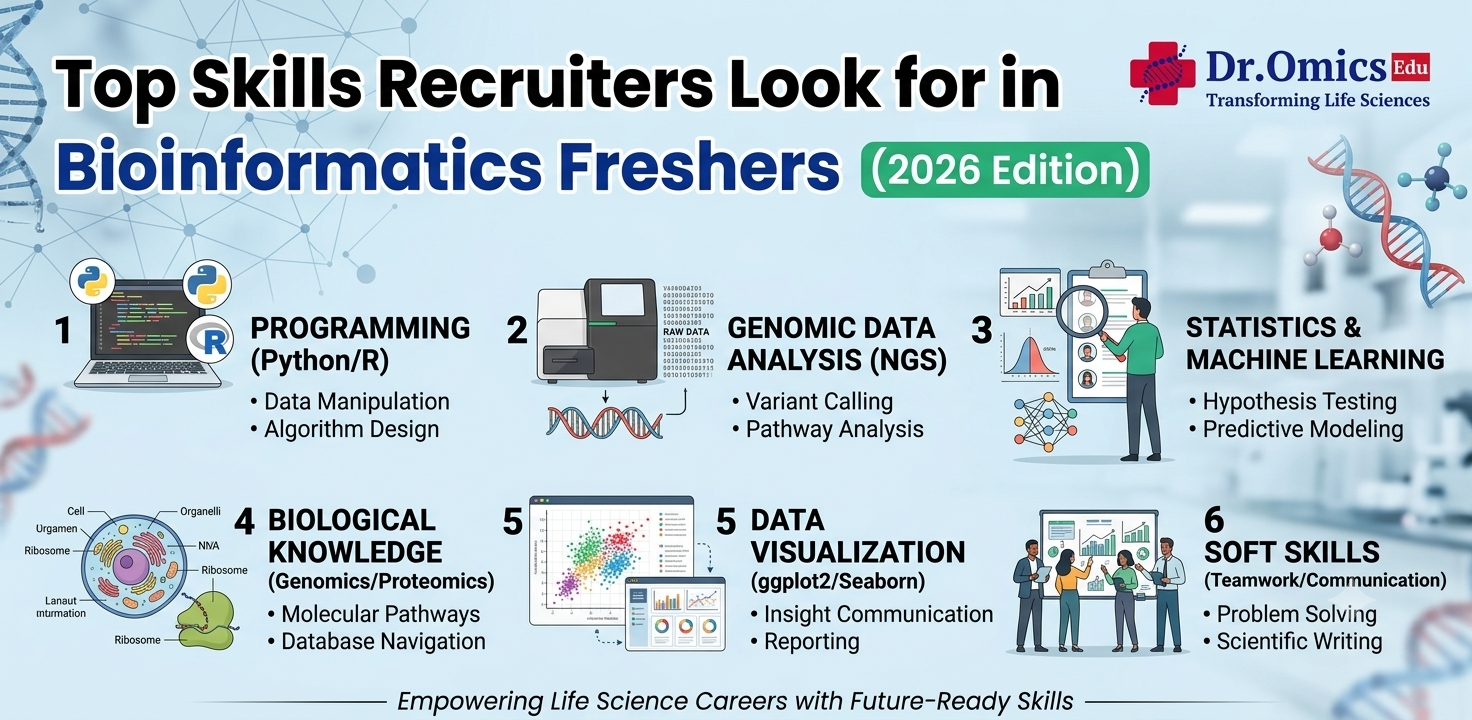
Top Skills Recruiters Look for in Bioinformatics Freshers (2026 Edition)
Dr. Omics Edu Team ·
Bioinformatics is becoming an important part of modern genomics, drug discovery, clinical research, and biotechnology. For freshers entering the field in 2026, a degree or certification is a good starting point—but recruiters increasingly look for practical skills and the ability to apply them to real biological data.
So, what are the top bioinformatics skills 2026 candidates should focus on?
1. Strong Bioinformatics Fundamentals
A good understanding of molecular biology and bioinformatics is essential. Freshers should be comfortable with DNA, RNA, proteins, sequence analysis, BLAST, biological databases, genomics, transcriptomics, and basic statistics.
Strong fundamentals help you understand why a tool is used and how to interpret its output, rather than simply following a workflow.
2. NGS & Practical Data Analysis
NGS remains one of the key areas for bioinformatics professionals. Understanding basic DNA-seq and RNA-seq workflows can give freshers a strong foundation.
Useful tools include FastQC, fastp, BWA, STAR/HISAT2, samtools, GATK, featureCounts, Galaxy, and other tools depending on the job role.
Hands-on experience with these workflows is one of the important in-demand bioinformatics skills for candidates targeting genomics-related positions.
3. Linux and Programming
Most bioinformatics workflows involve working with large datasets and command-line tools, making Linux an important skill.
Freshers should know basic Linux commands, file handling, directories, permissions, and running bioinformatics software.
Knowledge of Python or R is also valuable for data analysis, visualization, automation, and handling biological datasets. These are increasingly important technical skills for a bioinformatics career.
4. Data Interpretation
Running a pipeline is only one part of bioinformatics. Recruiters may expect candidates to understand what the results mean.
For example, you should be able to interpret quality-control reports, alignment statistics, differential expression results, variant data, and biological databases.
The ability to connect computational results with biological meaning can make your profile stronger.
5. Practical Project Experience
Projects are one of the best ways to demonstrate your skills as a fresher.
Instead of simply listing:
Python | Linux | RNA-seq | BLAST | GATK
show what you actually did:
“Analyzed RNA-seq data using quality control, alignment, read quantification, and differential expression analysis.”
This makes your bioinformatics resume skills more credible and gives you something concrete to discuss during interviews.
6. Communication & Problem-Solving
Technical knowledge alone is not enough. Bioinformatics recruiter expectations can also include communication, troubleshooting, teamwork, documentation, and the ability to explain your analysis clearly.
During an interview, you should be able to explain your project, justify your choice of tools, discuss challenges, and describe your results in simple language.
7. Build a Targeted Resume
Your resume should be tailored to the role you are applying for. Highlight relevant:
- Bioinformatics tools
- NGS workflows
- Programming languages
- Databases
- Research or internship projects
- Certifications
- Technical and analytical skills
Avoid filling your resume with tools you have only heard about. Focus on skills you can actually demonstrate.
What Are the Key Skills for Bioinformatics Jobs in 2026?
The exact bioinformatics industry requirements vary between companies and roles, but a strong fresher profile can combine:
Molecular Biology + Bioinformatics Fundamentals + NGS + Linux + Python/R + Data Interpretation + Projects + Communication
Final Takeaway
The goal is not to learn every bioinformatics tool available. Focus on developing practical skills, working with real datasets, understanding your results, and confidently explaining your projects.
If you're preparing for a career in 2026, use this bioinformatics fresher guide to identify the skills you need and gradually build a profile that matches current skills for bioinformatics jobs.
Learn the tools. Work on real data. Understand the biology. Build your project portfolio.
