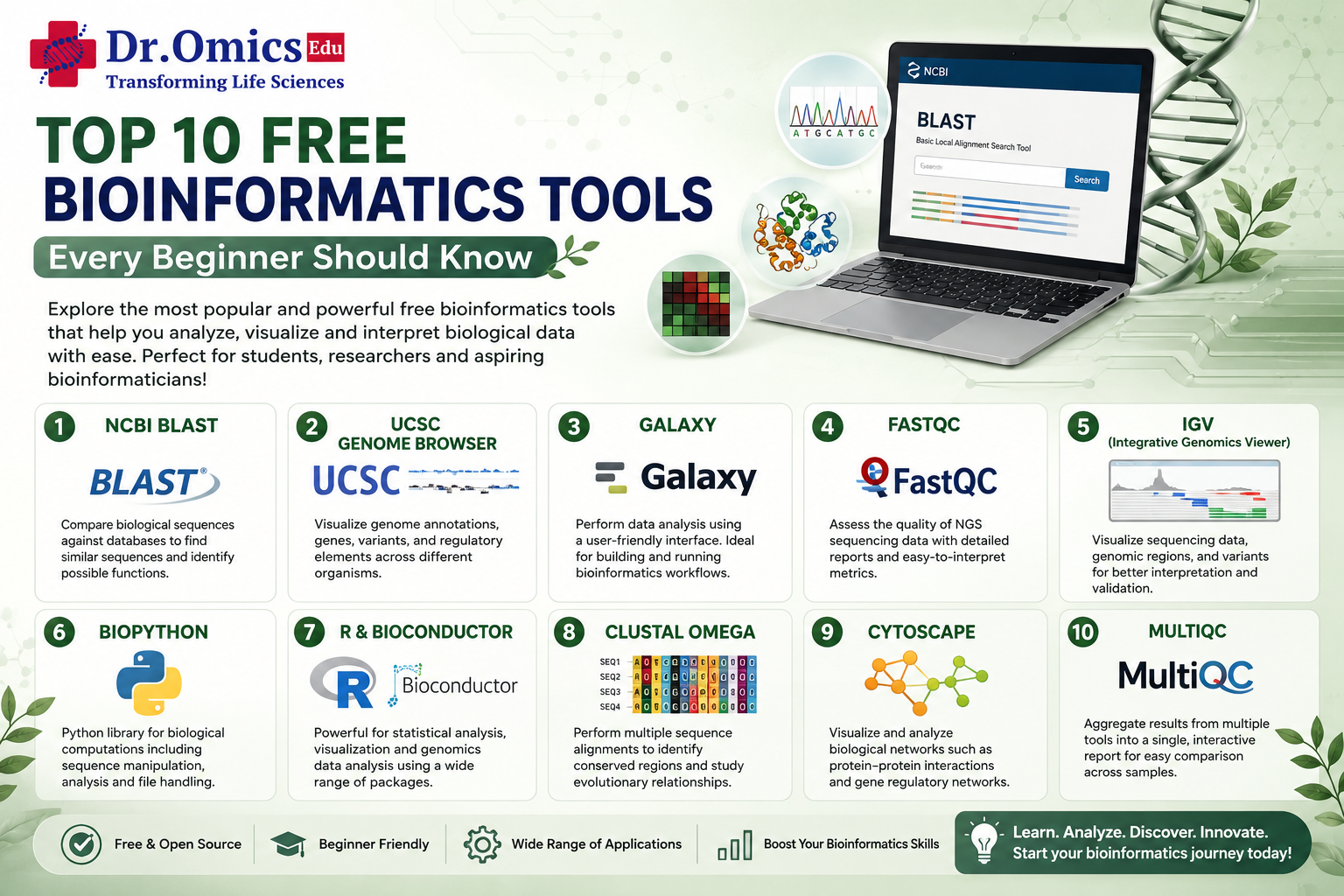
Top 10 Free Bioinformatics Tools Every Beginner Should Know
Dr. Omics Edu Team ·
Bioinformatics can seem overwhelming when you first start exploring the field. There are hundreds of databases, software packages, command-line tools, programming libraries, and analysis platforms available for biological research.
The good news is that beginners do not need to learn everything at once. A small set of reliable and widely used tools can help you build a strong foundation in sequence analysis, genomics, NGS, visualization, and biological data interpretation.
In this article, we explore 10 free bioinformatics tools that every beginner should know. These tools are useful for students, researchers, and aspiring bioinformaticians who want to gain practical experience without investing in expensive software.
Why Should Beginners Learn Bioinformatics Tools?
Bioinformatics involves working with different types of biological data, including DNA, RNA, protein sequences, genomic variants, and gene-expression data.
Learning the right tools helps you understand how these datasets are analyzed in real research.
For example, you may use one tool to compare DNA sequences, another to visualize a genome, and another to check the quality of sequencing data.
A beginner-friendly learning path could look like:
Biological Data → Database Search → Sequence Analysis → NGS → Visualization → Interpretation
The following tools can help you explore each of these areas.
1. NCBI BLAST
BLAST (Basic Local Alignment Search Tool) is one of the most important tools for anyone starting in bioinformatics.
It is used to compare a nucleotide or protein sequence against sequences available in biological databases.
What can you do with BLAST?
You can use BLAST to:
- Identify an unknown DNA sequence
- Find similar protein sequences
- Compare sequences between organisms
- Identify conserved regions
- Check sequence similarity
- Support gene or protein annotation
For example, if you have an unknown DNA sequence and want to determine which gene or organism it may belong to, you can submit the sequence to BLAST and examine the best matches.
BLAST is an excellent first tool for beginners because it demonstrates one of the fundamental ideas in bioinformatics:
Using computational comparison to understand biological sequences.
2. Galaxy
Galaxy is a popular open-source platform that allows researchers to perform bioinformatics analysis through a graphical interface.
One of its biggest advantages is that beginners can perform many analyses without writing extensive command-line code.
Galaxy can be used for workflows involving:
- Sequence analysis
- RNA-seq
- Genomics
- Variant analysis
- Metagenomics
- Proteomics
- Data visualization
A typical workflow can involve uploading data, selecting analysis tools, setting parameters, running the analysis, and examining the results.
Why should beginners learn Galaxy?
Galaxy provides a useful introduction to bioinformatics workflows before moving completely into command-line analysis.
It also helps beginners understand an important concept:
Bioinformatics analysis is usually a workflow rather than a single tool.
Galaxy is therefore one of the most useful bioinformatics tools for beginners.
3. FastQC
When working with next-generation sequencing data, checking the quality of raw reads is one of the first steps.
FastQC is a widely used tool for quality assessment of sequencing data.
It generates an HTML report containing several quality metrics.
These include:
- Per-base sequence quality
- Per-sequence quality
- Sequence length
- GC content
- Adapter contamination
- Duplicate sequences
- Overrepresented sequences
For example, before starting an RNA-seq or DNA-seq analysis, you can run FastQC on your FASTQ files to identify potential quality issues.
Why is FastQC important?
Beginners should understand that bioinformatics analysis should not start blindly with downstream tools.
The first question should often be:
“Is my data good enough for analysis?”
FastQC helps answer that question.
6. Biopython
If you want to learn programming for bioinformatics, Biopython is an excellent place to start.
Biopython is an open-source collection of Python tools designed for biological computation.
It can be used for tasks such as:
- Reading FASTA files
- Processing DNA and protein sequences
- Sequence manipulation
- Working with biological databases
- Performing sequence analysis
- Handling biological file formats
For example, instead of manually opening hundreds of FASTA sequences, Python and Biopython can be used to read and process them automatically.
Why is Biopython useful?
It connects programming with biology.
Beginners can first learn basic Python concepts and then apply them to real biological datasets.
This makes Biopython particularly useful for students who want to move toward:
- Bioinformatics programming
- Automation
- NGS analysis
- Data science
- Computational biology
R is a programming language and statistical computing environment widely used in biological data analysis.
Bioconductor provides a large collection of open-source R packages specifically designed for bioinformatics and computational biology.
Some popular packages include:
- DESeq2
- edgeR
- limma
- Biostrings
- GenomicRanges
- Seurat
R and Bioconductor are especially useful for:
- RNA-seq analysis
- Differential gene expression
- Genomic data analysis
- Single-cell analysis
- Statistical analysis
- Data visualization
For example, after obtaining a gene-count matrix from an RNA-seq experiment, R can be used to perform differential expression analysis and generate plots such as heatmaps, MA plots, and volcano plots.
Why should beginners learn R?
R is particularly valuable for students interested in statistics, transcriptomics, and biological data visualization.
9. Cytoscape
Bioinformatics does not only involve sequences. Biological systems can also be represented as networks.
Cytoscape is an open-source platform used to visualize and analyze molecular interaction networks.
It can be used to explore:
- Protein-protein interaction networks
- Gene regulatory networks
- Metabolic networks
- Pathway relationships
- Biological interaction data
For example, after identifying genes associated with a biological condition, you can visualize relationships between genes and proteins as a network.
Why is Cytoscape useful?
It helps beginners understand how biological systems are interconnected.
Instead of looking at genes individually, network visualization allows researchers to explore relationships between multiple biological components.
10. MultiQC
When working with NGS data, you may have quality-control reports from many samples.
Opening every individual report can become time-consuming.
MultiQC solves this problem by collecting results from multiple bioinformatics tools and creating a combined report.
It can summarize results from tools such as:
- FastQC
- Cutadapt
- STAR
- Samtools
- BWA
- Other supported analysis tools
Why should beginners learn MultiQC?
It introduces the concept of automated quality reporting.
For example, if you have 20 or 50 sequencing samples, MultiQC can help you quickly identify which samples have unusual quality metrics.
This makes it particularly useful for NGS pipelines and large datasets.
Conclusion
Learning bioinformatics does not mean memorizing hundreds of software packages. Beginners should first understand the purpose of commonly used tools and learn how to apply them to real biological questions.
The 10 free bioinformatics tools discussed in this article provide a strong starting point. BLAST helps with sequence similarity, UCSC helps explore genomes, Galaxy introduces workflow-based analysis, FastQC and MultiQC support NGS quality control, IGV enables genome visualization, while Biopython and R help develop programming and statistical skills.
Clustal Omega introduces sequence alignment, Cytoscape provides network analysis, and the combination of these tools gives beginners exposure to several important areas of computational biology.
The best way to learn is to combine theory + hands-on practice + real datasets.
Start with two or three tools, complete a small project, and gradually expand your toolkit. With consistent practice, these bioinformatics tools for beginners can become the foundation for more advanced work in genomics, transcriptomics, NGS, computational biology, and data science.
