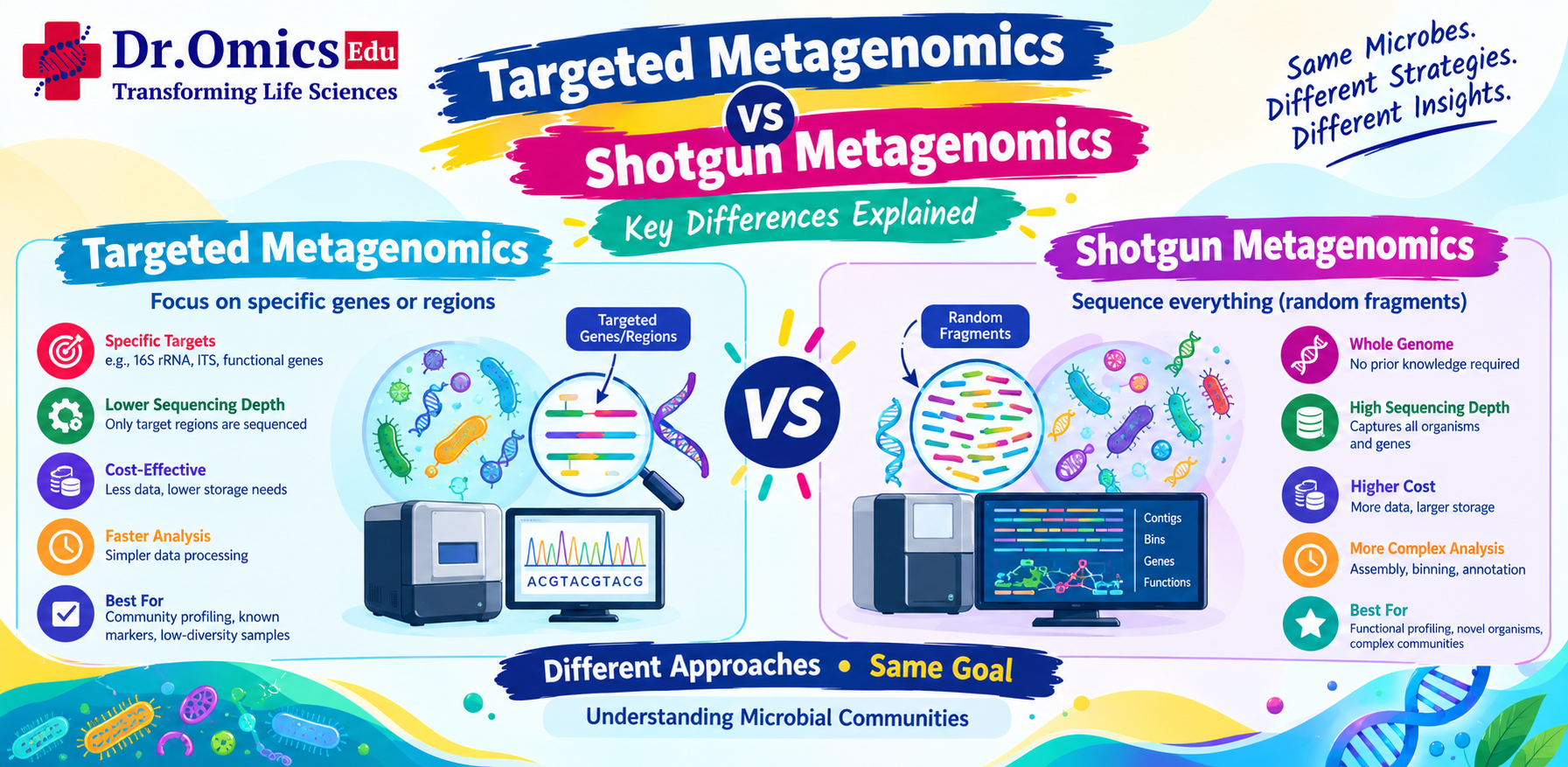
Targeted Metagenomics vs Shotgun Metagenomics: Key Differences Explained
Dr. Omics Edu Team ·
Introduction
Microorganisms play an essential role in human health, environmental balance, agriculture, and industrial biotechnology. Microbial communities exist in diverse environments, including the human gut, soil, oceans, wastewater, and fermented foods. Understanding these communities helps researchers investigate microbial diversity, identify potentially beneficial or harmful organisms, and explore how microorganisms interact with their surroundings. However, studying complex microbial communities requires specialized sequencing technologies and bioinformatics approaches.
Metagenomics has transformed microbial research by enabling scientists to study genetic material collected directly from environmental or biological samples without the need to culture individual microorganisms. Among the commonly used approaches, targeted metagenomics and shotgun metagenomics are two important methods for characterizing microbial communities. Although both approaches help researchers investigate microbiomes, they differ in their sequencing strategies, the information they generate, experimental requirements, and computational complexity.
Targeted metagenomics commonly focuses on selected genetic markers, such as the 16S ribosomal RNA (rRNA) gene for bacterial and archaeal community profiling. In contrast, shotgun metagenomics sequences DNA from across the microbial community, potentially capturing information about taxonomic diversity, genes, metabolic pathways, and functional capabilities.
Understanding the differences between these methods is essential when planning microbiome studies, selecting sequencing technologies, and choosing suitable metagenomics analysis methods. This article explains targeted and shotgun metagenomics, compares their major characteristics, and discusses how researchers can select the most appropriate approach for their research objectives.
1. What Is Targeted Metagenomics?
Targeted metagenomics is a sequencing approach that focuses on specific genetic regions or markers to characterize selected members of a microbial community. Instead of sequencing all the DNA present in a sample, researchers amplify or enrich a particular region of interest before sequencing.
One of the most widely used examples is 16S rRNA sequencing, which targets selected variable regions of the bacterial and archaeal 16S ribosomal RNA gene. This gene contains conserved regions that support primer binding and variable regions that help distinguish microbial groups.
Because the method focuses on a specific marker, it can provide a practical and relatively economical way to investigate bacterial community composition across many samples.
How Does Targeted Metagenomics Work?
The typical workflow includes the following steps:
Sample collection and DNA extraction: Biological or environmental samples are collected, and total DNA is extracted. The quality and quantity of the extracted DNA are assessed before library preparation.
Target amplification: Primers are used to amplify a selected genetic marker, such as a region of the 16S rRNA gene. The choice of primers and target region influences which organisms can be detected.
Library preparation and sequencing: Amplified DNA fragments are prepared for sequencing using a suitable platform. Sequencing generates reads corresponding primarily to the selected region.
Quality control and processing: Sequencing reads undergo quality filtering, primer removal, and other preprocessing steps. Depending on the workflow, reads may be grouped into operational taxonomic units (OTUs) or processed into amplicon sequence variants (ASVs).
Taxonomic classification and interpretation: Processed sequences are compared against appropriate reference databases to assign taxonomic identities. Researchers can then investigate microbial diversity, community composition, and differences between sample groups.
Common tools used in targeted microbiome analysis include QIIME 2, DADA2, and reference databases such as SILVA. The specific tools depend on the sequencing marker and study design.
Advantages of Targeted Metagenomics
Targeted metagenomics offers several advantages for microbiome research.
- Cost-effectiveness: Targeted sequencing often requires less sequencing per sample than shotgun metagenomics, making it attractive for large studies.
- Efficient community profiling: It provides useful information about bacterial and archaeal community composition.
- High sample throughput: Researchers can analyse many samples when the study focuses on selected microbial markers.
- Established workflows: Widely used tools and reference databases support standardized processing and taxonomic analysis.
- Useful for comparative studies: It can help identify differences in microbial diversity and relative abundance across conditions, such as healthy and diseased groups or treated and untreated environments.
Limitations of Targeted Metagenomics
Despite its advantages, targeted metagenomics has important limitations.
First, its results depend on the selected genetic marker and primer design. Some microorganisms may be underrepresented or missed because their target regions do not match the primers efficiently.
Second, marker-based sequencing generally provides limited information about microbial genes and metabolic pathways. It cannot comprehensively characterize the functional potential of a microbial community.
Third, taxonomic resolution varies. Depending on the marker, amplified region, organism, and database, sequences may be assigned reliably only to the genus level or another broader taxonomic group rather than to individual species.
Finally, amplification bias, variation in marker-gene copy number, and sequencing depth can influence observed community composition. Therefore, targeted metagenomics is valuable for answering focused taxonomic questions but is less suitable when researchers need broad, community-wide functional information.
2. What Is Shotgun Metagenomics?
Shotgun metagenomics is a sequencing approach that analyses DNA fragments from across the genetic material present in a sample. Rather than targeting a single marker gene, the method sequences a much broader collection of DNA fragments, including genomic regions that encode proteins and other functional elements.
Depending on the sample and experimental workflow, the data may represent bacteria, archaea, fungi, viruses, and other organisms. However, the ability to detect each group depends on DNA extraction efficiency, library preparation, sequencing depth, and the presence of suitable reference databases.
Shotgun metagenomics can provide information about both microbial taxonomy and functional potential. This makes it useful for studies investigating microbial diversity alongside genes associated with metabolism, antimicrobial resistance, virulence, and environmental adaptation.
How Does Shotgun Metagenomics Work?
A typical shotgun metagenomics workflow includes the following steps.
Sample collection and DNA extraction: Samples are collected from the environment, human microbiome, animal systems, or other sources. Total DNA is extracted, and its quality and quantity are assessed.
Library preparation: Extracted DNA is fragmented or processed into sequencing-compatible libraries. Unlike conventional amplicon-based workflows, the library preparation does not rely on amplifying one specific taxonomic marker.
High-throughput sequencing: Sequencing produces reads from across the DNA fragments in the sample. Adequate sequencing depth is important for detecting less abundant organisms and genes.
Quality control and preprocessing: Reads are checked for quality, and adapters, low-quality sequences, and other unwanted material are removed. Host DNA may need to be filtered when analysing human or animal microbiome samples.
Taxonomic profiling: Reads can be classified using reference-based methods, k-mer approaches, or other sequence classification strategies. The resulting profiles help researchers characterize microbial community composition.
Functional profiling: Researchers can identify genes and infer functional capabilities using sequence annotation, gene catalogues, and pathway databases. Common resources include KEGG and eggNOG, depending on the analytical workflow.
Assembly and genome reconstruction: Where appropriate, reads may be assembled into longer contigs, followed by metagenome-assembled genome (MAG) reconstruction and quality assessment. These steps can help researchers study the genomic characteristics of organisms within a community.
Advantages of Shotgun Metagenomics
Shotgun metagenomics offers several benefits for comprehensive microbiome research.
- Broader taxonomic coverage: It can investigate multiple microbial groups without depending on a single marker gene.
- Greater functional insight: It supports the identification of genes associated with metabolic processes, resistance mechanisms, and other biological functions.
- Improved taxonomic resolution in suitable datasets: It can provide species-level or, in some cases, strain-level information when sequencing data and reference resources are sufficiently informative.
- Genome reconstruction: Suitable datasets can support assembly and reconstruction of microbial genomes directly from community DNA.
- Greater flexibility: The same dataset can support multiple analyses, including taxonomic profiling, functional annotation, gene discovery, and selected comparative genomic investigations.
Limitations of Shotgun Metagenomics
Shotgun metagenomics also presents several challenges.
Higher sequencing and computational costs: The approach often requires greater sequencing depth, storage capacity, and computational resources, especially for complex samples and large studies.
Host DNA contamination: In samples containing substantial human or animal DNA, host sequences can consume a significant portion of sequencing capacity without contributing to the microbial analysis.
Complex data processing: Taxonomic classification, functional annotation, assembly, and genome reconstruction may require multiple tools, databases, and substantial computational expertise.
Dependence on reference databases: Organisms or genes that are poorly represented in existing databases may remain unclassified or receive incomplete functional annotations.
Functional interpretation limitations: Detecting a gene indicates potential biological capability, not necessarily that the gene is expressed or that the corresponding process is active. Additional methods, such as metatranscriptomics, metaproteomics, or metabolomics, may be needed to investigate activity.
3. Targeted Metagenomics vs Shotgun Metagenomics: Key Differences
The main distinction between these approaches is the scope of the DNA being sequenced. Targeted metagenomics examines selected genetic markers, whereas shotgun metagenomics surveys DNA from across the microbial community.
The following microbiome sequencing comparison summarizes the key differences.
| Feature | Targeted metagenomics | Shotgun metagenomics |
| Sequencing strategy | Targets selected genetic regions | Sequences DNA fragments from across the sample |
| Common example | 16S rRNA sequencing | Whole-community DNA sequencing |
| Main objective | Microbial community profiling | Taxonomic and functional characterization |
| Taxonomic coverage | Depends on the selected marker | Broader, depending on extraction and sequencing |
| Species-level resolution | Often limited by the marker | Often better when data and references permit |
| Functional analysis | Limited direct functional information | Supports gene and pathway analysis |
| Genome reconstruction | Generally not suitable from marker reads alone | Possible with suitable sequencing data |
| Amplification bias | Can be significant in PCR-based workflows | Avoids target-specific PCR bias, although other biases remain |
| Host DNA interference | Depends on the targeted assay and sample | Can substantially reduce useful microbial sequencing depth |
| Sequencing requirements | Often lower per sample | Often higher per sample |
| Computational complexity | Generally lower | Generally higher |
| Typical applications | Community diversity and taxonomic comparisons | Functional profiling, gene discovery, and deeper community analysis |
Neither method is universally superior. The appropriate choice depends on the scientific question, sample characteristics, budget, and level of detail required.
4. Metagenomics Analysis Methods: Understanding the Bioinformatics Workflow
Choosing a sequencing method is only one part of a microbiome study. Appropriate metagenomics analysis methods are essential for generating reliable and biologically meaningful results.
Targeted Metagenomics Analysis
For 16S rRNA sequencing, the analysis commonly begins with quality assessment and removal of primers and low-quality reads. DADA2 can infer ASVs by modelling sequencing errors, while QIIME 2 provides a framework for managing and analysing microbiome data.
The resulting sequences are classified against a reference database such as SILVA. Researchers can then calculate alpha diversity, which describes diversity within individual samples, and beta diversity, which compares community composition between samples.
Statistical comparisons may be used to investigate differences in community composition or relative abundance. However, researchers should account for study design, sample size, multiple testing, and potential confounding variables.
Shotgun Metagenomics Analysis
Shotgun analysis generally begins with quality control, adapter removal, and filtering of unwanted sequences. Host read removal may be necessary for human-associated or animal-associated samples.
Taxonomic profiling can then be performed using tools such as Kraken 2 or MetaPhlAn, depending on the research objective and available references. Functional profiling may use tools such as HUMAnN to characterize gene families and metabolic pathways.
For genome-centric studies, researchers may use assemblers such as MEGAHIT or metaSPAdes, followed by binning and MAG quality assessment. These workflows can reveal information about organisms that are difficult to characterize using marker-based sequencing alone.
The choice of tools should be guided by the dataset, scientific question, validation requirements, and computational resources. Results should be checked for technical biases, database limitations, and statistical reliability before biological conclusions are drawn.
5. When Should You Choose Targeted or Shotgun Metagenomics?
The decision between targeted and shotgun metagenomics should begin with a clear research question.
Choose targeted metagenomics when:
- The primary objective is to compare bacterial or archaeal community composition across many samples.
- The study focuses on microbial diversity rather than detailed functional characterization.
- The project has a limited sequencing budget.
- A well-established marker-based workflow is suitable for the organisms being investigated.
- The research aims to profile community patterns across conditions, locations, or time points.
For example, a researcher comparing gut bacterial communities between healthy individuals and patients with a particular condition may use 16S rRNA sequencing to investigate differences in bacterial diversity and composition.
Choose shotgun metagenomics when:
- The study requires broader taxonomic coverage.
- Researchers need to investigate genes, metabolic pathways, or antimicrobial resistance determinants.
- The objective includes discovering previously uncharacterized genes or reconstructing microbial genomes.
- A deeper understanding of microbial functional potential is necessary.
- The available budget and computational infrastructure support more extensive sequencing and analysis.
For example, a researcher investigating antimicrobial resistance in hospital wastewater may use shotgun metagenomics to characterize microbial communities and identify resistance-associated genes. Further analysis and validation may be required to determine which organisms carry these genes and whether they are clinically relevant.
In some projects, combining both methods can provide complementary information. Targeted sequencing can support economical community profiling, while shotgun sequencing can investigate selected samples in greater functional detail. This combined strategy should be designed carefully to ensure that both datasets address compatible research questions.
6. Future Perspectives in Microbiome Sequencing
Microbiome research is evolving beyond basic taxonomic profiling toward a more comprehensive understanding of microbial ecosystems. Improvements in sequencing technologies, computational methods, and reference databases are expanding the range of questions researchers can investigate.
Shotgun metagenomics is particularly useful for exploring microbial genes, metabolic potential, antimicrobial resistance, and genome reconstruction. Targeted approaches remain valuable when researchers need efficient, focused profiling across large sample collections.
Emerging approaches, including long-read sequencing, metatranscriptomics, metaproteomics, and metabolomics, can provide additional insights into microbial identity, gene expression, proteins, and metabolic activity. Integrating these datasets may help researchers develop a more complete picture of microbial community structure and function.
Artificial intelligence and machine learning are also being explored for microbiome classification, biomarker discovery, and predictive modelling. However, these methods require appropriate study design, representative datasets, careful validation, and transparent interpretation to avoid misleading conclusions.
As these technologies continue to develop, bioinformatics expertise will remain central to processing complex datasets, assessing data quality, selecting suitable statistical methods, and translating computational results into biological knowledge.
Conclusion
Targeted metagenomics and shotgun metagenomics are two important approaches for studying microbial communities, but they serve different research objectives. Targeted metagenomics, particularly 16S rRNA sequencing, is widely used for microbial community profiling and diversity analysis. It can be an economical and practical choice when the primary objective is to compare bacterial and archaeal communities across samples.
Shotgun metagenomics provides a broader view of microbial DNA and supports taxonomic profiling, functional annotation, gene discovery, and microbial genome reconstruction. Although it generally requires greater sequencing and computational resources, it can offer valuable insights into the functional potential and genomic characteristics of complex microbial ecosystems.
The choice between these approaches should be based on the research question, sample type, required taxonomic resolution, desired functional information, and available resources. Understanding the strengths and limitations of each method helps researchers select appropriate sequencing strategies and design more reliable studies.
Ultimately, a successful microbiome study requires more than choosing a sequencing platform. Careful experimental design, suitable metagenomics analysis methods, rigorous quality control, and thoughtful biological interpretation are essential for obtaining meaningful results. By understanding the differences in this microbiome sequencing comparison, researchers and aspiring bioinformaticians can make informed decisions and contribute to advances in microbial ecology, healthcare, agriculture, and biotechnology.
