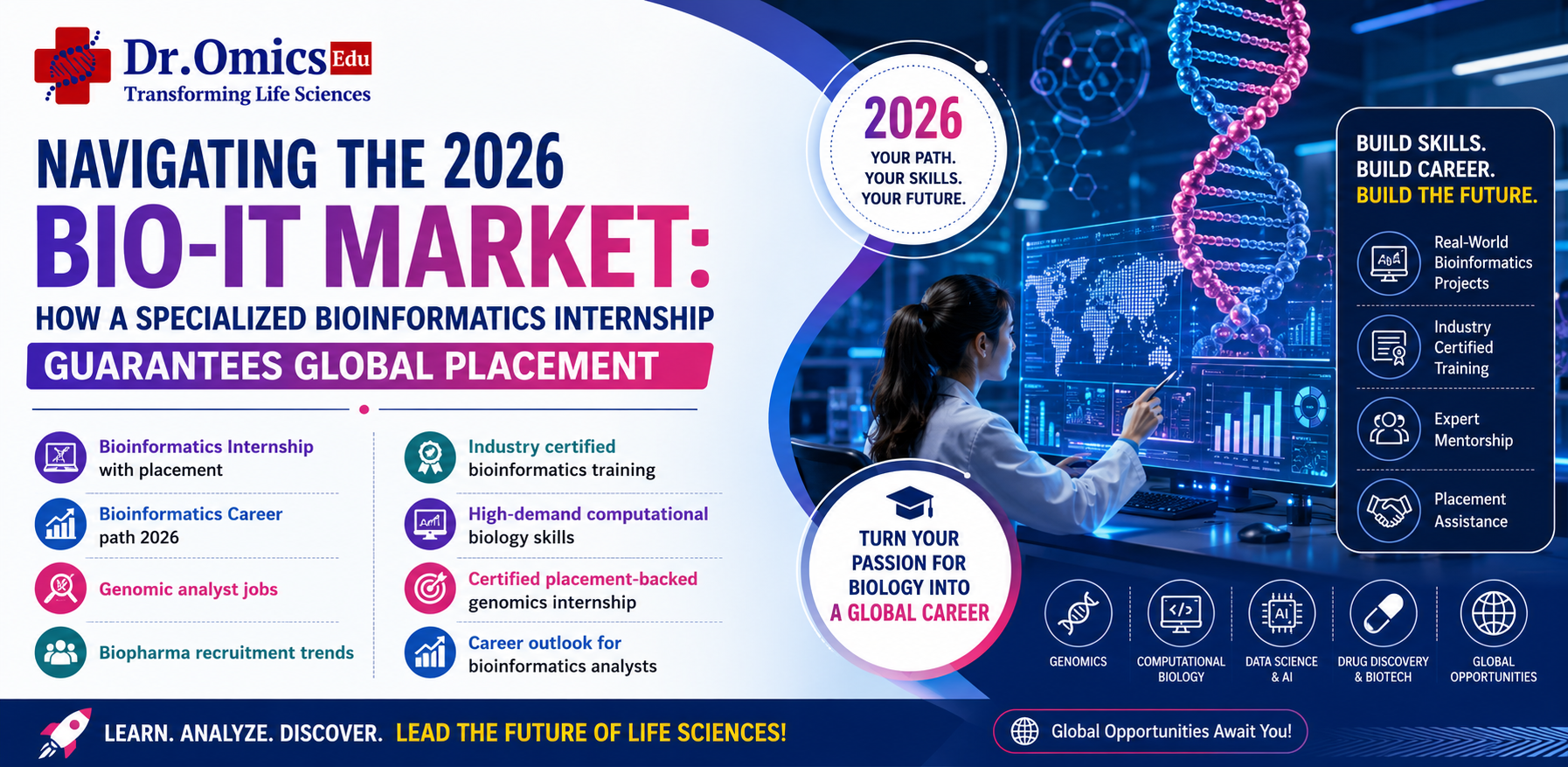
Navigating the 2026 Bio-IT Market: How a Specialized Bioinformatics Internship Guarantees Global Placement
Dr. Omics Edu Team · · Updated
The biotechnology industry is entering a new era where genomics, artificial intelligence (AI), and big data are transforming healthcare, drug discovery, and precision medicine. As biological data continues to grow at an unprecedented rate, organizations are actively seeking professionals who can analyze, interpret, and convert complex genomic information into meaningful insights. This has made the Bioinformatics Career Path 2026 one of the fastest-growing and most rewarding career options for life science graduates.
Today's employers are looking beyond academic degrees. They prefer candidates who possess practical expertise in bioinformatics workflows, programming, and real-world data analysis. This is why a Bioinformatics Internship with Placement has become an essential stepping stone for students aiming to build successful careers in biotechnology and pharmaceutical industries.
Why Bioinformatics Professionals Are in High Demand
The increasing adoption of Next-Generation Sequencing (NGS), whole genome sequencing, transcriptomics, and AI-powered healthcare has created thousands of opportunities across research laboratories, pharmaceutical companies, biotechnology startups, hospitals, and clinical research organizations.
Popular genomic analyst jobs include Bioinformatics Analyst, Computational Biologist, Clinical Bioinformatician, NGS Data Analyst, and Genomic Data Scientist. These roles require professionals who can work with biological datasets, automate workflows, and support research teams in making data-driven discoveries.
Skills That Employers Expect in 2026
According to current biopharma recruitment trends, organizations prefer candidates with practical experience rather than theoretical knowledge alone. Professionals who can confidently work with Linux, Python, R, RNA-Seq analysis, genome assembly, variant calling, and industry-standard tools such as FastQC, HISAT2, SAMtools, GATK, and DESeq2 have a significant advantage in today's job market.
Developing these high-demand computational biology skills enables graduates to contribute effectively from the very beginning of their careers and opens doors to opportunities across the globe.
The Importance of Industry-Certified Training
While universities provide a strong academic foundation, they often offer limited exposure to real sequencing projects and industrial workflows. Industry certified bioinformatics training helps bridge this gap by providing hands-on experience with real genomic datasets, project-based learning, and mentorship from experienced professionals.
A certified placement-backed genomics internship further enhances career readiness by combining technical training with resume building, interview preparation, and placement assistance. Working on real-world bioinformatics projects not only strengthens technical expertise but also builds confidence and demonstrates practical skills to potential employers.
A Bright Future in Bioinformatics
The career outlook for bioinformatics analysts remains exceptionally strong as industries continue investing in genomics, personalized medicine, AI-driven drug discovery, and healthcare analytics. Countries such as the United States, Canada, Germany, the United Kingdom, Singapore, Australia, and India are actively recruiting skilled bioinformatics professionals to support these rapidly growing sectors.
For aspiring professionals, investing in a Bioinformatics Internship with Placement is one of the smartest career decisions in 2026. By combining practical experience, industry certified bioinformatics training, and the high-demand computational biology skills sought by employers, students can confidently pursue genomic analyst jobs and establish successful careers in the global Bio-IT industry.
