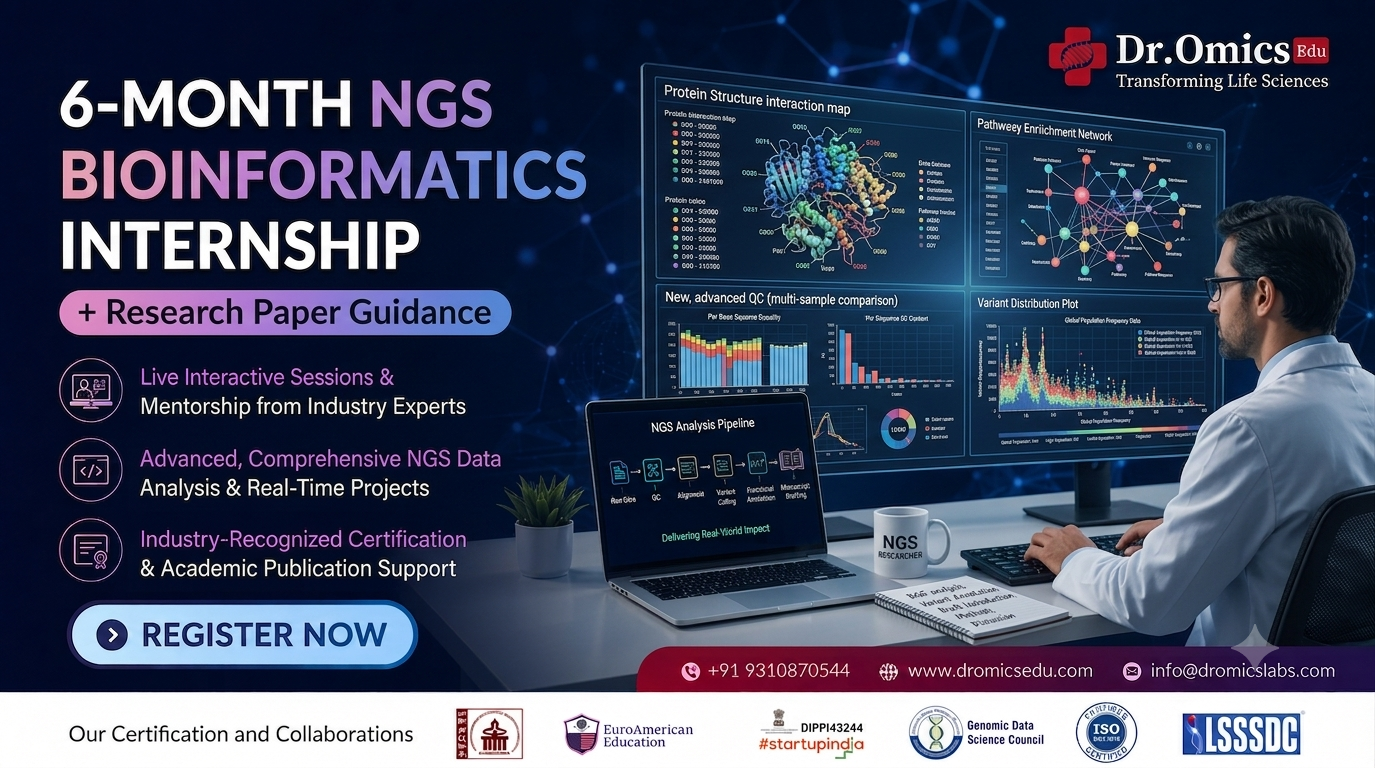
Advanced Genomic Internship for 6 Months

Internship Project-Based Dr. Omics
Featured

Master the intersection of Big Data and Molecular Biology through high-impact research projects. Build industry-ready expertise in Next-Generation Sequencing (NGS) and AI-driven genomic modeling.

Mode: Live

Level: All Levels

Language: English

Certification: Available

Advanced Genomic Internship for 6 Months

Internship Overview

This Advanced Genomics Internship is an intensive, project-based program designed to bridge the gap between biological theory and Computational Data Science. In an era where Precision Medicine is powered by data, this course provides hands-on exposure to high-throughput Next-Generation Sequencing (NGS) pipelines and Artificial Intelligence (AI) applications. Participants will work on real-world datasets, leveraging Machine Learning algorithms to decode complex genetic architectures and identify clinical biomarkers. Our curriculum emphasizes Bioinformatics workflow automation using Python and R, ensuring you master the tools used by global biotech leaders. By integrating Deep Learning for protein structure prediction and variant calling, this internship prepares you for the high-demand Genomics Data Science market. You will move beyond basic sequence analysis into Multi-Omics data integration, focusing on scalability and reproducible research. The program concludes with a capstone project that showcases your ability to transform raw genomic data into actionable biological insights.

What You'll Achieve

Genomic Pipeline Development: Build automated workflows for Whole Genome Sequencing (WGS) and RNA-Seq.
AI in Biomedicine: Apply Supervised Learning for gene-disease association mapping and drug response prediction.
Structural Bioinformatics: Use tools like AlphaFold for AI-powered protein folding and 3D structure analysis.
Cloud Computing: Execute large-scale genomic analyses using AWS and Google Cloud Platform (GCP).
Clinical Variant Interpretation: Master the art of identifying and annotating pathogenic mutations using GATK and Ensemble.

Project Details

During this internship, you'll work on real-world projects that include:

  • Hands-on implementation of concepts learned
  • Industry-standard tools and technologies
  • Project documentation and presentation
  • Code review and optimization sessions

Internship Curriculum

  • "Module 1- Basics of Bioinformatics & NGS
    Session
  • Module 2- Linux, Cloud Computing and its application in NGS
    Session
  • Module 3- Python and its application in NGS Techniques
    Session
  • Module 4- R and its application in NGS Techniques
    Session
  • Module 5- Carrier Guidance Session
    Session
  • Module 6- DNA Seq (Variant Calling) Annotation Data Analysis
    Session
  • Module 7- RNA Seq Denovo Based Data Analysis
    Session
  • Module 8- RNA Seq Refereance Based Data Analysis
    Session
  • Module 9- Targeted Metagenomics Data analysis
    Session
  • Module 10- Microarray Data Analysis"
    Session

  • 1) = Introduction and Installation of R
    Session
  • 2)= Data Types in R
    Session
  • 3)= Data Structure
    Session
  • 4)= File Handling
    Session
  • 5)=Control Structure
    Session
  • 6) = Function
    Session
  • 7)= Package Management
    Session
  • 8)= Data Manipulation
    Session
  • 9)= Data Visualization
    Session
  • 10)= Statistical Analysis
    Session

  • 1) Introduction
    Session
  • 2) Tools
    Session

  • Module 3 Python
    Session
  • Topic 1 M3T1 = Introduction to Python
    Session
  • Topic 2 M3T2= Data Types
    Session
  • Topic 3 M3T3= String Handling
    Session
  • Topic 4 M3T4= Data Structure
    Session
  • Topic 5 M3T5=Control Structure
    Session
  • Topic 6 M3T6 = Function
    Session
  • Topic 7 M3T7= File Handling
    Session
  • Topic 8 M3T8= Data Manipulation
    Session
  • Topic 9 M3T9= Data Visualization
    Session
  • Topic 10 M3T10= Biopython
    Session

  • M3T1 = Introduction to Python
    Session
  • M3T2= Data Types
    Session
  • M3T3= String Handling
    Session
  • M3T4= Data Structure
    Session
  • M3T5=Control Structure
    Session
  • M3T6 = Function
    Session
  • M3T7= File Handling
    Session
  • M3T8= Data Manipulation
    Session
  • M3T9= Data Visualization
    Session
  • M3T10= Biopython
    Session

  • Topic 1 M1T1 = Introduction to Bioinformatics
    Session
  • Topic 2 M1T2 = NCBI Database Overview
    Session
  • Topic 3 M1T3 = Genbank Database Practical Exercises
    Session
  • Topic 4 M1T4 = UCSC Genome Browser Overview
    Session
  • Topic 5 M1T5 = UCSC Genome Browser Hands-on Exercises
    Session
  • Topic 6 M1T6 = Pubmed Database Introduction
    Session
  • Topic 7 M1T7 = Clinvar Database Overview
    Session
  • Topic 8 M1T8 = KEGG Database Overview and Exercises
    Session
  • Topic 9 M1T9 = Protein Databases (UniProt)
    Session
  • Topic 10 M1T10 = Protein Databases (PDB)
    Session
  • Topic 11 M1T11 = Online BLAST Introduction and Exercises
    Session
  • Topic 12 M1T12 = Standalone BLAST Setup and Exercises
    Session
  • Topic 13 M1T13 = Standalone BLAST Advanced Exercises
    Session
  • Topic 14 M1T14 = Multiple Sequence Alignment with ClustalW
    Session
  • Topic 15 M1T15 = Multiple Sequence Alignment with MEGA
    Session

  • 1) = Overview and Installation of Linux
    Session
  • 2) = Basic Linux Commands
    Session
  • 3) = Advanced Linux Commands
    Session
  • 4) = Package Management using Repository
    Session
  • 5) = Package Management using Source Code
    Session

  • 1) = Introduction to Python
    Session
  • 2)= Data Types
    Session
  • 3= String Handling
    Session
  • 4)= Data Structure
    Session
  • 5)=Control Structure
    Session
  • 6) = Function
    Session
  • 7)= File Handling
    Session
  • 8)= Data Manipulation
    Session
  • 9)= Data Visualization
    Session
  • 10)= Biopython
    Session

  • 1)= Introduction to NGS and DNAseq
    Session
  • 2)= Basic Terminologies in NGS
    Session
  • 3)= Understanding of SRA database
    Session
  • 4)= Tools installation in Linux for Variation Calling
    Session
  • 5)= Quality control
    Session
  • 6)= Trimming of Reads
    Session
  • 7)= Indexing of Genome and Alignment of Reads
    Session
  • 8)= Variation calling using GATK
    Session
  • 9)= Variant Effect Prediction(VEP)
    Session
  • 10)= Variation Visualization (IGV)
    Session

  • 1)=Introduction to RNAseq and it’s basic terminologies
    Session
  • 2)=Tools installation in Linux for Gene Expression analysis
    Session
  • 3)=Quality control and Trimming of reads
    Session
  • 4)=Indexing of Genome and Alignment of Reads
    Session
  • 5)=Normalization of Data (Cufflinks)
    Session
  • 6)=Merging of Data and Differential expression of genes
    Session
  • 7)=Understanding of DEG results
    Session
  • 8)=Annotation of DEG
    Session
  • 9)=Functional and Pathway Enrichment Analysis
    Session
  • 10)=Network Analysis
    Session

  • 1)= Tools installation for De-novo RNAseq
    Session
  • 2)= Tools installation for De-novo RNAseq
    Session
  • 3)= Data downlading and Quality control
    Session
  • 4)= Assembly Creation
    Session
  • 5)= Abundance count estimation
    Session
  • 6) = Generation of count matrix and DEG
    Session
  • 7)= BLAST
    Session
  • 8)= Understanding the DEG results
    Session
  • 9)= Annotation of DEGs
    Session
  • 10)= Encrichment Analysis
    Session

  • 1)= Introduction to metagenomics
    Session
  • 2)= Tools installation for metagenomics
    Session
  • 3)= Data Downloading
    Session
  • 4)= Quality control & Trimming
    Session
  • 5)= Data importing in Qimme2
    Session
  • 6)= Data quality check using DADA2
    Session
  • 7)= Phylogentic Analysis
    Session
  • 8)= Taxonomy Analysis
    Session
  • 9)= Krona Plot
    Session
  • 10)= Phylogenetic tree construction
    Session

  • 1)= Introduction to MIcroarray
    Session
  • 2)= Introduction to Microarray
    Session
  • 3)= Data Downloading
    Session
  • 4)= Microarray Pipeline upto Normalization
    Session
  • 5)= Microarray Pipeline till DEG
    Session
  • 6)= Annotation of DEG
    Session
  • 7)= Encrichment Analysis
    Session
  • 8)= Network Analysis
    Session
  • 9)= Volcano Plot
    Session
  • 10)= Heatmap
    Session

Enroll Now

Start your internship journey today

₹100000.00

Internship Details

  • Duration Flexible
  • Level All Levels
  • Language English
  • Provider DROMICS
  • Certificate Yes

Skills You'll Gain

NGS Python Bioinformatics AI MachineLearning R-Programming Bioconductor Linux CRISPR-Design Data Mining

Prerequisites

Basic understanding of Molecular Biology and Genetics.
Familiarity with any programming language (Python or R is a plus but not mandatory).
A laptop with a minimum of 8GB RAM for running local bioinformatics simulations.

Ideal For

B.Tech/M.Tech/M.Sc Students in Biotechnology, Bioinformatics, or Life Sciences.
Data Scientists looking to transition into the Healthcare AI and Biotech sector.
Research Scholars aiming to enhance their thesis with advanced Computational Genomics.
Medical Professionals interested in the technical side of Precision Oncology.

Certification

Available

Issued by DROMICS
WhatsApp