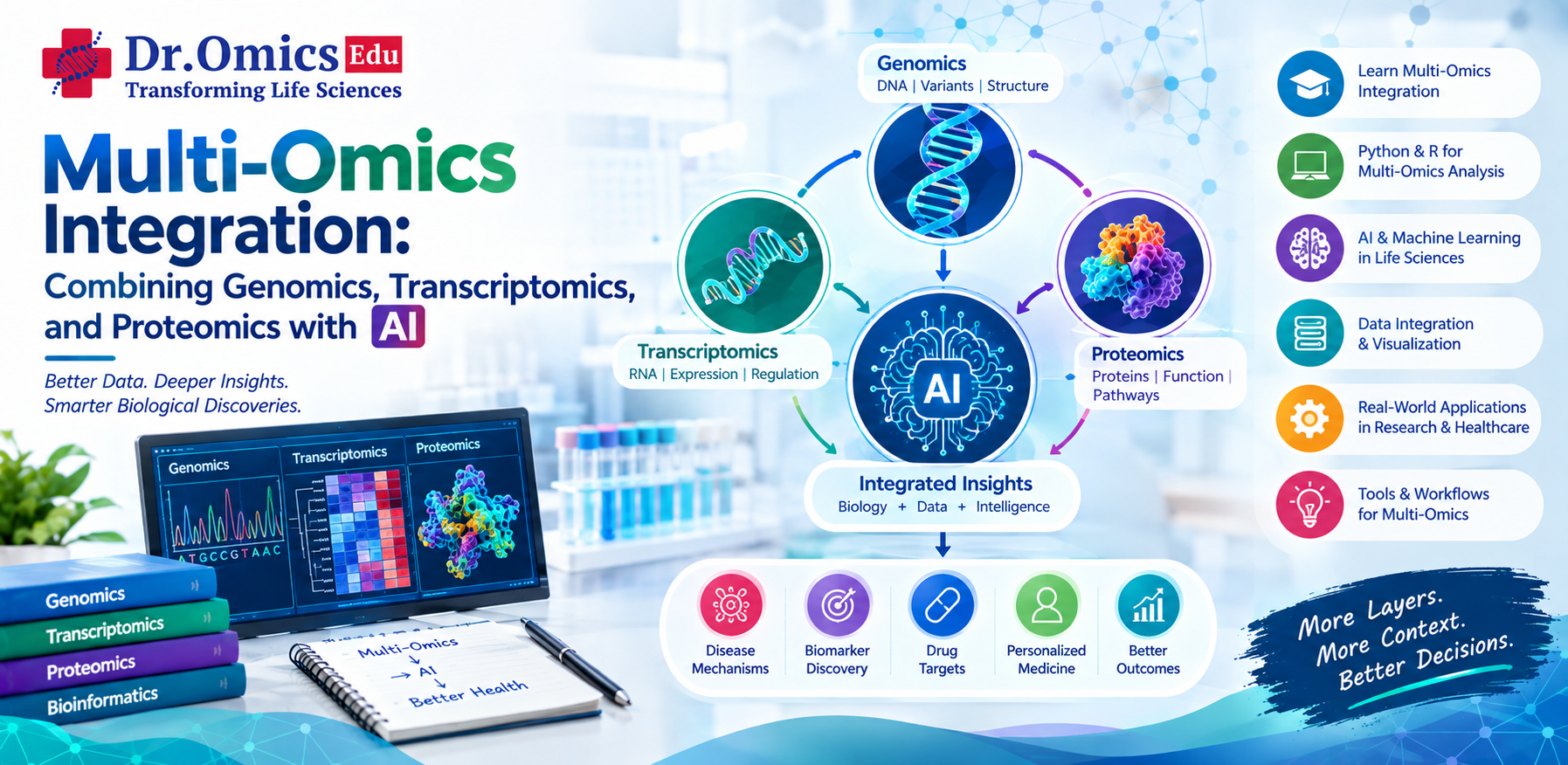
Multi-Omics Integration: Combining Genomics, Transcriptomics, and Proteomics with AI
Dr. Omics Edu Team ·
Modern biology is increasingly moving beyond the analysis of individual molecular layers. Genomics tells us about the DNA blueprint, transcriptomics reveals how genes are being expressed, and proteomics provides information about the proteins that ultimately perform many cellular functions. Combining these datasets through multi-omics analysis can provide a more comprehensive view of biological systems, disease mechanisms, and therapeutic responses.
With the rapid development of artificial intelligence, AI in multi-omics is making it possible to integrate increasingly complex datasets and identify biological relationships that may be difficult to detect using conventional analysis methods.
What Is Multi-Omics Integration?
Multi-omics integration refers to the computational combination of multiple biological data types, including genomics, transcriptomics, proteomics, metabolomics, epigenomics, and other molecular layers.
Each omics technology captures a different aspect of biology:
Genomics → What could happen?
Transcriptomics → What genes are being expressed?
Proteomics → What proteins are present and active?
When analyzed together, these layers can reveal connections between genetic variation, gene regulation, protein activity, and cellular phenotypes.
Why Combine Genomics, Transcriptomics, and Proteomics?
Analyzing one molecular layer can provide valuable information, but it may not fully explain a biological phenotype. For example, a genomic variant may affect a gene, but its functional consequences may only become apparent through changes in RNA expression or protein abundance.
Multi-omics integration can therefore help researchers move from identifying genomic associations toward understanding functional biological mechanisms.
This approach is particularly valuable in cancer research, precision medicine, drug discovery, biomarker identification, infectious disease research, and systems biology.
The Role of AI in Multi-Omics
The volume and complexity of omics datasets make computational integration challenging. This is where omics data integration AI approaches are becoming increasingly important.
Machine-learning and deep-learning models can identify patterns across molecular layers, discover relationships between features, reduce dimensionality, classify biological samples, and potentially predict disease outcomes.
Modern multi omics bio AI workflows may use methods such as neural networks, autoencoders, graph-based models, clustering algorithms, and multimodal learning architectures.
Instead of examining each dataset independently, AI can learn representations that capture information shared across multiple omics layers.
Multi-Omics in Systems Biology
Multi-omics is closely connected to systems biology bioinformatics, where researchers aim to understand biological systems as interconnected networks rather than isolated genes or proteins.
For example:
DNA variation → RNA expression → Protein abundance → Cellular pathway → Phenotype
Studying these relationships can reveal disease-associated pathways, regulatory networks, molecular subtypes, and potential therapeutic targets.
This systems-level perspective represents an important step beyond NGS analysis, where the goal is not simply to identify variants or quantify transcripts but to understand how molecular changes interact within biological systems.
Multi-Omics Research Methods
A typical multi omics research methods workflow may involve:
Data generation → Quality control → Individual omics analysis → Data preprocessing → Feature selection → Cross-omics integration → AI/ML modeling → Biological interpretation → Validation
Researchers must carefully address differences in data formats, scales, missing values, batch effects, sample matching, and experimental design. AI does not eliminate these challenges; high-quality preprocessing and biological validation remain essential.
Learning Multi-Omics Skills
As pharmaceutical companies, research institutes, and biotechnology organizations increasingly adopt integrated molecular analysis, expertise in multi-omics is becoming a valuable bioinformatics skill.
A structured multi omics integration course, integrative genomics course, or omics data analysis training can help learners understand sequencing technologies, statistical analysis, machine learning, data integration strategies, and biological interpretation.
The Future of Multi-Omics
The future of computational biology is moving toward increasingly integrated and AI-assisted analysis. By combining genomic, transcriptomic, proteomic, and other molecular information, researchers can build more complete models of biological systems.
Ultimately, multi-omics integration is not simply about combining datasets—it is about connecting molecular information to biological function. With AI accelerating this process, multi-omics has the potential to transform disease research, biomarker discovery, drug development, and precision medicine.
