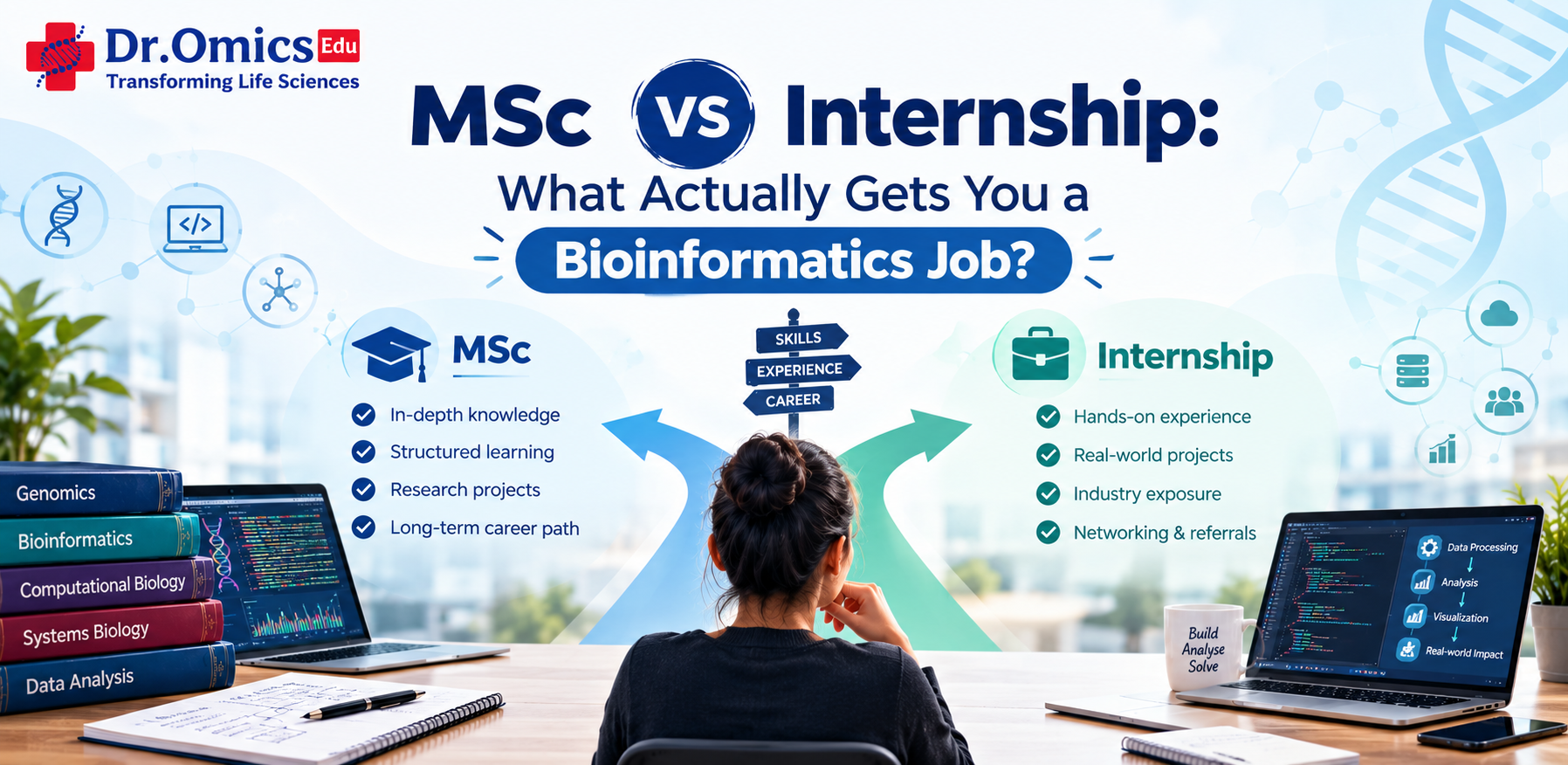
MSc vs Internship: What Actually Gets You a Bioinformatics Job?
Dr. Omics Edu Team ·
A common question among biology and biotechnology graduates is: “Do I need a master’s degree to get a bioinformatics job?” The answer depends on the role, employer, and—most importantly—the skills you can demonstrate.
An MSc can provide a strong academic foundation, while an internship can transform theoretical knowledge into practical experience. In today's increasingly skill-based hiring in biology, candidates who can demonstrate relevant technical abilities often have an advantage.
So, when comparing MSc bioinformatics vs internship, which path should you choose?
What Does an MSc in Bioinformatics Offer?
An MSc provides structured and comprehensive exposure to computational biology. Students may study programming, statistics, genomics, molecular biology, databases, NGS analysis, structural bioinformatics, and machine learning.
A master's degree can be particularly valuable for students who want to pursue research, specialized computational biology roles, higher education, or eventually a PhD.
However, completing an MSc does not automatically mean that a graduate is job-ready. The depth of practical exposure varies between programs. Employers may still expect candidates to understand Linux, bioinformatics tools, NGS workflows, programming, data interpretation, and scientific reporting.
What Is the Value of a Bioinformatics Internship?
The internship value in bioinformatics comes primarily from practical exposure. A well-structured internship allows learners to apply concepts to real or research-oriented datasets and understand how bioinformatics workflows operate.
For example, an NGS project may involve:
Raw sequencing data → Quality control → Preprocessing → Alignment → Variant analysis → Annotation → Interpretation
This type of hands-on training in bioinformatics helps students develop problem-solving skills that cannot be gained effectively through theory alone.
A strong internship can also provide a project for your CV, portfolio, or interview discussions.
Practical Skills vs Degree: What Do Employers Want?
The debate over practical skills vs degree is often misleading. A degree and practical experience serve different purposes.
An MSc demonstrates formal academic training, while practical projects demonstrate your ability to apply knowledge.
For entry-level roles, employers may evaluate skills such as:
- Linux and command-line usage
- Python or R
- NGS data analysis
- Sequence analysis
- Variant calling and annotation
- Statistics and visualization
- Bioinformatics workflow development
- Problem-solving and interpretation
Therefore, having a degree without practical skills can be limiting, while having practical skills can strengthen your profile significantly.
Can You Get a Bioinformatics Job Without a Master's?
Yes, some entry-level positions may be accessible through a bachelor's degree combined with relevant technical training, projects, and practical experience. However, requirements differ between organizations and job roles.
A bioinformatics job without a master's is more achievable when candidates can demonstrate what they can actually do through projects, internships, certifications, portfolios, or previous technical experience.
Similarly, a bioinformatics career without a PhD is entirely possible, particularly in industry-oriented roles involving data analysis, NGS, genomics, software, and computational workflows. A PhD becomes more important for many advanced research and academic positions.
Internship vs Higher Studies: Which Should You Choose?
If you need deeper theoretical knowledge and want to pursue research or advanced studies, an MSc may be the better choice.
If you already have a relevant academic background and need practical exposure, an internship can accelerate your transition toward job-ready skills.
The strongest approach is often to combine both: build your scientific foundation through education and strengthen it through real-world bioinformatics experience.
What Actually Gets You Hired?
There is no single qualification that guarantees a bioinformatics job. Employers increasingly look for candidates who can demonstrate knowledge, technical skills, project experience, and the ability to solve biological problems computationally.
Your degree may get your resume noticed—but your skills, projects, and ability to explain your work can determine what happens next.
Don't choose between education and experience. Build both.
Start with strong fundamentals, gain hands-on bioinformatics experience, work on meaningful projects, and develop a portfolio that demonstrates your capabilities.
The goal isn't simply to become qualified on paper. It's to become capable in practice.
