High-Performance Bioconductor: Optimizing Memory Allocation for Whole Genome Expression Matrices in R
Dr. Omics Edu Team · · Updated
Introduction
The increasing use of next-generation sequencing (NGS), single-cell RNA sequencing, and large-scale genomics projects has generated massive gene expression datasets that often contain millions of observations. While R remains one of the most widely used programming languages in bioinformatics, handling these large datasets efficiently can be challenging due to memory limitations and long processing times.
Fortunately, the Bioconductor ecosystem offers powerful solutions for managing large genomic datasets. By combining advanced R for bioinformatics techniques with optimized data structures and specialized packages, researchers can process whole genome expression matrices more efficiently without requiring high-end computing resources.
Why Memory Optimization Matters
Gene expression matrices generated from RNA-seq or single-cell experiments can occupy several gigabytes of memory. Loading these datasets entirely into RAM often slows analysis and may even cause R sessions to crash.
This is where Bioconductor memory optimization becomes essential. Efficient memory management reduces computational overhead, improves processing speed, and enables researchers to analyze larger datasets while maintaining reproducible workflows.
Instead of relying on standard R objects, many Bioconductor packages use memory-aware data structures that load only the required portions of a dataset during analysis.
Understanding Expression Matrices
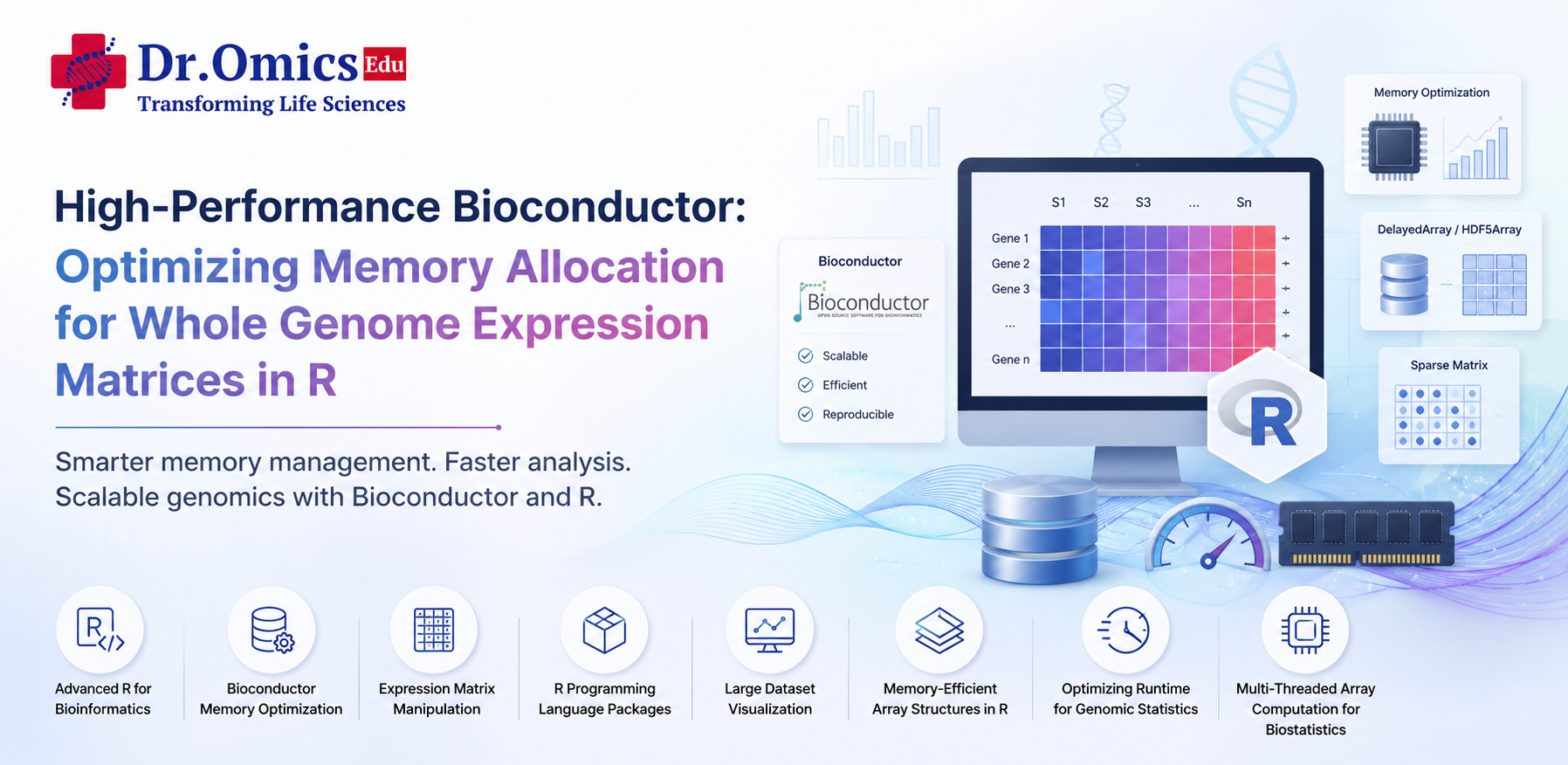
An expression matrix is the foundation of transcriptomic analysis. Each row represents a gene, while each column corresponds to a biological sample or individual cell. These matrices are used for differential expression analysis, clustering, pathway enrichment, and visualization.
Efficient expression matrix manipulation is critical because operations such as filtering, normalization, and transformation are performed repeatedly throughout a bioinformatics workflow. Optimized data handling significantly reduces both runtime and memory consumption.
Bioconductor Packages for Large Datasets
One of the biggest strengths of Bioconductor is its collection of specialized R programming language packages designed specifically for genomic data analysis.
Some widely used packages include:
- SummarizedExperiment for storing assay data with sample metadata.
- DelayedArray for working with datasets larger than available memory.
- HDF5Array for storing large matrices on disk while accessing them efficiently.
- BiocParallel for parallel computation.
- Matrix for sparse matrix representation.
These packages allow researchers to analyze whole genome datasets efficiently without loading every value into memory simultaneously.
Memory-Efficient Data Structures
Modern Bioconductor workflows increasingly rely on memory-efficient array structures in R. Instead of storing complete datasets in RAM, delayed operations calculate results only when needed.
Sparse matrices are particularly useful for single-cell RNA sequencing, where many genes have zero expression across numerous cells. By storing only non-zero values, memory usage can be reduced dramatically while maintaining analytical accuracy.
These optimized data structures make it possible to process datasets that would otherwise exceed available system memory.
Optimizing Runtime for Genomic Analysis
Large datasets not only require more memory but also increase computational time. Applying strategies for optimizing runtime for genomic statistics helps accelerate common analyses such as normalization, principal component analysis, clustering, and differential expression.
Researchers can improve performance by:
- Filtering low-quality genes before analysis.
- Using delayed computations instead of loading complete datasets.
- Selecting appropriate sparse matrix formats.
- Parallelizing computationally intensive tasks.
- Processing only required subsets of data whenever possible.
These approaches reduce execution time while improving workflow efficiency.
Multi-Threaded Computing in Biostatistics
Many modern computers contain multiple processor cores, allowing analyses to run simultaneously rather than sequentially. Bioconductor supports multi-threaded array computation for biostatistics through packages such as BiocParallel, enabling computational tasks to be distributed across multiple CPU cores.
Parallel processing is particularly useful for large RNA-seq studies, bootstrapping, permutation testing, and statistical modeling, where independent calculations can be performed concurrently. This significantly decreases analysis time without altering the underlying results.
Visualizing Large Expression Datasets
Visualization remains an important step in genomic data analysis, but plotting millions of data points can become computationally expensive.
Several Bioconductor and R packages support large dataset visualization by using efficient rendering methods and optimized data structures. Heatmaps, PCA plots, volcano plots, dimensionality reduction, and clustering visualizations can be generated more efficiently by working with filtered or summarized datasets instead of raw matrices.
Combining visualization with memory-efficient workflows allows researchers to explore complex biological patterns while maintaining good computational performance.
Best Practices for Efficient Bioconductor Workflows
To maximize performance when working with whole genome expression matrices:
- Use Bioconductor-specific data containers whenever possible.
- Store very large datasets using HDF5-backed files.
- Remove unnecessary objects from memory during analysis.
- Take advantage of parallel computing for intensive calculations.
- Filter datasets before performing downstream analyses.
- Update Bioconductor packages regularly to benefit from performance improvements.
Following these practices results in faster, more scalable, and reproducible bioinformatics workflows.
Conclusion
As genomic datasets continue to grow in size and complexity, efficient data management has become just as important as accurate biological analysis. By adopting advanced R for bioinformatics techniques and leveraging Bioconductor memory optimization, researchers can analyze large-scale expression data with greater speed and stability.
Modern R programming language packages, combined with memory-efficient array structures in R, simplify expression matrix manipulation, improve large dataset visualization, support optimizing runtime for genomic statistics, and enable multi-threaded array computation for biostatistics. Together, these tools allow scientists to process whole genome expression matrices more efficiently, making Bioconductor an essential platform for scalable and high-performance genomic research.
