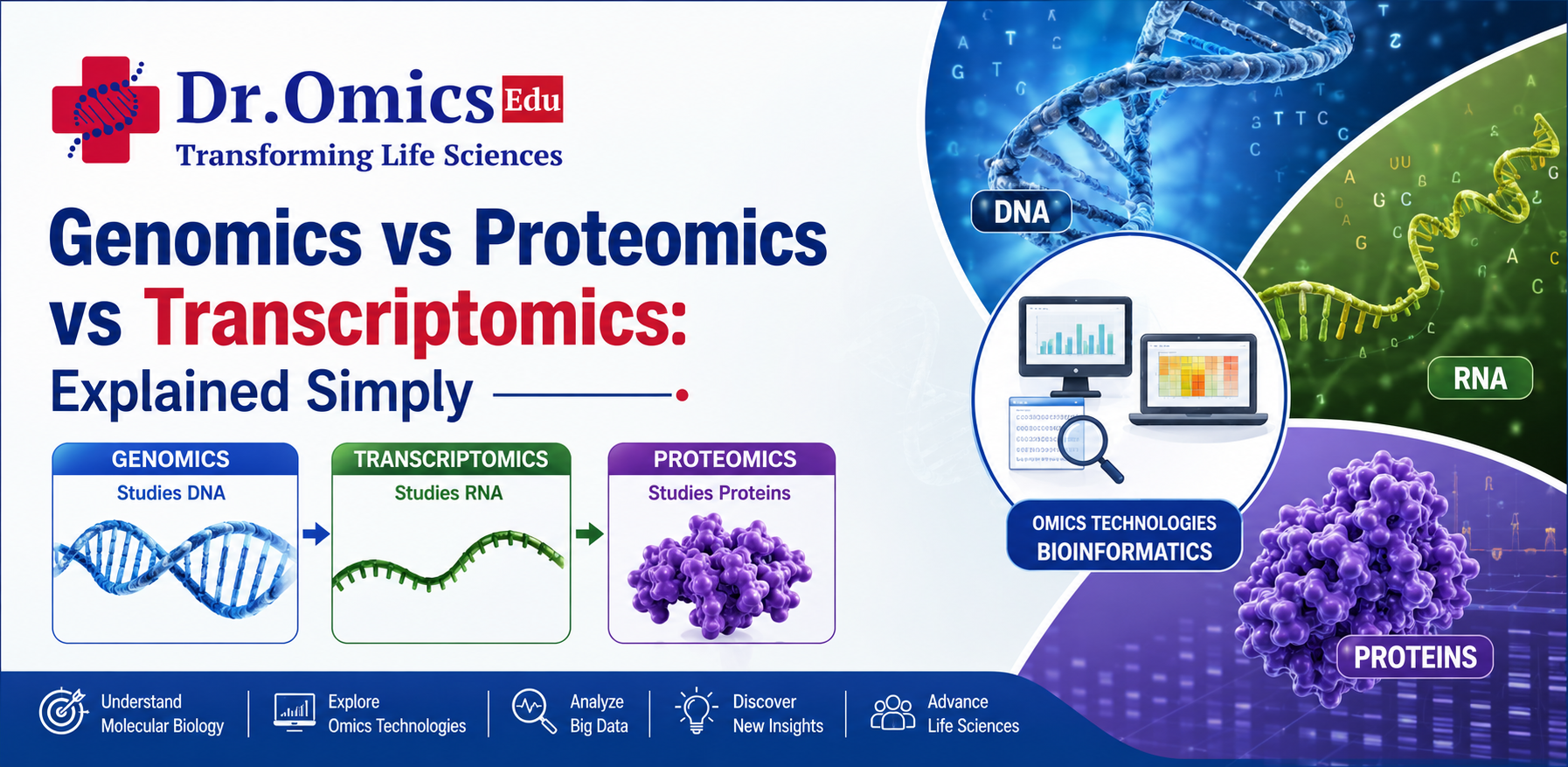
Genomics vs Proteomics vs Transcriptomics: Explained Simply
Dr. Omics Edu Team ·
Modern biology has entered an era where scientists can study living organisms at multiple molecular levels. Instead of examining one gene or one protein at a time, researchers can analyze thousands of biological molecules simultaneously. This has led to the development of powerful fields known as omics technologies.
Three of the most important areas are genomics, transcriptomics, and proteomics. Although these fields are closely connected, they study different types of biological information. Understanding the difference between genomics, proteomics, and transcriptomics is essential for anyone learning molecular biology or bioinformatics.
Simply explained:
Genomics studies DNA.
Transcriptomics studies RNA.
Proteomics studies proteins.
Together, they provide a more complete understanding of how living organisms function.
What Is Genomics?
Genomics is the study of an organism's complete genetic material, known as the genome. The genome consists primarily of DNA and contains the instructions required for the development and functioning of an organism.
Genomics can help answer questions such as:
- What genes are present in an organism?
- What mutations or genetic variants exist?
- Which DNA regions are associated with disease?
- How do different individuals differ genetically?
- How has a species evolved?
Modern DNA sequencing technologies allow researchers to generate enormous amounts of genomic data. Bioinformatics tools are then used to analyze these sequences.
A typical genomics workflow may include:
- DNA extraction
- DNA sequencing
- Quality control of sequencing reads
- Alignment to a reference genome
- Variant identification
- Functional annotation
- Biological interpretation
Genomics is widely used in human health, cancer research, agriculture, microbial research, evolution, and personalized medicine.
What Is Transcriptomics?
To understand transcriptomics explained simply, it is important to understand the role of RNA.
DNA contains the genetic instructions, but not every gene is active all the time. When a gene is expressed, its DNA information is copied into RNA. The complete collection of RNA molecules produced in a cell or tissue is called the transcriptome.
Transcriptomics studies these RNA molecules to understand which genes are active and how strongly they are expressed.
For example, two cells may contain nearly identical DNA but produce very different RNA molecules. This is because different genes can be switched on or off depending on the cell type, environment, developmental stage, or disease condition.
RNA sequencing, commonly known as RNA-Seq, is one of the most important technologies used in transcriptomics.
Transcriptomics can help answer questions such as:
- Which genes are expressed in a particular tissue?
- Which genes are upregulated or downregulated?
- How does gene expression change during disease?
- How do cells respond to treatment?
- What genes are involved in specific biological pathways?
A common transcriptomics workflow includes:
- RNA extraction
- RNA sequencing
- Quality control
- Read alignment or transcript quantification
- Gene expression analysis
- Differential expression analysis
- Functional and pathway analysis
In simple terms, transcriptomics tells us which genetic instructions are currently being used by the cell.
What Is Proteomics?
Proteomics is the large-scale study of proteins produced by a cell, tissue, or organism.
Proteins are essential molecules responsible for performing many biological functions. They act as enzymes, structural components, receptors, transporters, signaling molecules, and much more.
The complete set of proteins present in a biological system is called the proteome.
Proteomics can help answer questions such as:
- Which proteins are present?
- How much of each protein is produced?
- How do protein levels change during disease?
- What modifications occur in proteins?
- Which proteins interact with each other?
One of the most widely used techniques in proteomics is mass spectrometry. The resulting data can be highly complex and requires computational methods for protein identification and quantification.
Proteomics is particularly important because proteins are often the molecules that directly perform biological functions.
Genomics vs Proteomics vs Transcriptomics: The Simple Difference
The easiest way to understand these three fields is to follow the central flow of biological information:
DNA → RNA → Protein
Genomics studies the DNA.
Transcriptomics studies the RNA produced from DNA.
Proteomics studies the proteins produced as a result of gene expression.
This relationship provides an important framework for understanding molecular biology.
Genomics: The Blueprint
Think of DNA as a large instruction manual.
It contains information about what an organism could potentially produce.
However, having a gene in the DNA does not necessarily mean that the gene is active.
Transcriptomics: The Instructions Being Read
RNA represents the instructions currently being copied from the DNA.
Transcriptomics shows which genes are actively being expressed under specific conditions.
Proteomics: The Final Working Products
Proteins are the functional products that perform many of the activities within cells.
Proteomics helps us understand what is actually happening at the protein level.
Why Are These Three Fields Different?
One of the most important points in understanding the difference between genomics, proteomics, and transcriptomics is that information at one level does not always perfectly predict information at another level.
For example, a person may have a particular gene in their DNA, but that gene may not be expressed in every cell.
Similarly, a gene may produce a large amount of RNA, but this does not always mean that the corresponding protein will be produced at the same level.
Many additional biological processes influence the final outcome, including:
- RNA processing
- RNA degradation
- Translation efficiency
- Protein degradation
- Protein modifications
Therefore, studying only DNA may not provide the complete biological picture.
This is why researchers increasingly combine multiple omics technologies.
The Role of Bioinformatics in Omics Technologies
Modern sequencing and analytical technologies can generate extremely large datasets. A single genomics, transcriptomics, or proteomics experiment may produce millions or billions of data points.
Bioinformatics is essential for managing and analyzing this information.
In omics technologies bioinformatics, computational tools are used for:
- Data storage and management
- Quality control
- Sequence alignment
- Genome assembly
- Variant calling
- Gene expression analysis
- Protein identification
- Functional annotation
- Pathway analysis
- Data visualization
- Statistical analysis
Without bioinformatics, interpreting large-scale omics data would be extremely difficult.
For example, RNA-Seq experiments generate millions of sequencing reads. Bioinformatics pipelines are required to process the reads and determine which genes are differentially expressed between experimental groups.
Similarly, genomic sequencing data can be analyzed to identify mutations associated with disease, while proteomics data can reveal changes in protein abundance.
Applications in Human Health
The combination of genomics, transcriptomics, and proteomics has transformed biomedical research.
In cancer research, scientists may study:
- DNA mutations associated with cancer
- RNA expression changes in tumor cells
- Protein changes affecting cellular pathways
This provides a more complete understanding of how cancer develops and progresses.
The same approach can be applied to infectious diseases, genetic disorders, neurological conditions, and personalized medicine.
For example, genomics may identify a mutation, transcriptomics may reveal whether the affected gene is actively expressed, and proteomics may show how the mutation influences protein function.
Applications in Agriculture
Omics technologies are also increasingly important in agriculture.
Genomics can identify genetic variations associated with desirable crop traits.
Transcriptomics can help researchers understand how plants respond to drought, heat, or disease.
Proteomics can reveal changes in proteins involved in plant growth and stress responses.
By combining these approaches, researchers can develop improved crop varieties with characteristics such as:
- Higher yield
- Disease resistance
- Drought tolerance
- Improved nutritional value
- Better environmental adaptation
The Power of Multi-Omics
When genomics, transcriptomics, and proteomics are studied together, the approach is often called multi-omics.
Multi-omics provides a more complete understanding of biological systems because it examines multiple levels of molecular information.
For example:
Genomics can identify what genetic information is present.
Transcriptomics can identify which genes are actively expressed.
Proteomics can identify the proteins performing biological functions.
Combining these datasets can help researchers connect genetic variation with changes in gene expression and protein activity.
This approach is becoming increasingly important in precision medicine, cancer research, agriculture, drug discovery, and systems biology.
Which Omics Field Is Most Important?
There is no single answer because each field provides different information.
Genomics is essential for understanding the genetic blueprint.
Transcriptomics is important for understanding gene activity.
Proteomics provides information about functional molecules that directly perform many cellular activities.
The best approach depends on the research question.
If the goal is to identify DNA mutations, genomics may be most appropriate.
If the goal is to study changes in gene expression, transcriptomics is useful.
If the goal is to understand functional protein changes, proteomics may be the best choice.
In many modern research projects, combining multiple omics technologies provides the strongest and most complete results.
Conclusion
Understanding genomics vs proteomics vs transcriptomics is easier when we remember the basic biological flow: DNA → RNA → Protein.
Genomics studies the DNA and genetic blueprint of an organism. Transcriptomics examines RNA to understand which genes are actively expressed. Proteomics investigates proteins, the functional molecules responsible for carrying out many biological processes.
The main difference between genomics, proteomics, and transcriptomics lies in the type of biological molecule being studied. However, these fields are strongly interconnected.
With the rapid development of omics technologies, bioinformatics has become essential for processing and interpreting the enormous datasets generated by genomics, transcriptomics, and proteomics research. Together, these approaches are helping scientists gain deeper insights into human health, disease, agriculture, and biological systems.
As technology continues to advance, the integration of these omics fields through bioinformatics will play an increasingly important role in understanding the complexity of life.
