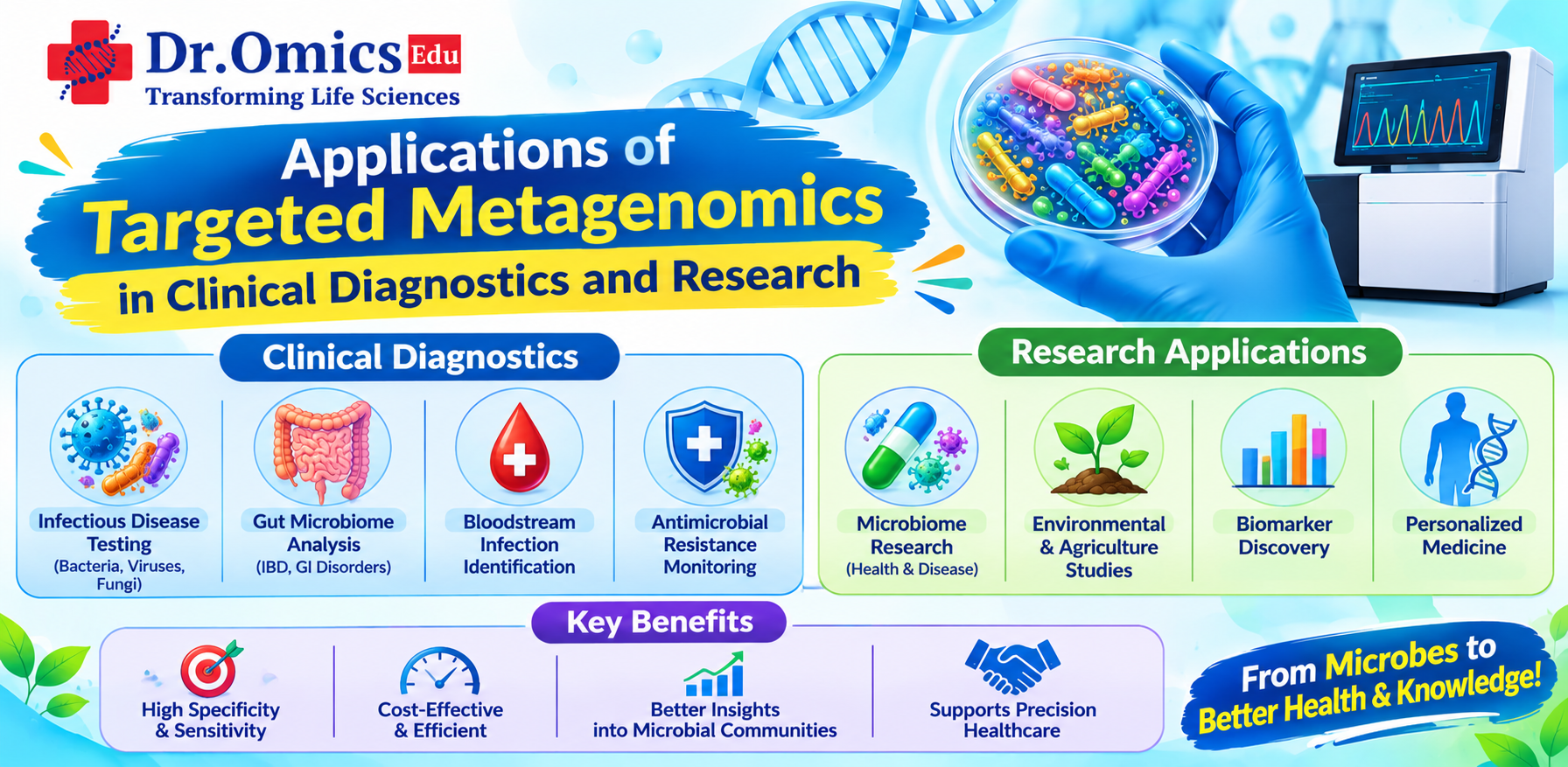
Applications of Targeted Metagenomics in Clinical Diagnostics and Research
Dr. Omics Edu Team ·
Introduction
Identifying microorganisms responsible for infections is an important part of clinical diagnosis and disease management. Traditional diagnostic methods, such as culture-based identification and targeted PCR, are widely used. However, these approaches may have limitations when dealing with complex infections, mixed microbial populations, or microorganisms that are difficult to culture.
Advances in DNA sequencing have introduced new ways to investigate microbial communities and detect potential pathogens. One such approach is targeted metagenomics, which focuses on sequencing selected genetic regions or groups of genes to study microorganisms present in a sample.
Unlike conventional diagnostic tests that look for a specific pathogen, targeted metagenomics can provide information about multiple microbial groups within a single sample, depending on the selected sequencing targets.
This approach has growing applications in clinical metagenomics, infectious disease research, microbiome studies, and pathogen surveillance.
In this blog, we will explore how targeted metagenomics works, its major applications in clinical diagnostics and research, and how it supports the investigation of infectious diseases.
1. What Is Targeted Metagenomics?
Targeted metagenomics is a sequencing-based approach in which specific genetic regions or marker genes are selected for amplification and analysis.
Instead of sequencing all the DNA present in a sample, researchers focus on particular genomic targets that help identify or characterize microorganisms.
Common examples include:
- 16S rRNA gene sequencing: Used mainly to study bacterial and archaeal communities.
- 18S rRNA gene sequencing: Used to investigate eukaryotic microorganisms, including some parasites and fungi.
- ITS sequencing: Commonly used for fungal identification and diversity analysis.
- Targeted pathogen panels: Focus on selected genes or genomic regions associated with specific pathogens.
For example, if a patient sample contains a complex bacterial population, 16S rRNA sequencing may help identify the bacterial groups present without requiring researchers to culture every organism individually.
The choice of target depends on the clinical question, sample type, and microorganisms being investigated.
2. How Does Targeted Metagenomics Work?
A typical targeted metagenomics workflow involves several laboratory and computational steps.
Step 1: Sample collection
Samples are collected depending on the suspected infection or research objective.
Common sample types include:
- Blood
- Stool
- Respiratory samples
- Urine
- Cerebrospinal fluid (CSF)
- Tissue samples
- Environmental or food samples
Sample collection and handling are critical because contamination can influence sequencing results, particularly when microbial DNA concentrations are low.
Step 2: DNA extraction
DNA is extracted from the sample using appropriate extraction protocols.
For some applications, RNA extraction followed by reverse transcription may also be required, particularly when RNA targets or RNA viruses are being investigated.
Step 3: Target amplification
Selected microbial genes or genomic regions are amplified using PCR primers.
For example, the 16S rRNA gene may be amplified using primers targeting the V3–V4 region to investigate bacterial communities.
Step 4: Library preparation and sequencing
Sequencing adapters and sample-specific barcodes are added to the amplified DNA. The prepared libraries are then sequenced using an appropriate sequencing platform.
Step 5: Bioinformatics analysis
The generated sequencing reads undergo computational analysis.
The major steps generally include:
- Quality control of sequencing reads.
- Removal of adapters and low-quality sequences.
- Denoising and sequence error correction.
- Taxonomic classification.
- Identification of microbial composition.
- Statistical analysis and biological interpretation.
Tools such as QIIME 2, DADA2, and suitable taxonomic reference databases are commonly used for marker-gene analysis.
The final output helps researchers understand which microbial groups or targeted organisms are detected in the sample.
3. Applications in Clinical Diagnostics
One of the important areas of clinical metagenomics is investigating infections where conventional diagnostic methods may not provide sufficient information.
3.1 Identification of microorganisms in complex infections
Some clinical samples contain multiple microorganisms. Identifying the organisms responsible for an infection can be difficult when several microbial populations are present.
Targeted sequencing can help characterize the microbial community in such samples.
For example, sequencing bacterial 16S rRNA gene regions from selected tissue or sterile-site samples may help identify bacterial DNA when routine culture methods do not provide an identification.
However, detecting microbial DNA does not necessarily confirm active infection. Results must be interpreted alongside clinical findings, sample quality, and contamination controls.
3.2 Investigation of culture-negative infections
In some cases, patients show signs of infection, but routine microbial culture does not identify an organism.
Possible reasons include:
- Previous antibiotic treatment.
- Microorganisms that are difficult to grow.
- Low microbial abundance.
- Inappropriate culture conditions.
- Complex microbial communities.
Targeted sequencing can provide additional information by detecting genetic material from microorganisms that may not be recovered through routine culture.
For example, bacterial 16S rRNA gene sequencing may support the investigation of suspected bacterial infections when conventional testing is inconclusive.
It is important to understand that sequencing does not replace culture in every situation. Culture can provide living isolates for antimicrobial susceptibility testing, which targeted DNA sequencing generally cannot provide on its own.
3.3 Investigation of respiratory infections
Respiratory samples can contain diverse microbial populations, including bacteria that naturally colonize the respiratory tract.
Targeted metagenomics can help characterize bacterial communities in respiratory samples and investigate changes associated with respiratory diseases.
For example, researchers may compare the bacterial composition of respiratory samples from healthy individuals and patients with chronic respiratory conditions.
However, detecting a microorganism in a respiratory sample does not automatically establish that it is causing the infection. Colonization and contamination must also be considered.
3.4 Gastrointestinal infection research
The gastrointestinal tract contains a large and diverse microbial community.
Targeted sequencing can help identify changes in microbial composition associated with gastrointestinal infections and other intestinal conditions.
For example, researchers can compare gut microbial profiles between individuals with gastrointestinal infections and healthy controls.
This may help identify bacterial community patterns associated with disease and support further investigation of host–microbe interactions.
4. Applications in Pathogen Detection and Infectious Disease Research
Pathogen detection metagenomics provides an opportunity to investigate microorganisms in a sample without designing a separate assay for every possible organism.
Targeted approaches are particularly useful when the research question involves a defined microbial group or a selected set of pathogens.
4.1 Detection of bacterial pathogens
Bacterial marker-gene sequencing can help identify bacterial groups present in clinical samples.
For example, 16S rRNA sequencing may support bacterial identification in selected cases involving:
- Bloodstream and tissue infections.
- Bone and joint infections.
- Respiratory infections.
- Gastrointestinal infections.
The level of identification depends on the target region, sequencing quality, and reference database. Closely related bacterial species may have very similar 16S sequences, making species-level identification difficult.
4.2 Fungal pathogen investigation
Fungal marker regions such as the Internal Transcribed Spacer (ITS) region are widely used for fungal identification and community analysis.
ITS sequencing can help investigate fungal diversity in clinical and environmental samples.
For example, researchers can use ITS-based approaches to characterize fungal populations in respiratory or other relevant samples.
The method's usefulness depends on the target organisms and validation of the assay for the intended clinical application.
4.3 Antimicrobial resistance research
Antimicrobial resistance is a major concern in infectious disease research.
Targeted sequencing can be designed to investigate selected antimicrobial resistance genes or genetic markers associated with resistance.
For example, researchers may examine the presence of genes associated with resistance to particular antibiotic classes in microbial communities.
However, detecting a resistance gene does not always establish that a particular pathogen carries it or that the organism will show phenotypic resistance. Additional information, such as genomic context, organism identification, and laboratory susceptibility testing, may be necessary.
4.4 Infectious disease surveillance
Targeted sequencing can also support surveillance studies by monitoring microbial populations across different locations or time periods.
Researchers may compare pathogen-associated sequences or microbial community profiles from different patient groups.
This can help investigate changes in microbial distribution and identify patterns that require further epidemiological investigation.
5. Applications in Microbiome Research
Targeted metagenomics is not limited to pathogen detection. It also has important applications in understanding microbial communities and their relationships with human health.
Some important microbiome research applications include:
The human gut contains a diverse microbial ecosystem that contributes to digestion, metabolism, immune regulation, and other biological processes.
16S rRNA sequencing is frequently used to study bacterial composition in stool samples.
Researchers may compare microbial diversity between healthy individuals and people with conditions such as inflammatory bowel disease, obesity, or metabolic disorders.
These studies can reveal associations between microbial composition and health conditions, although they do not independently establish causation.
5.2 Oral microbiome research
The oral cavity contains several microbial communities that may be associated with oral health and disease.
Targeted sequencing can help investigate changes in bacterial composition associated with:
- Dental caries.
- Periodontal disease.
- Oral inflammation.
- Changes in oral microbial diversity.
This information can help researchers understand the relationship between oral microbial communities and disease development.
5.3 Skin microbiome studies
The skin supports diverse microbial populations that contribute to its local microbial ecosystem.
Targeted sequencing can be used to compare microbial communities across different skin sites or between healthy and disease-associated conditions.
Such studies may provide insights into microbial changes associated with acne, eczema, and other skin conditions.
5.4 Environmental and agricultural microbiome research
Targeted sequencing is also used beyond human health.
In agriculture, researchers can investigate soil microbial communities and their association with plant health, nutrient cycling, and crop productivity.
Environmental researchers may use marker-gene sequencing to study microbial diversity in water, soil, and other ecosystems.
6. Targeted Metagenomics vs Shotgun Metagenomics
Although both approaches are used to study microbial communities, they differ in the type of DNA being sequenced.
Targeted metagenomics focuses on selected genes or genomic regions, whereas shotgun metagenomics sequences DNA from across the sample's microbial community.
The major differences include:
- Sequencing target: Targeted methods amplify selected marker genes or genomic regions. Shotgun sequencing analyzes a broader range of DNA.
- Microbial identification: Targeted approaches are useful for profiling selected microbial groups, while shotgun sequencing can provide broader taxonomic information.
- Functional analysis: Targeted marker-gene sequencing provides limited direct information about microbial functions. Shotgun sequencing can identify genes associated with metabolic pathways and other biological functions.
- Cost and data requirements: Targeted sequencing is generally less expensive and produces smaller datasets. Shotgun metagenomics usually requires greater sequencing depth and computational resources.
- Research applications: Targeted methods are useful for focused microbial profiling, while shotgun sequencing is more suitable when researchers need broader taxonomic and functional information.
The best approach depends on the research objective, sample characteristics, budget, and required level of microbial resolution.
7. Challenges and Limitations of Targeted Metagenomics
Although targeted metagenomics has several advantages, researchers must consider its limitations before interpreting results.
Primer bias: Primers may amplify some microbial groups more efficiently than others, affecting the observed microbial composition.
Limited taxonomic resolution: Some marker genes cannot reliably distinguish closely related microbial species.
Contamination: Reagents, laboratory environments, and sample handling can introduce unwanted microbial DNA, particularly in low-biomass samples.
Limited functional information: Marker-gene sequencing generally cannot provide the same level of direct functional information as shotgun metagenomics.
Detection versus infection: The presence of microbial DNA does not necessarily indicate an active infection. Clinical interpretation requires additional evidence.
Lack of antimicrobial susceptibility information: Detecting a pathogen through marker-gene sequencing does not automatically provide information about its antibiotic susceptibility.
Understanding these limitations is essential for designing reliable experiments and interpreting sequencing results accurately.
Conclusion
Targeted metagenomics has become a valuable approach in clinical diagnostics and microbiome research. By focusing on selected microbial genes and genomic regions, researchers can investigate microbial diversity, identify potential pathogens, and study microbial community changes across different biological samples.
Its applications range from investigating culture-negative infections and characterizing bacterial communities to studying the gut, oral, skin, and environmental microbiomes.
However, targeted sequencing should be selected according to the research objective, and its results must be interpreted carefully. It is not a universal replacement for culture, PCR, or shotgun metagenomics.
As sequencing technologies and bioinformatics methods continue to improve, targeted metagenomics is expected to remain an important approach in infectious disease research and microbiome science.
For anyone interested in infectious disease metagenomics, learning the principles of targeted sequencing, taxonomic classification, and microbiome bioinformatics provides a strong foundation for working with real-world microbial datasets.
