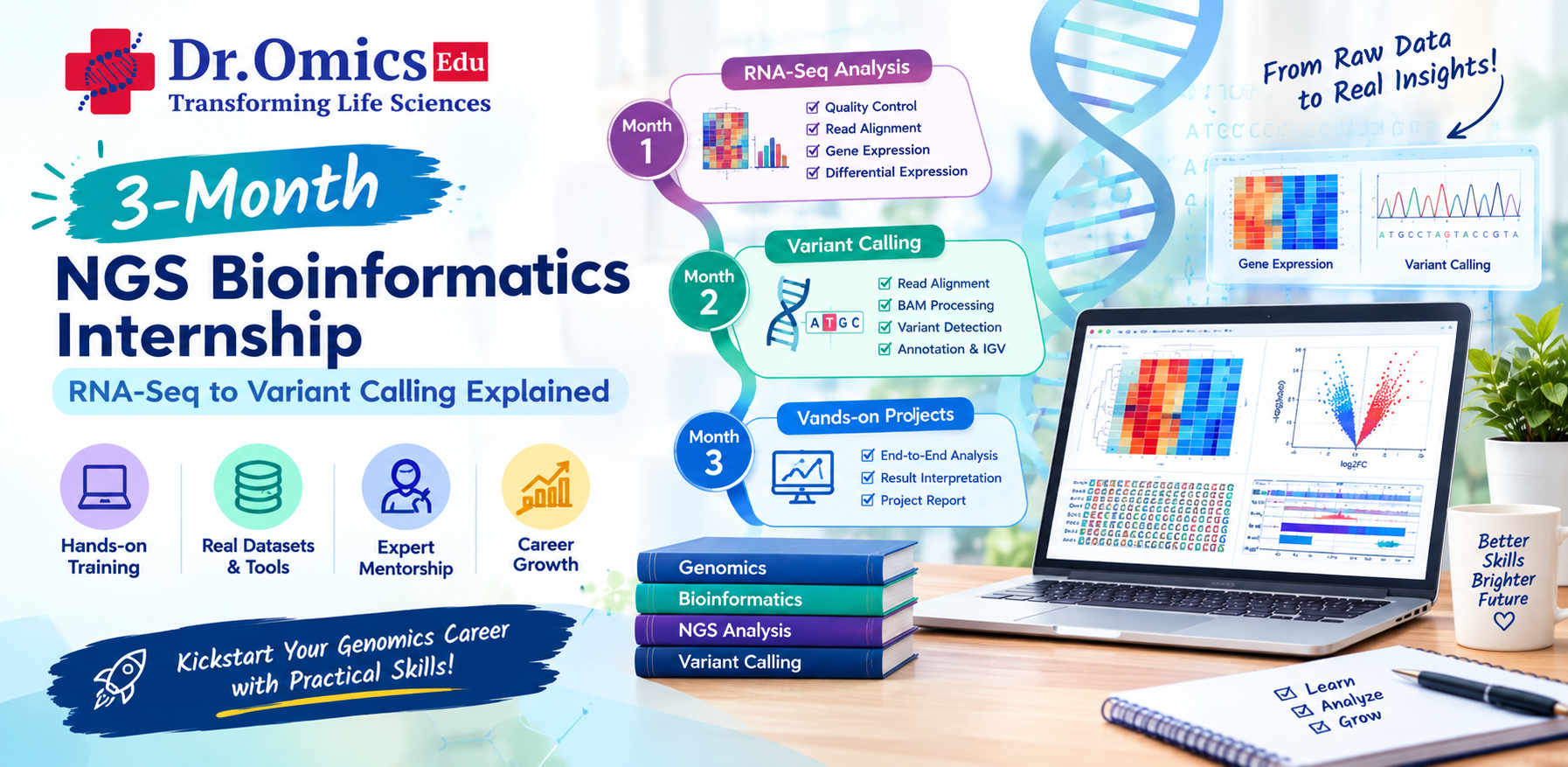
3-Month NGS Bioinformatics Internship: RNA-Seq to Variant Calling Explained
Dr. Omics Edu Team ·
Explore a 3-month NGS internship covering RNA-Seq analysis, variant calling, essential bioinformatics tools, and hands-on genomics projects.
Introduction: Build Practical Skills in NGS Bioinformatics
Next-generation sequencing (NGS) has transformed biological research by helping scientists study gene expression, genetic variations, and disease-associated changes in DNA. As sequencing technologies become increasingly important, the ability to analyze and interpret sequencing data is a valuable skill for aspiring bioinformaticians.
A structured NGS internship helps students connect their biological knowledge with computational techniques. A three-month learning program covering RNA-Seq and variant calling can introduce learners to two major applications of NGS while providing opportunities to practice essential bioinformatics tools.
What Will You Learn During a 3-Month NGS Internship?
Month 1: RNA-Seq Data Analysis
RNA sequencing (RNA-Seq) helps researchers understand gene expression and identify changes in gene activity under different biological conditions.
An RNA-Seq internship may introduce you to the following workflow:
Quality control: Assess sequencing read quality using FastQC and MultiQC.
Read preprocessing: Remove adapters and filter low-quality reads using fastp.
Read alignment: Map sequencing reads to a reference genome using HISAT2 or STAR.
Gene expression quantification: Count aligned reads using featureCounts.
Differential expression analysis: Identify genes with changes in expression using DESeq2.
Result interpretation: Explore volcano plots, heatmaps, and gene expression patterns.
Through these steps, learners can understand how raw sequencing data are processed into results that help answer biological research questions.
Month 2: Variant Calling and Genomic Analysis
Unlike RNA-Seq, which primarily focuses on gene expression, variant calling aims to identify differences between a sample's DNA sequence and a reference genome.
During variant calling training, learners can explore:
Read alignment using BWA.
BAM file processing and sorting using SAMtools.
Variant detection using GATK HaplotypeCaller.
Variant annotation using Ensembl VEP or SnpEff.
Variant visualization using IGV.
Interpretation of variant information stored in VCF files.
This workflow introduces learners to the computational steps used to identify and annotate genetic variants. Understanding these steps provides a foundation for further study in genomics, disease research, and precision medicine.
Month 3: Hands-On Projects and Workflow Integration
The final month can focus on applying the concepts learned during the first two months.
A hands-on bioinformatics internship should provide opportunities to work with suitable sequencing datasets and complete guided analytical exercises.
Possible project activities include:
Performing a complete RNA-Seq analysis on a selected dataset.
Comparing gene expression between control and treatment samples.
Running a guided variant-calling workflow.
Examining annotated variants and their potential biological relevance.
Preparing a report describing the methods, results, and conclusions.
These exercises help learners understand how individual bioinformatics tools work together in a complete workflow. They also encourage independent practice, troubleshooting, and scientific documentation.
Who Can Apply for a Genomics Internship in India?
A genomics internship India opportunity may be suitable for students and graduates from:
Bioinformatics
Biotechnology
Genetics and genomics
Microbiology
Biochemistry
Life sciences and computational biology
Basic molecular biology knowledge is helpful for beginners. Familiarity with Linux commands, Python, or R can be beneficial when progressing to more advanced analytical tasks.
What Should a Bioinformatics Internship Syllabus Include?
Before enrolling, review the bioinformatics internship syllabus to ensure it covers both theoretical concepts and practical applications.
Training module | Key learning outcomes |
NGS fundamentals | Understand sequencing technologies and file formats |
Quality control | Assess sequencing data quality |
RNA-Seq analysis | Learn read alignment, gene quantification, and differential expression |
Variant calling | Understand alignment, variant detection, and annotation |
Bioinformatics tools | Practice commonly used software and workflows |
Project work | Interpret results and prepare analytical reports |
A good next generation sequencing internship should explain why each analytical step is necessary, how to recognize common errors, and how to interpret the resulting data.
Why Choose a Structured NGS Internship?
A structured internship can help learners develop a clearer understanding of genomics workflows rather than learning individual tools in isolation.
Key benefits include:
Practical exposure: Understand how bioinformatics tools are used to analyze sequencing datasets.
Workflow knowledge: Connect the different stages of RNA-Seq and variant analysis.
Problem-solving skills: Learn to identify common issues involving file formats, quality control, and alignment.
Research preparation: Develop experience with data interpretation and project documentation.
Career development: Establish a foundation for advanced training, research projects, or relevant job opportunities.
Remember that completing an internship alone does not guarantee employment. Regular practice, strong biological understanding, and independent projects are important for continued development.
Conclusion: Take the Next Step in Your Bioinformatics Career
A three-month NGS internship can provide a valuable introduction to RNA-Seq analysis and variant calling. By progressing from sequencing fundamentals to practical workflows and guided projects, learners can develop a foundation in modern genomic data analysis.
Whether you are a biotechnology student, bioinformatics graduate, or life science researcher, structured training can help you identify the skills needed for your next learning milestone.
Ready to explore NGS bioinformatics?
Discover relevant training opportunities with Dr. Omics Edu and begin your journey into sequencing technologies, genomic data analysis, and computational biology.
Learn the tools. Practice the workflows. Explore the science behind the data.
