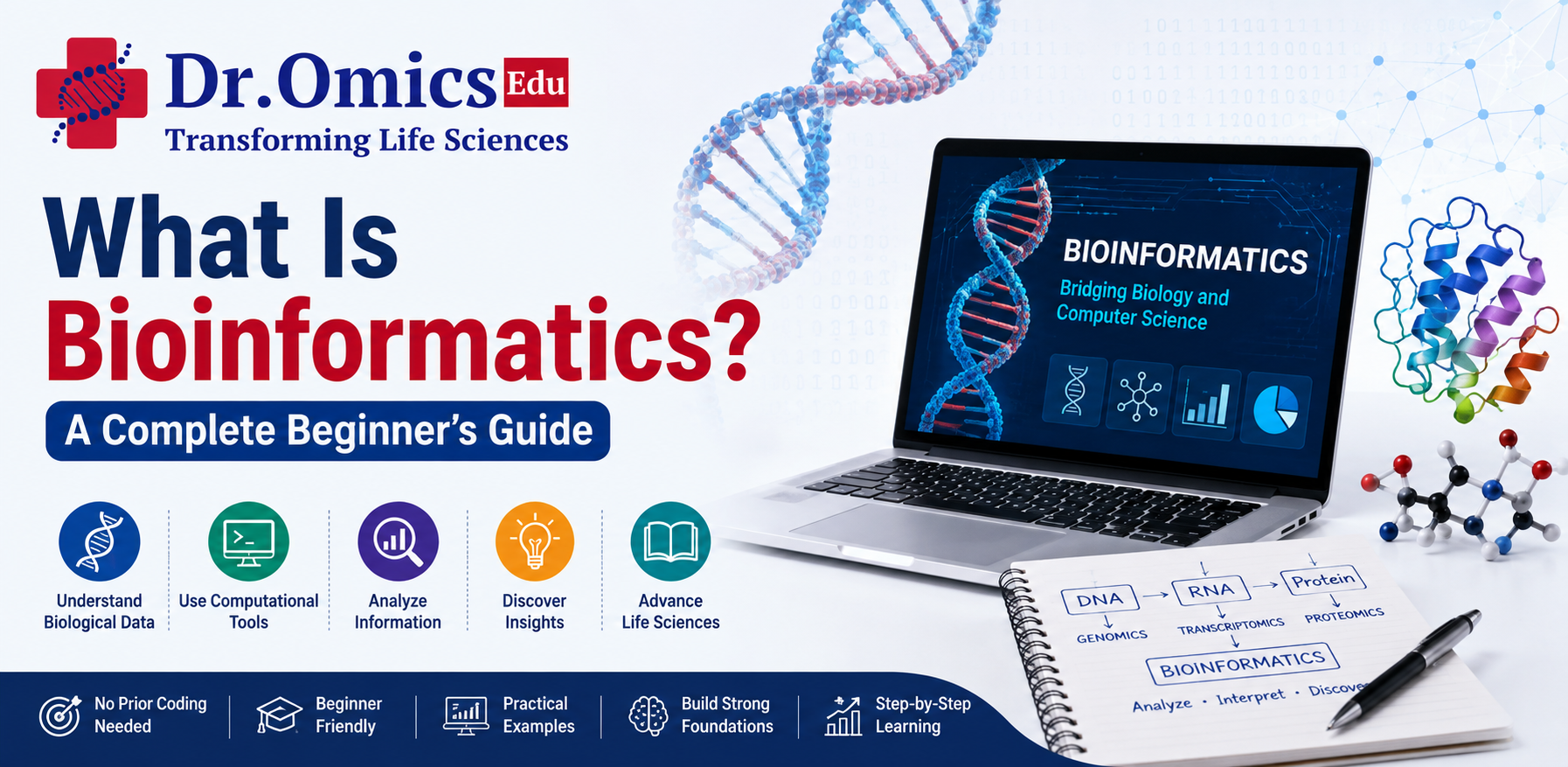
What Is Bioinformatics? A Complete Beginner’s Guide
Dr. Omics Edu Team ·
Biology has entered the age of big data. Modern technologies can generate enormous amounts of biological information, including DNA sequences, RNA expression data, protein structures, and genomic datasets. However, collecting this information is only the first step. Scientists also need effective ways to store, process, analyze, and interpret these complex datasets.
This is where bioinformatics plays an essential role.
If you are wondering what is bioinformatics, this beginner’s guide will help you understand the basic concepts, applications, tools, and importance of this rapidly growing field.
What Is Bioinformatics?
The simplest bioinformatics meaning is the use of computers, software, mathematics, and statistics to analyze biological data.
Bioinformatics combines several scientific disciplines, including:
- Biology
- Computer science
- Mathematics
- Statistics
- Data science
In simple terms, bioinformatics helps scientists make sense of large and complex biological datasets.
For example, a DNA sequencing machine can generate millions of DNA sequences in a single experiment. Analyzing these sequences manually would be almost impossible. Bioinformatics tools can process the data, compare sequences, identify genetic variations, and help researchers understand their biological significance.
Therefore, the answer to what is bioinformatics can be summarized as:
Bioinformatics is the science of using computational tools and methods to collect, manage, analyze, and interpret biological data.
Why Is Bioinformatics Important?
Modern biological research generates an enormous amount of data. Technologies such as next-generation sequencing can produce millions or billions of DNA or RNA reads.
Scientists need computational methods to answer important questions such as:
- Which genes are present in an organism?
- What mutations exist in a DNA sequence?
- Which genes are active in a particular tissue?
- How are two organisms genetically related?
- Which proteins interact with each other?
- What genetic changes are associated with disease?
Bioinformatics provides the tools needed to answer these questions efficiently.
Without computational analysis, much of the biological information generated by modern technologies would be difficult to interpret.
Bioinformatics Basics Explained
To understand bioinformatics basics explained, it is useful to think about a typical biological data analysis process.
A simplified workflow often includes:
1. Biological Data Generation
The first step is generating biological data through laboratory experiments.
Examples include:
- DNA sequencing
- RNA sequencing
- Protein analysis
- Microarray experiments
- Mass spectrometry
Modern technologies can generate very large datasets in a relatively short time.
2. Data Storage and Management
The generated data must be stored and organized properly.
Biological databases contain large amounts of information about genes, proteins, genomes, scientific publications, and other biological resources.
Bioinformatics helps researchers manage and access these datasets efficiently.
3. Quality Control
Raw biological data may contain errors, low-quality sequences, or unwanted information.
Bioinformatics tools are used to evaluate data quality before further analysis.
For example, sequencing reads can be checked for:
- Sequence quality
- Adapter contamination
- Read length
- Base composition
- Duplicate sequences
Quality control is an important step because poor-quality data can affect the final results.
4. Data Analysis
The next step involves analyzing the biological information.
Depending on the research question, this may include:
- Sequence alignment
- Genome assembly
- Variant calling
- Gene expression analysis
- Protein structure prediction
- Functional annotation
- Phylogenetic analysis
Different bioinformatics tools are used for different types of biological data.
5. Biological Interpretation
The final step is understanding what the results mean biologically.
For example, identifying a mutation is not enough. Researchers must determine whether the mutation affects a gene or protein and whether it may be associated with a biological condition.
This combination of computational analysis and biological interpretation is one of the most important aspects of bioinformatics.
Major Types of Biological Data
Bioinformatics deals with many different types of biological information.
DNA Data
DNA contains the genetic information of an organism.
Bioinformatics can be used to:
- Analyze DNA sequences
- Assemble genomes
- Identify mutations
- Compare genomes
- Study genetic variation
RNA Data
RNA provides information about gene activity.
RNA sequencing can help researchers determine:
- Which genes are expressed
- How strongly genes are expressed
- Which genes change under different conditions
This is particularly important in transcriptomics and gene expression studies.
Protein Data
Proteins perform many important biological functions.
Bioinformatics can help analyze:
- Protein sequences
- Protein structures
- Protein functions
- Protein interactions
Genomic Data
Genomics involves studying the complete genetic material of an organism.
Bioinformatics is essential for processing and interpreting large genomic datasets.
Common Applications of Bioinformatics
Bioinformatics is used in many areas of biological and medical research.
Genomics
Bioinformatics helps researchers study complete genomes.
Applications include:
- Genome sequencing
- Genome assembly
- Variant analysis
- Comparative genomics
- Gene annotation
Transcriptomics
Transcriptomics focuses on RNA and gene expression.
Bioinformatics tools can identify genes that are:
- Upregulated
- Downregulated
- Differentially expressed
RNA-Seq analysis is one of the most common applications in this field.
Proteomics
Proteomics involves the large-scale study of proteins.
Bioinformatics helps researchers analyze protein sequences, structures, functions, and interactions.
Drug Discovery
Bioinformatics can help identify potential drug targets and study interactions between biological molecules.
Computational approaches can reduce the time required to analyze large biological datasets during drug development.
Personalized Medicine
Every individual has genetic differences.
Bioinformatics can help analyze genetic information and support research into personalized approaches to healthcare and treatment.
Agriculture
Bioinformatics is also widely used in agriculture.
Researchers can study plant genomes to identify genes associated with:
- Higher crop yield
- Disease resistance
- Drought tolerance
- Improved nutritional quality
Evolution and Phylogenetics
Bioinformatics allows researchers to compare DNA and protein sequences between organisms.
This information can be used to study evolutionary relationships and construct phylogenetic trees.
Common Bioinformatics Tools and Databases
There are many tools and databases used in bioinformatics.
Some commonly known resources include:
Sequence Databases
Databases store DNA, RNA, and protein sequences that researchers can access and analyze.
Examples include:
- GenBank
- ENA
- DDBJ
Sequence Analysis Tools
Tools can compare biological sequences to identify similarities.
A well-known example is BLAST, which is used to compare a sequence against database sequences.
Genome Browsers
Genome browsers allow users to explore genomic regions and annotations visually.
Protein Databases
Protein databases provide information about protein sequences, functions, and structures.
Resources such as UniProt and the Protein Data Bank are widely used in biological research.
For someone starting with bioinformatics for beginners, learning how to search biological databases and interpret basic results is an excellent first step.
What Skills Are Needed to Learn Bioinformatics?
Bioinformatics is an interdisciplinary field, so different skills are useful.
Biology Knowledge
A basic understanding of biology is important.
Helpful topics include:
- DNA and RNA
- Genes
- Proteins
- Molecular biology
- Genetics
Computer Skills
Bioinformatics frequently involves using software and computational systems.
Basic knowledge of:
- Linux
- Command-line tools
- File management
can be very useful.
Programming
Programming is not always required when starting, but it becomes increasingly useful for advanced analysis.
Common programming languages include:
Python is widely used for data processing and automation, while R is commonly used for statistical analysis and data visualization.
Statistics
Basic statistical knowledge helps researchers interpret biological data and determine whether observed differences are meaningful.
Bioinformatics for Beginners: Where Should You Start?
Starting in bioinformatics can feel overwhelming because the field includes biology, programming, statistics, and computational analysis. However, beginners can learn step by step.
A useful learning pathway is:
Step 1: Learn Basic Molecular Biology
Understand:
- DNA
- RNA
- Proteins
- Genes
- Chromosomes
- Gene expression
Step 2: Learn Biological Databases
Explore databases containing biological information.
Practice searching for:
- Gene sequences
- Protein sequences
- Scientific literature
- Genome information
Step 3: Learn Basic Bioinformatics Analysis
Begin with simple tasks such as:
- Retrieving sequences
- Performing sequence similarity searches
- Aligning sequences
- Exploring genome browsers
Step 4: Learn Linux
Many bioinformatics tools are designed to run using the Linux command line.
Learning basic Linux commands can make it easier to work with bioinformatics software.
Step 5: Learn Programming
Start with Python or R.
You do not need to become an expert programmer immediately. Begin by learning how to:
- Read data files
- Manipulate datasets
- Automate simple tasks
- Create visualizations
Step 6: Learn NGS Data Analysis
After developing the basics, beginners can move toward next-generation sequencing analysis.
A typical NGS workflow may involve:
- Downloading sequencing data
- Quality control
- Read trimming
- Alignment
- Variant calling or gene expression analysis
- Functional interpretation
Bioinformatics and the Future of Biology
Bioinformatics is becoming increasingly important because biological datasets continue to grow.
Advances in technologies such as:
- Next-generation sequencing
- Artificial intelligence
- Machine learning
- Single-cell sequencing
- Multi-omics
are generating more complex biological information than ever before.
Computational analysis will therefore continue to play a central role in biological research.
The future of bioinformatics will involve combining different types of biological data, including genomic, transcriptomic, proteomic, and clinical information, to gain a more complete understanding of biological systems.
Is Bioinformatics Difficult to Learn?
Bioinformatics can initially seem challenging because it combines multiple disciplines. However, beginners do not need to master everything at once.
A strong approach is to learn progressively:
Biology → Databases → Basic tools → Linux → Programming → Advanced analysis
With regular practice, complex concepts become easier to understand.
The most important skill is learning how to connect computational results with biological questions.
Conclusion
So, what is bioinformatics?
Bioinformatics is the combination of biology and computational science used to analyze and interpret biological data. It plays a central role in modern research by helping scientists manage and understand large datasets generated from DNA, RNA, proteins, and other biological sources.
This bioinformatics introduction shows that the field has applications in genomics, transcriptomics, proteomics, medicine, agriculture, drug discovery, and evolutionary research.
For those interested in bioinformatics for beginners, the best approach is to start with basic molecular biology and gradually learn biological databases, analysis tools, Linux, programming, and data analysis.
As biological technologies continue to generate larger and more complex datasets, bioinformatics will remain one of the most important fields connecting computer science with modern life sciences.
