Reserve free seat
Free live 2-day crash course · September 2026 · Beginner friendly

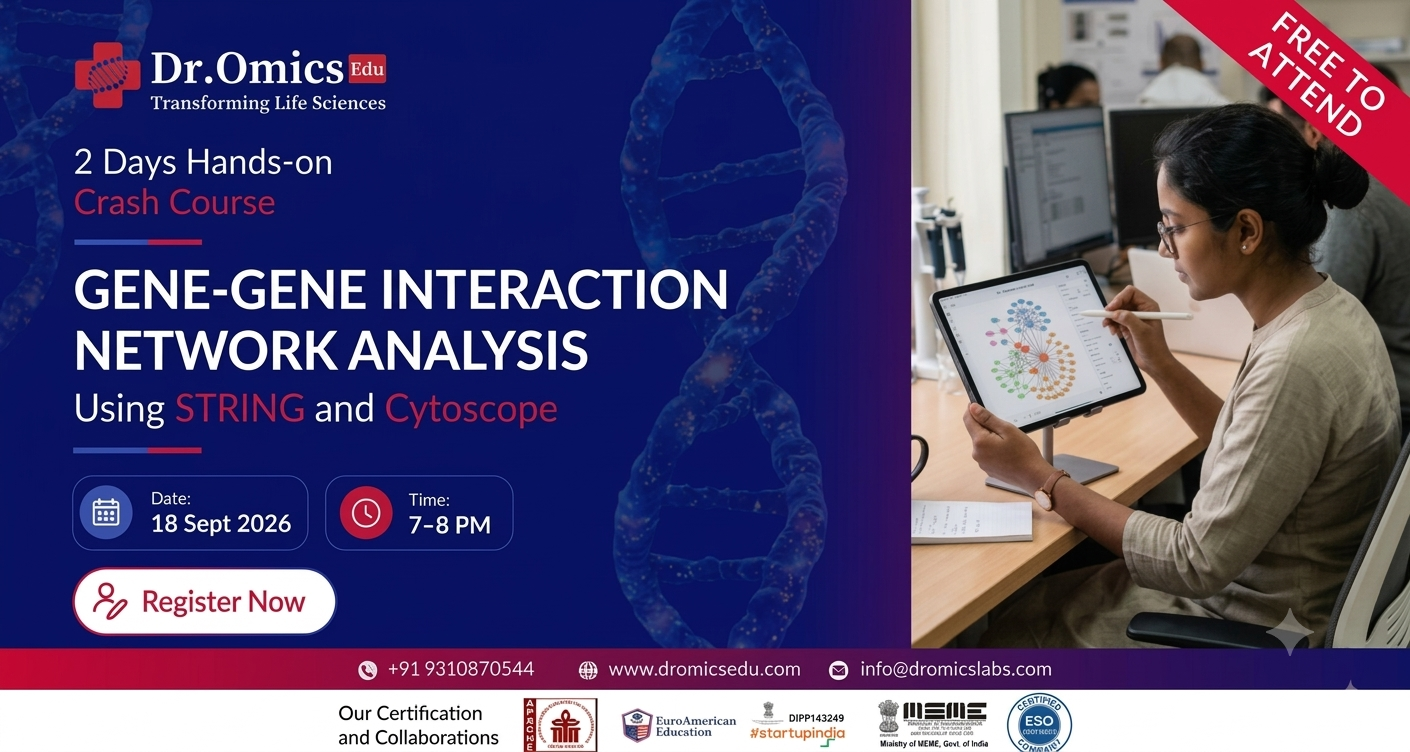
Gene-Gene Interaction Networks: STRING & Cytoscape Crash Course

Turn a gene list into biological insight in two intensive hands-on days. Learn PPI networks in STRING, network analysis in Cytoscape, and hub gene identification — building, scoring and interpreting interaction networks on real gene expression datasets.

Free to attend · Limited live seats
September 2026 Beginner to Intermediate · Real DEG lists Live Online Session
50,000+ learners trained
★★★★★ 4.9/5
Learn with Bioinformatics Experts at DrOmics Labs
Gene List to Insights · Network Workflow
Gene list STRING Cytoscape
Class starts in
days
hrs
min
sec
Grab a seat →
Attending is free

Free to join. Add what you need afterwards.

The live crash course costs nothing — the course fee is ₹0. The certificate and recording are an optional add-on from ₹599, with additional tiers available if you want study materials, practice datasets, project resources, or personalized guidance.

ATTEND LIVE
Free

No charges to attend the live crash course.

  • Live hands-on 2-day network analysis crash course
  • STRING networks, Cytoscape analysis & hub genes
  • Live tool demonstrations & Q&A with the trainer
Reserve free seat
Get certificate + recording
₹599.00

Proof of completion, plus access to the full session replay.

  • Everything in ATTEND LIVE
  • Certificate of participation
  • Full session recording
Certificate + Recording
Most picked + Study material & dataset
₹999.00

Everything you need to rebuild the whole workflow on your own gene list.

  • Everything in Get certificate + recording
  • Complete study material & reference notes
  • Practice DEG lists & exported network files
  • STRING & Cytoscape practice exercises
Get the bundle
+ Project template & 1:1
₹1499.00

For learners who want to apply network analysis to a real project of their own.

  • Everything in + Study material & dataset
  • Project template for a real study
  • Step-by-step analysis guide
  • One 1:1 review of your work
Book with review

Each tier includes everything in the one before it. Add-ons are entirely optional — you can attend the full live crash course without paying anything. See what we cover ↓

The syllabus

Two days, from a gene list to a publication-ready network

Start with what a gene-gene interaction network actually represents, then build one in STRING, carry it into Cytoscape, and finish by pulling out the hub genes and enriched pathways that explain your data.

01

Introduction to gene-gene interaction networks

What a network actually represents biologically, why interaction data is the bridge between a differential expression list and a mechanism, and where network analysis is genuinely used in disease research.

Networks · PPI · Systems biology
02

Gene interaction analysis using STRING

Build a network from your own gene list — the evidence channels behind each edge, what a confidence score means and where to set the threshold, and running functional enrichment directly in STRING.

STRING-db · Confidence · Enrichment
03

Hands-on network visualization

Make the network readable: build it, customise the layout, and interpret what the shape is telling you rather than accepting the default hairball.

Layout · Styling · Interpretation
04

Network analysis using Cytoscape

Import the STRING network into Cytoscape, apply topology metrics — degree, betweenness, closeness — to find the driver genes, and export a figure at publication resolution.

Cytoscape · Hub Gene ·
Skills you'll build

What you walk away able to do

STRING-db & PPI Networks Cytoscape Network Analysis Hub Gene Identification GO & KEGG Enrichment Publication-Quality Visualisation
Requirements

What you need before you start

Who it's for

For anyone with a gene list and no idea what to do with it next

If you have a differential expression list, or will have one soon, and want to turn it into a network that actually explains something — this crash course is for you.

Life sciences students

Undergraduate, postgraduate and PhD scholars in biotechnology, bioinformatics, biochemistry, genetics and microbiology.

Academic researchers & postdocs

Biologists analysing differential gene expression lists and high-throughput NGS data who need the interpretation step, not just the statistics.

Industry professionals

R&D scientists in pharmaceuticals, drug discovery and precision medicine looking for therapeutic targets in their own data.

Beginners entering systems biology

You understand basic biology but want to learn what actually happens between a list of gene symbols and a network figure in a paper.

What you'll learn

Build it, score it, interpret it — STRING to Cytoscape

  • Query and retrieve functional protein interaction data using the STRING database.
  • Import, parse and filter molecular interaction networks within Cytoscape.
  • Apply network topology metrics — degree centrality, betweenness, closeness — to isolate key driver genes.
  • Export publication-quality, high-resolution figures.

Certificate in Gene Network Analysis with STRING & Cytoscape

Complete the crash course to earn a certificate of completion issued by DrOmics Labs, demonstrating your practical understanding of PPI network construction, functional enrichment and hub gene identification.

Who's behind this

Taught by a working genomics lab — not a content channel

DrOmics is a molecular diagnostics and bioinformatics lab first. The training exists because we kept meeting researchers stuck on data they couldn't analyze.

Dr. Deepshikha Satish, PhD — Founder & CEO, DrOmics Labs
Founder

Dr. Deepshikha Satish, PhD

Founder & CEO · DrOmics Labs

DrOmics was founded by a translational bioinformatician who earned her PhD at the International Centre for Genetic Engineering and Biotechnology (ICGEB) and worked as a senior bioinformatics scientist before starting the lab. She built DrOmics around a gap she saw repeatedly: capable life-science researchers sitting on sequencing data with no practical way to analyze it.

That's the gap this masterclass is designed to close. The session itself is run by the DrOmics bioinformatics training team.

  • PhD, Translational Bioinformatics · ICGEB
  • 10+ international peer-reviewed publications
  • Woman Entrepreneur of the Year, 2024
  • CSIR-NET JRF qualified
Dr. Deepshikha on LinkedIn ↗
Research grants & funding from
DST AWS Illumina Pfizer–IIT Delhi
Skill-development collaborations
LSSSDC APSCHE
50,000+ students trained to date
What learners say

From a list of gene names to a network that explains them

★★★★★

"My DEG list used to just sit there. After understanding confidence scores and degree centrality, I can finally say which genes matter instead of just listing all of them."

RN
Rohit N. Bioinformatics Student
★★★★★

"The jump from STRING to Cytoscape was explained really well. Importing the network and running cytoHubba on it made the whole workflow finally click."

MJ
Meera J. Research Scholar · Biotechnology
★★★★★

"I had used STRING for years without really understanding the edges. Having the evidence channels and confidence thresholds explained properly changed how I read every network."

AS
Arjun S. Computational Biology Learner
Questions

Good things to know

Do I need previous bioinformatics experience? +

No. Day 1 starts with what a gene-gene interaction network is and why it matters, before touching any tool. A basic understanding of molecular biology — DNA, RNA, proteins and gene expression — is all you need.

Do I need programming experience? +

None at all. STRING runs in the browser and Cytoscape is a point-and-click desktop application — there is no coding anywhere in this crash course. Basic computer literacy is enough.

Which tools will we cover? +

The crash course covers the STRING database for building and scoring interaction networks, and Cytoscape for analysing them — including the cytoHubba and MCODE plugins for hub genes and dense clusters.

What do I need to know beforehand? +

A basic understanding of molecular biology concepts — DNA, RNA, proteins and gene expression — plus a computer with an internet connection. No prior network analysis or programming experience is expected.

Will this crash course include hands-on demonstrations? +

Yes. Both days are hands-on: you will build and score a network in STRING and read its enrichment on Day 1, then import it into Cytoscape, run the topology metrics and pull out hub genes on Day 2.

Is it really free? +

Yes — the course fee is ₹0 and attending the live crash course costs nothing. The certificate and recording are ₹599, study material and practice datasets are ₹999, and the project template with a 1:1 review is ₹1,699. These add-ons are completely optional and are not required to attend the live session.

What certificate do I get? +

Participants who choose the certificate option and complete the required learning activities receive a Certificate of Completion in Gene Network Analysis with STRING & Cytoscape, issued by DrOmics Labs.

Free · Live · Hands-on

Turn your gene list into a network in two days

Join the free live crash course and learn how a gene list moves from a STRING interaction network to hub genes and enriched pathways in Cytoscape. Understand the tools, interpret what the network is telling you, and leave with a publication-ready figure you produced yourself. Certificate, recording and study materials are optional add-ons.

September 2026 · Free to attend · Limited seats