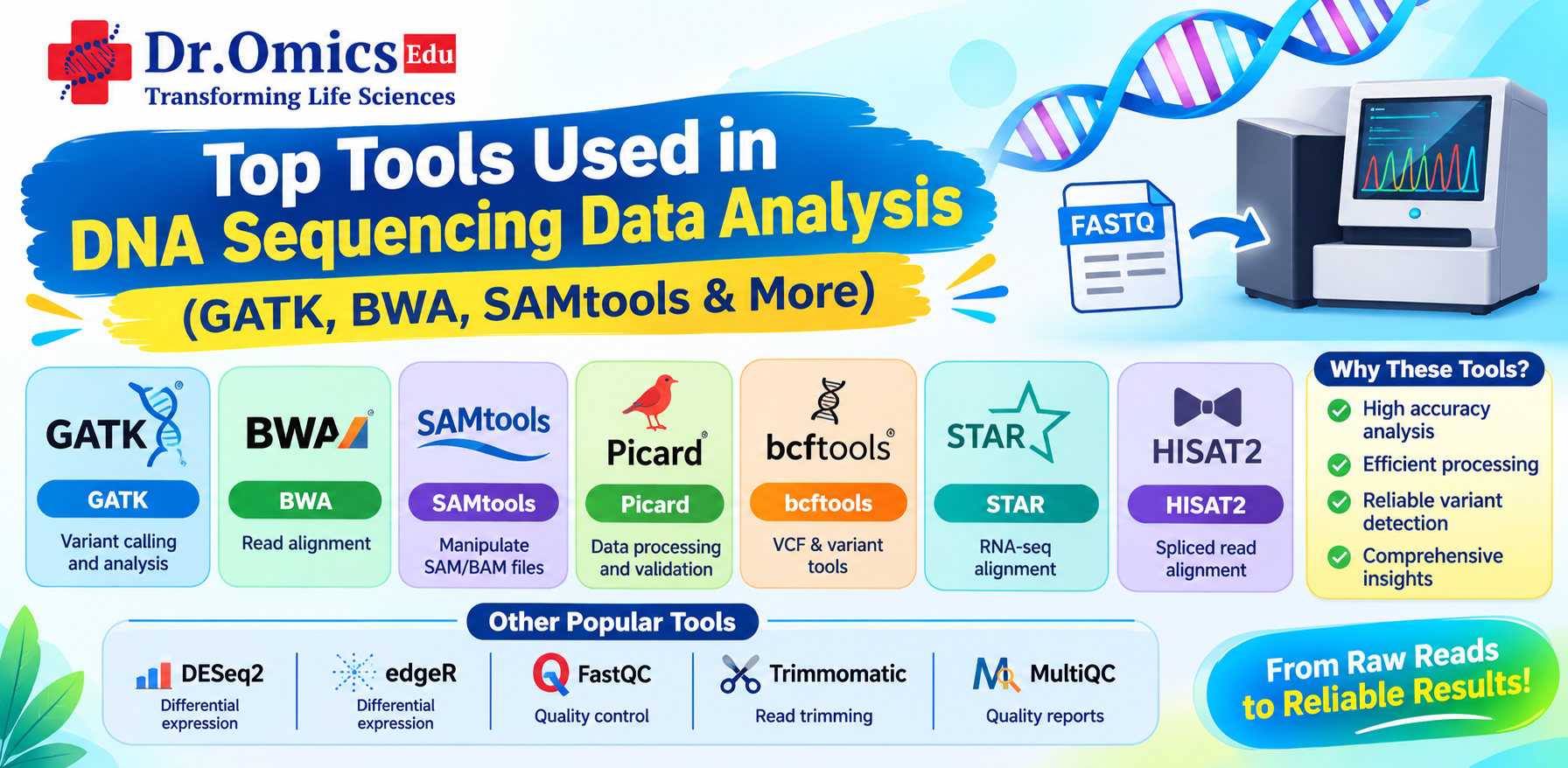
Top Tools Used in DNA Sequencing Data Analysis (GATK, BWA, SAMtools & More)
Dr. Omics Edu Team ·
Introduction
DNA sequencing has become an essential part of modern biological research, clinical genomics, disease studies, and precision medicine. With the advancement of Next-Generation Sequencing (NGS), researchers can generate millions of DNA sequencing reads in a single experiment. However, generating sequencing data is only the first step. The real challenge is processing these reads, identifying genetic variations, and interpreting their biological significance.
This is where DNA sequencing software and bioinformatics tools play an important role. Tools such as BWA, SAMtools, GATK, FastQC, and bcftools are widely used to process sequencing data and identify genetic variants.
Each tool performs a specific function in the DNA sequencing analysis workflow. Some tools evaluate sequencing quality, others align reads to a reference genome, while others identify variations such as SNPs and insertions or deletions (indels).
In this blog, we will explore the most commonly used NGS analysis tools, understand their applications, and see how they work together in a typical DNA sequencing data analysis pipeline.
1. Understanding the DNA Sequencing Data Analysis Workflow
Before exploring individual tools, it is important to understand the overall workflow.
In a typical Whole Genome Sequencing (WGS) or Whole Exome Sequencing (WES) analysis, raw sequencing reads are processed through several steps.
The general workflow includes:
- Quality control: Checking the quality of raw sequencing reads.
- Read trimming: Removing adapter sequences and low-quality bases when required.
- Read alignment: Mapping sequencing reads to a reference genome.
- Alignment processing: Sorting, indexing, and preparing alignment files.
- Variant calling: Identifying genetic variations from sequencing data.
- Variant filtering: Removing low-confidence variants.
- Variant annotation: Understanding the possible biological or clinical effects of identified variants.
Different bioinformatics tools are used at each stage.
2. FastQC – Quality Control of Sequencing Reads
FastQC is one of the most commonly used tools for checking the quality of raw sequencing data.
When sequencing is performed, the output is generally provided in FASTQ format. Each FASTQ file contains sequencing reads and their corresponding quality scores.
Before starting downstream analysis, researchers need to understand whether the sequencing data is reliable.
FastQC provides a detailed quality report containing several important parameters:
- Per-base sequence quality: Evaluates the quality scores at each position in the reads.
- Per-sequence quality scores: Shows the overall quality distribution across reads.
- GC content: Examines the GC percentage of sequencing reads.
- Sequence duplication levels: Identifies duplicated reads.
- Adapter content: Detects possible adapter contamination.
- Sequence length distribution: Shows the distribution of read lengths.
For example, if a sequencing dataset contains poor-quality bases towards the end of reads, researchers may consider trimming those regions before alignment.
Example command:
fastqc sample_R1.fastq.gz sample_R2.fastq.gz -o fastqc_results/
This command generates quality reports for both paired-end FASTQ files.
FastQC does not modify the sequencing data. It only evaluates and reports its quality.
3. BWA – Burrows-Wheeler Aligner
BWA is a widely used read alignment tool for mapping short DNA sequencing reads against a reference genome.
During DNA sequencing, millions of short DNA fragments are generated. These fragments need to be mapped to their corresponding locations in a reference genome to understand where they originated.
BWA performs this alignment efficiently, making it an important component of many WGS and WES pipelines.
Important BWA algorithms
BWA provides different algorithms for different sequencing data characteristics:
- BWA-MEM: Commonly used for aligning relatively long reads, including typical short-read sequencing data.
- BWA-backtrack: Designed primarily for shorter reads and older sequencing datasets.
- BWA-SW: Developed for longer reads but is less commonly used in modern short-read workflows.
BWA-MEM is frequently used in short-read DNA sequencing analysis.
How does BWA work?
BWA uses the Burrows-Wheeler Transform (BWT) and an FM-index to search for matching regions in the reference genome efficiently.
The general process involves:
- Preparing and indexing the reference genome.
- Reading sequencing data from FASTQ files.
- Finding matching regions in the reference genome.
- Generating alignment records in SAM format.
Example commands
Step 1: Index the reference genome
bwa index reference.fa
This creates index files required for alignment.
Step 2: Align paired-end reads
bwa mem reference.fa sample_R1.fastq.gz sample_R2.fastq.gz > sample.sam
This command aligns paired-end reads against the reference genome and generates a SAM file.
Why is BWA important?
BWA helps researchers determine the genomic location of sequencing reads. Accurate alignment is essential because incorrect read mapping can affect downstream variant identification.
4. SAMtools – Processing and Managing Alignment Files
After read alignment, the output is commonly generated in SAM format. However, SAM files are text-based and can become very large.
SAMtools is a collection of command-line utilities used to manipulate SAM, BAM, and CRAM alignment files.
It is one of the most important tools in a standard NGS analysis workflow.
Major applications of SAMtools
1. SAM to BAM conversion
BAM is the compressed binary version of SAM.
samtools view -bS sample.sam -o sample.bam
This converts the SAM file into BAM format.
2. Sorting alignment files
Alignment records need to be sorted by genomic coordinates for many downstream operations.
samtools sort sample.bam -o sample_sorted.bam
3. Indexing BAM files
Indexing allows tools to access specific genomic regions efficiently.
samtools index sample_sorted.bam
This generates an index file, generally with the .bai extension.
4. Checking alignment statistics
samtools flagstat sample_sorted.bam
This provides useful alignment statistics, including total reads, mapped reads, and properly paired reads.
5. Extracting reads from a genomic region
samtools view sample_sorted.bam chr1:100000-200000
This extracts alignments overlapping the specified region.
Why is SAMtools important?
SAMtools helps organize and manage alignment data before variant calling. Sorting, indexing, and checking alignment statistics are important quality-control steps in DNA sequencing analysis.
5. GATK – Genome Analysis Toolkit
GATK, developed by the Broad Institute, is one of the most widely used frameworks for variant discovery and genotyping in genomic sequencing data.
While BWA aligns reads and SAMtools processes alignment files, GATK is commonly used to identify genetic variants from aligned sequencing reads.
These variants may include:
- Single Nucleotide Polymorphisms (SNPs)
- Insertions and deletions (indels)
- Other forms of genetic variation, depending on the analysis workflow and caller
Important GATK tools
1. MarkDuplicates
PCR amplification and library preparation can generate duplicate sequencing reads. These duplicates may influence variant analysis.
GATK MarkDuplicates identifies and marks duplicate reads in alignment files.
gatk MarkDuplicates \
-I sample_sorted.bam \
-O sample_marked.bam \
-M duplicate_metrics.txt
2. BaseRecalibrator
Sequencing machines may introduce systematic errors in base quality scores.
BaseRecalibrator calculates covariates used to model these systematic errors. It generally uses known variant sites when available.
gatk BaseRecalibrator \
-I sample_marked.bam \
-R reference.fa \
--known-sites known_variants.vcf.gz \
-O recalibration.table
3. ApplyBQSR
This step applies the recalibration model generated by BaseRecalibrator.
gatk ApplyBQSR \
-I sample_marked.bam \
-R reference.fa \
--bqsr-recal-file recalibration.table \
-O sample_recalibrated.bam
4. HaplotypeCaller
HaplotypeCaller is a widely used GATK tool for identifying germline variants.
It uses local de novo assembly in active regions to help identify SNPs and indels.
gatk HaplotypeCaller \
-R reference.fa \
-I sample_recalibrated.bam \
-O sample.g.vcf.gz \
-ERC GVCF
The -ERC GVCF option generates a GVCF file, which retains genotype information useful for joint genotyping across multiple samples.
5. GenotypeGVCFs
When multiple samples are analyzed using the GVCF workflow, GenotypeGVCFs can be used to produce jointly genotyped variant calls.
gatk GenotypeGVCFs \
-R reference.fa \
-V sample.g.vcf.gz \
-O sample_variants.vcf.gz
For a multi-sample study, individual GVCFs are generally combined or imported into an appropriate joint-genotyping workflow before final genotyping.
Why is GATK important?
GATK provides a structured framework for identifying and evaluating genetic variants. It is widely used in human genetics, population genomics, cancer research, and clinical genomics.
However, the appropriate GATK workflow depends on the experimental design. Germline and somatic variant calling require different approaches, and not every dataset requires every preprocessing step.
6. BCFtools – Variant Calling and VCF Processing
BCFtools is another important tool in DNA sequencing analysis. It is used to call variants, filter variant records, and manipulate VCF and BCF files.
It works closely with SAMtools and supports several operations involving genomic variant data.
Important applications
1. Variant calling
BCFtools mpileup and call can be used together to identify variants from aligned sequencing reads.
bcftools mpileup -f reference.fa sample_sorted.bam | \
bcftools call -mv -Ov -o variants.vcf
Here:
- mpileup generates genotype likelihood information from the alignment.
- call identifies variants.
- -m uses the multiallelic caller.
- -v outputs variant sites.
- -Ov generates an uncompressed VCF file.
2. Filtering variants
bcftools filter -i 'QUAL>30 && DP>10' \
variants.vcf -o filtered_variants.vcf
This retains variants with quality greater than 30 and depth greater than 10.
These thresholds are examples, not universal standards. Appropriate filtering criteria should be selected according to the sequencing experiment and analysis objectives.
3. Extracting SNPs
bcftools view -v snps variants.vcf -o snps.vcf
This extracts SNP records from the VCF file.
Why is BCFtools useful?
BCFtools is particularly useful for variant calling and downstream VCF manipulation. It is also helpful when researchers need lightweight command-line operations on large variant datasets.
7. Additional Tools Used in DNA Sequencing Data Analysis
Apart from the major tools discussed above, several other tools are commonly used in NGS workflows.
Trimmomatic
Trimmomatic is used to remove adapter sequences and low-quality bases from Illumina sequencing reads.
It supports both single-end and paired-end read processing.
fastp
fastp is an all-in-one FASTQ preprocessing tool. It performs quality control, adapter trimming, filtering, and read correction where applicable.
It also generates HTML and JSON reports.
Picard
Picard is a collection of tools for manipulating high-throughput sequencing data.
It is commonly used for operations such as marking duplicates, collecting alignment metrics, and working with SAM/BAM files.
FreeBayes
FreeBayes is a haplotype-based variant detector used to identify SNPs, indels, and other small variants from aligned sequencing reads.
It is useful for germline and population-based variant analysis.
DeepVariant
DeepVariant is a deep-learning-based variant caller developed by Google. It uses neural networks to identify genetic variants from sequencing data.
It supports different sequencing technologies and has dedicated models for supported data types.
VEP – Variant Effect Predictor
After identifying variants, researchers need to understand their potential biological effects.
Ensembl VEP is used to annotate variants with information such as:
- Affected genes and transcripts
- Consequence types
- Predicted protein changes
- Known variant identifiers
- Population frequency information, where available
- Clinical and functional annotations from supported sources
Variant annotation helps connect raw variant calls with their possible biological significance.
8. Variant Calling Tools Comparison
Different variant callers are designed for different purposes. Selecting the appropriate tool depends on the sequencing technology, study design, variant type, and research objective.
| Tool | Main application | Common use |
| GATK HaplotypeCaller | Germline variant calling | Human WGS and WES |
| BCFtools | Variant calling and VCF processing | Population and small-variant analysis |
| FreeBayes | Haplotype-based variant calling | Germline and population studies |
| DeepVariant | Deep-learning-based variant calling | Supported short- and long-read datasets |
| GATK Mutect2 | Somatic variant calling | Cancer sequencing |
| Strelka2 | Germline and somatic variant calling | WGS, WES and cancer studies |
There is no single best variant caller for every sequencing project.
For example, GATK HaplotypeCaller is widely used for germline variant discovery, whereas Mutect2 is designed for somatic variant calling. DeepVariant offers a machine-learning-based approach, while BCFtools provides flexible command-line variant calling and manipulation.
Researchers should select tools based on their experimental requirements and validate their performance using suitable benchmarks or known reference datasets.
9. Putting Everything Together: A Basic DNA Sequencing Analysis Pipeline
Now that we understand the major tools, let's see how they work together in a practical workflow.
Consider a paired-end Whole Genome Sequencing dataset containing:
- sample_R1.fastq.gz
- sample_R2.fastq.gz
- reference.fa
The following example illustrates a simplified germline variant analysis workflow.
Step 1: Quality control
fastqc sample_R1.fastq.gz sample_R2.fastq.gz
Step 2: Read alignment using BWA
bwa index reference.fa
bwa mem reference.fa sample_R1.fastq.gz sample_R2.fastq.gz > sample.sam
Step 3: Convert and sort using SAMtools
samtools view -bS sample.sam | \
samtools sort -o sample_sorted.bam
Step 4: Index the BAM file
samtools index sample_sorted.bam
Step 5: Mark duplicates using GATK
gatk MarkDuplicates \
-I sample_sorted.bam \
-O sample_marked.bam \
-M metrics.txt
Step 6: Call variants using GATK HaplotypeCaller
gatk HaplotypeCaller \
-R reference.fa \
-I sample_marked.bam \
-O sample_variants.vcf.gz
This simplified example demonstrates the relationship between quality control, alignment, alignment processing, and variant calling.
For production germline workflows, additional steps may include reference dictionary and sequence-dictionary preparation, base quality score recalibration where appropriate, GVCF generation, joint genotyping, variant filtering, and annotation.
The reference genome build and all associated resources must also be consistent throughout the analysis.
10. How to Choose the Right NGS Analysis Tools
Choosing the right software is an important part of designing a reliable DNA sequencing pipeline.
Consider the following factors:
1. Sequencing technology
Different tools support different sequencing technologies. A pipeline designed for Illumina short reads may not be directly suitable for Oxford Nanopore or PacBio long reads.
2. Research objective
The tools required for germline variant calling may differ from those used in cancer studies, structural variant detection, or population genomics.
3. Computational resources
Some tools require significant memory and processing power, especially when analyzing large WGS datasets.
4. Accuracy and validation
Variant calling performance should be evaluated using suitable reference datasets, benchmarking resources, and quality metrics.
5. Reproducibility
Version control, reference genome tracking, parameter documentation, and workflow management are essential for reproducible analysis.
Tools such as Nextflow and Snakemake can help automate complex NGS workflows and make them easier to reproduce.
Conclusion
DNA sequencing data analysis involves multiple steps, and each step requires specialized bioinformatics software. FastQC evaluates sequencing quality, BWA aligns reads to a reference genome, SAMtools processes alignment files, and GATK supports variant discovery and genotyping. Additional tools such as BCFtools, FreeBayes, DeepVariant, and VEP provide further capabilities for variant calling and interpretation.
Understanding these tools is an important step for anyone learning NGS data analysis or working in genomics research. Rather than learning each tool independently, it is useful to understand how they connect within a complete DNA sequencing workflow.
With practical experience in these DNA sequencing software tools, bioinformatics professionals can develop reliable analysis pipelines and work confidently with real-world genomic datasets.
