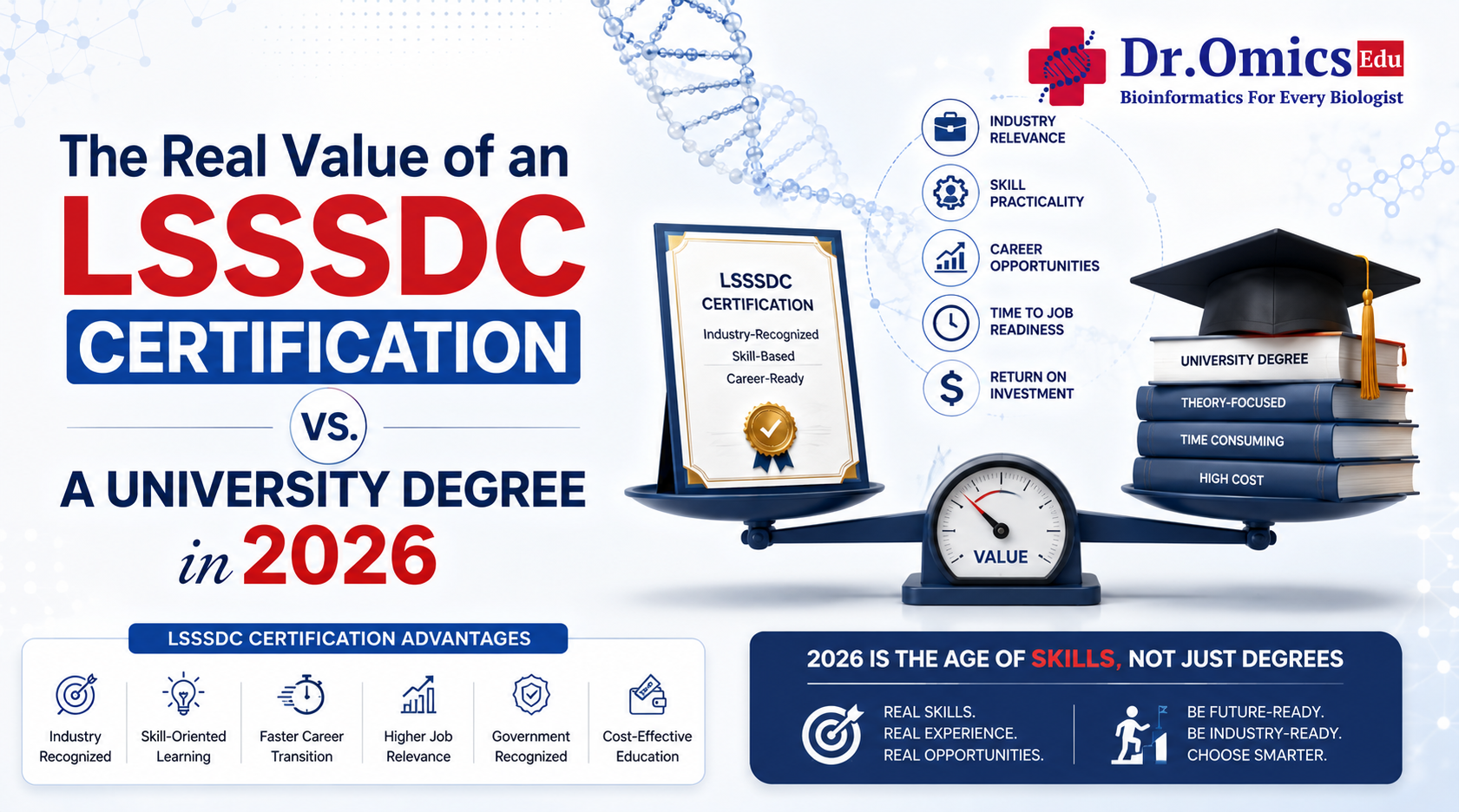
The Real Value of an LSSSDC Certification vs. a University Degree in 2026
Dr. Omics Edu Team · · Updated
In today's competitive life sciences industry, earning a university degree is no longer the only pathway to a successful career. Employers are increasingly seeking professionals with practical, industry-ready skills alongside academic qualifications. This shift has sparked an important question among aspiring bioinformatics professionals: What offers greater career value in 2026—a university degree or an LSSSDC certification?
If you're planning a bioinformatics career in India, understanding the difference can help you make smarter career decisions.
University Degree vs. LSSSDC Certification
A university degree provides a strong academic foundation in biology, genetics, biotechnology, and computational sciences. It focuses on theoretical knowledge and research principles, preparing students for higher education and scientific exploration.
An LSSSDC certification value, however, lies in its industry-driven curriculum. Developed under the National Skill Development Corporation (NSDC), these certifications are designed in collaboration with biotechnology companies to bridge the gap between classroom learning and workplace expectations.
While a degree teaches what bioinformatics is, an LSSSDC certification teaches how to perform real-world bioinformatics tasks.
Why Recruiters Prefer Job-Ready Skills
Today's employers prioritize candidates who can contribute from day one. Whether it's NGS data analysis, RNA-Seq workflows, Python programming, R, Linux, or genomic data interpretation, organizations value professionals with job-ready skills that align with industry demands.
This is where LSSSDC-certified programs stand out. They emphasize:
- Hands-on training with industry-standard bioinformatics tools
- Real-world projects and case studies
- Practical workflow development
- Assessment through standardized skill evaluation
- Industry-recognized certification
These skills significantly improve employability, especially for fresh graduates entering the life sciences sector.
Government Certification vs. Degree: Which Holds More Value?
The debate around government certification vs degree isn't about choosing one over the other—they complement each other.
A university degree establishes academic credibility, while an LSSSDC certification validates practical competency. Together, they create a stronger professional profile that appeals to recruiters in biotechnology, genomics, clinical diagnostics, pharmaceutical companies, and research organizations.
Is LSSSDC Worth It?
A common question among students is, "Is LSSSDC worth it?"
For aspiring bioinformatics professionals, the answer is increasingly yes. Since LSSSDC certifications are aligned with industry skill standards and supported by NSDC, they provide recognized evidence of practical expertise. The NSDC certification benefits include enhanced credibility, structured skill development, and better alignment with employer expectations.
For candidates transitioning from wet-lab biology to computational biology, these certifications also provide a structured pathway into one of the fastest-growing domains in life sciences.
Career Growth and Salary Potential
As India's genomics and biotechnology sectors continue to expand, demand for skilled bioinformatics professionals is rising. Individuals with both academic qualifications and practical certifications are often better positioned for competitive opportunities and improved bioinformatics analyst salary India prospects.
Recruiters increasingly value candidates who demonstrate technical proficiency, analytical thinking, and the ability to work with modern bioinformatics workflows.
Final Takeaway
In 2026, success in bioinformatics depends on more than earning a degree. Combining academic knowledge with industry-recognized certification creates a powerful advantage in today's competitive job market. If your goal is to build a rewarding bioinformatics career in India, an LSSSDC certification can complement your university education by providing the practical, job-ready skills employers actively seek. Together, they offer a stronger foundation for long-term career growth in the rapidly evolving world of bioinformatics.
