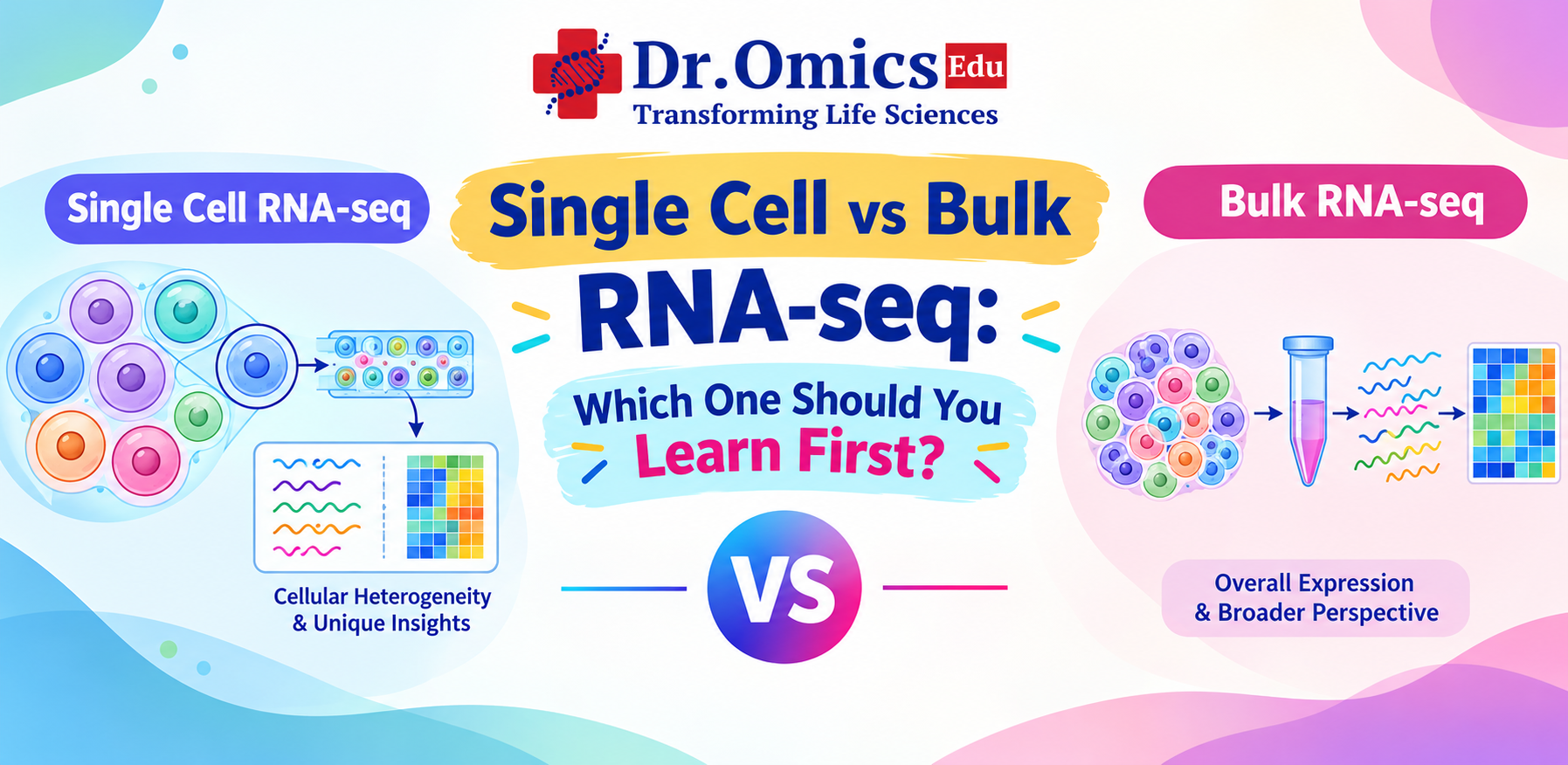
Single Cell vs Bulk RNA-seq: Which One Should You Learn First?
Dr. Omics Edu Team ·
A beginner-friendly guide to transcriptomics, bioinformatics skills, and career development
Introduction
RNA sequencing (RNA-seq) has become an essential technique in modern bioinformatics, helping researchers understand gene expression, disease mechanisms, treatment responses, and biological processes. From cancer research to drug discovery and immunology, RNA-seq provides valuable insights into how genes behave under different conditions.
However, if you are beginning your journey in bioinformatics, you may have an important question: Should you learn bulk RNA-seq or single-cell RNA-seq first?
Both techniques are widely used in transcriptomics, but they differ in the type of biological information they provide, the complexity of their analysis, and the skills required to work with them.
Single-cell RNA-seq is often considered an advanced technology because it allows researchers to investigate gene expression at the individual-cell level. Bulk RNA-seq, on the other hand, provides an overall picture of gene expression across a group of cells.
If you are exploring single cell vs bulk RNA seq, this blog will help you understand both approaches, compare their applications, and choose the most suitable learning path for your bioinformatics career.
1. Understanding Bulk RNA-seq Basics
Bulk RNA-seq is a sequencing technique used to measure gene expression across a collection of cells or a tissue sample. Instead of analysing individual cells separately, RNA from the entire sample is extracted and sequenced together.
The resulting data represent the combined gene-expression profile of the sample.
How does bulk RNA-seq work?
A typical bulk RNA-seq workflow includes the following steps:
- Sample collection: Researchers collect tissue, blood, cultured cells, or another biological sample.
- RNA extraction: RNA is isolated from the sample.
- Library preparation: RNA is converted into a sequencing-ready library.
- Sequencing: The library is sequenced to generate millions of reads.
- Quality control: Tools such as FastQC and MultiQC help assess sequencing quality.
- Read alignment or quantification: STAR, HISAT2, or Salmon can be used, depending on the workflow.
- Differential expression analysis: DESeq2 or edgeR helps identify genes with differences in expression between experimental conditions.
- Biological interpretation: Pathway enrichment and gene-set analysis help connect the results to biological processes.
Example: Studying a disease
Imagine a researcher wants to identify genes associated with a particular disease. They collect samples from healthy individuals and patients with the disease.
Using bulk RNA-seq, the researcher can compare gene-expression profiles between the two groups and identify differentially expressed genes.
For example, the analysis may reveal increased expression of inflammatory genes in patients compared with healthy controls. Further pathway analysis may suggest that immune-related biological processes are involved.
However, bulk RNA-seq cannot usually determine which specific cell types produced those expression changes because RNA from different cell populations is combined.
Why should beginners learn bulk RNA-seq?
Bulk RNA-seq provides an excellent introduction to transcriptomics because it teaches several fundamental concepts:
- FASTQ files and sequencing quality control
- Reference genomes and gene annotations
- Read alignment and transcript quantification
- Gene-expression count matrices
- Normalization and differential expression
- Statistical significance and adjusted p-values
- Biological interpretation and pathway analysis
These concepts are valuable for understanding many other bioinformatics workflows.
Although bulk RNA-seq is often a more accessible starting point, it still requires careful experimental design, biological replication, statistical reasoning, and awareness of batch effects.
2. scRNA-seq Beginner Guide: Understanding Gene Expression at the Single-Cell Level
Single-cell RNA sequencing (scRNA-seq) measures gene expression in individual cells or cell-associated barcodes. Instead of generating one combined expression profile for an entire sample, it allows researchers to investigate cellular diversity within a tissue.
This is particularly important because tissues are rarely composed of only one type of cell.
For example, a tumour may contain cancer cells, T cells, B cells, macrophages, endothelial cells, and fibroblasts. Each cell population may have a different role in tumour growth, immune response, and treatment resistance.
Bulk RNA-seq provides an overall expression profile of the tumour, while scRNA-seq can help researchers distinguish these different cell populations.
How does scRNA-seq work?
A typical single-cell RNA-seq workflow involves the following stages:
- Cell or nucleus preparation: Cells or nuclei are prepared for analysis.
- Cell capture and barcoding: Individual cells or nuclei are associated with barcodes, depending on the technology.
- Library preparation and sequencing: RNA-derived material is processed and sequenced.
- Count matrix generation: Sequencing information is converted into a cell-by-gene expression matrix.
- Quality control: Low-quality cells, potential doublets, and other technical artefacts are assessed.
- Normalization and dimensionality reduction: Methods such as PCA and UMAP help summarize patterns in high-dimensional data.
- Clustering: Cells with similar expression profiles are grouped together.
- Cell-type annotation: Marker genes and reference datasets help identify cell populations.
- Downstream analysis: Researchers may investigate cell states, differential expression, cellular composition, and other biological questions.
Commonly used tools include Cell Ranger for supported 10x Genomics workflows, Seurat in R, and Scanpy in Python.
What can scRNA-seq reveal?
Consider a study investigating immune cells in patients with an autoimmune disease.
Bulk RNA-seq may identify increased expression of immune-related genes in patient samples. However, it may not reveal whether these changes are associated with T cells, B cells, macrophages, or another population.
Single-cell RNA-seq can help identify these populations and investigate their gene-expression patterns separately.
It can also help researchers explore rare cell populations, differences between cellular states, and changes in cell composition.
Why is single-cell analysis more challenging?
Single-cell data require additional considerations.
- Sparse expression data: Many genes have zero observed counts in individual cells.
- Quality control: Low-quality cells and doublets can distort results.
- Batch effects: Technical differences between samples may create misleading patterns.
- Cell-type annotation: Clusters must be interpreted using biological evidence, not just visual separation.
- Computational resources: Large datasets may require substantial memory and processing capacity.
- Experimental replication: Cells from the same individual are not equivalent to independent biological replicates.
Therefore, a strong scRNA-seq beginner guide should teach both computational workflows and the scientific reasoning behind them.
3. Single Cell vs Bulk RNA-seq: Key Differences
The most important difference between these methods is the level at which gene expression is measured.
| Feature | Bulk RNA-seq | Single-cell RNA-seq |
| Measurement | Combined expression across a sample | Expression associated with individual cells or barcodes |
| Main objective | Compare overall gene expression | Explore cellular diversity and cell states |
| Typical data | Sample-by-gene matrix | Cell-by-gene matrix |
| Main analyses | Differential expression and pathway analysis | Clustering, cell annotation and cell-state analysis |
| Complexity | Moderate, with important statistical considerations | Generally higher, with additional QC and annotation steps |
| Computing needs | Often relatively modest | Often higher, depending on dataset size |
| Main limitation | Expression signals from different cell types are mixed | Sparse data, technical artefacts and complex analysis |
| Beginner suitability | Often the best starting point | Often the next step after core RNA-seq concepts |
Neither method is universally better. The right approach depends on the biological question, sample type, available resources, and desired level of detail.
4. Choosing RNA-seq Method: Which One Fits Your Research Question?
When choosing RNA seq method, begin by identifying the scientific question you want to answer.
Choose bulk RNA-seq when:
- You want to compare gene expression between control and treatment groups.
- You want to identify genes associated with a disease.
- You want to study transcriptional responses to a drug.
- You want to investigate changes in biological pathways.
- You are beginning to learn RNA-seq data analysis.
For example, if your objective is to identify genes differentially expressed between healthy and diseased tissue samples, bulk RNA-seq may be an appropriate choice.
Choose single-cell RNA-seq when:
- You want to identify different cell types within a tissue.
- You want to study rare cell populations.
- You want to understand differences between cellular states.
- You want to explore immune-cell heterogeneity.
- You suspect that important biological changes are hidden within specific cell populations.
For example, if you want to investigate which immune-cell populations respond to a cancer treatment, scRNA-seq may provide information that a bulk expression profile cannot resolve on its own.
Can both approaches be used together?
Yes. Bulk and single-cell RNA-seq can complement one another.
A researcher might use bulk RNA-seq to investigate gene-expression patterns across a large cohort and use single-cell data to explore which cell populations may contribute to those patterns.
The combination can provide broader context and greater cellular resolution, although the study design and interpretation must be appropriate for the question.
5. Which RNA-seq Should You Learn First? A Practical Learning Path
For most beginners, learning bulk RNA-seq first and then progressing to single-cell RNA-seq is a sensible approach.
This sequence helps you understand the foundations before working with more complex data. However, if your current research specifically requires single-cell analysis, you can begin learning scRNA-seq while studying the underlying concepts in parallel.
Stage 1: Build your bioinformatics foundations
Start by understanding:
- Basic molecular biology and gene expression
- Linux commands and file handling
- FASTQ files and sequencing quality
- Reference genomes and gene annotations
- Basic statistics
- R or Python programming
You do not need to become an expert programmer before starting RNA-seq, but basic scripting skills will make your analysis more reproducible.
Stage 2: Learn bulk RNA-seq analysis
Work through a complete bulk RNA-seq project using a publicly available dataset.
Learn how to assess sequencing quality, quantify gene expression, examine sample relationships, perform differential expression analysis, and interpret pathways.
Pay particular attention to biological replicates, normalization, fold changes, adjusted p-values, and batch effects.
The goal is not simply to execute commands. You should be able to explain why each step is performed and how its results influence your conclusions.
Stage 3: Learn single-cell RNA-seq concepts
Once you understand the basic principles of gene-expression analysis, begin exploring single-cell data.
Learn about cell barcodes, unique molecular identifiers (UMIs), count matrices, cell filtering, normalization, PCA, UMAP, clustering, and cell-type annotation.
Start with a well-documented dataset and use Seurat or Scanpy to complete an introductory analysis.
Try to understand why each cluster forms, which marker genes support its annotation, and whether the observed patterns could reflect technical artefacts.
Stage 4: Develop a portfolio project
A practical portfolio could include two projects:
Project 1: Bulk RNA-seq differential expression analysis
Compare control and treatment samples, identify differentially expressed genes, perform pathway analysis, and prepare a concise biological report.
Project 2: Single-cell RNA-seq cell-type identification
Perform quality control, clustering, visualization, and marker-based cell-type annotation on a public dataset.
Document your methods, software versions, important decisions, results, and limitations. A clear, reproducible project demonstrates your skills more effectively than simply listing software tools on your résumé.
6. Single Cell Sequencing Course Comparison: What Should You Look For?
When evaluating a bulk RNA-seq course versus a single cell genomics course, focus on the learning outcomes and practical experience rather than the course title alone.
A good bulk RNA-seq course should cover:
- Sequencing quality control
- Read alignment or transcript quantification
- Count matrices and normalization
- Differential expression using DESeq2 or edgeR
- Pathway enrichment and biological interpretation
- Experimental design and reproducible reporting
The course should include hands-on analysis using a real dataset rather than only demonstrations of individual commands.
A good single-cell RNA-seq course should cover:
- Cell-level quality control
- Count matrices, barcodes, and UMIs
- Normalization and dimensionality reduction
- Clustering and cell-type annotation
- Marker-gene interpretation
- Batch effects and sample integration
- Appropriate comparisons between biological conditions
It should also explain the limitations of single-cell data and the importance of biological replication.
Which course should you choose?
If you are new to transcriptomics, choose a course that builds strong foundations in RNA-seq analysis and statistics.
If you already understand differential expression, normalization, and biological interpretation, a single-cell sequencing course may be the more useful next step.
The best single cell sequencing course is one that matches your current level and gives you enough practical experience to explain and reproduce the analysis independently.
7. RNA-seq Career Skills: What Should You Develop?
Both bulk and single-cell RNA-seq offer valuable skills for bioinformatics research and computational biology roles.
Important RNA seq career skills include:
1. Data analysis: Understanding RNA-seq workflows, quality control, normalization, and statistical analysis.
2. Programming: Using R or Python to process data, generate plots, and automate repetitive tasks.
3. Linux and workflow management: Running bioinformatics tools, managing files, troubleshooting errors, and building reproducible pipelines.
4. Statistical thinking: Understanding biological variation, experimental design, multiple-testing correction, and the limitations of the data.
5. Biological interpretation: Connecting gene-expression results to biological mechanisms without overstating the evidence.
6. Communication: Presenting methods, visualizations, findings, and limitations clearly.
Bulk RNA-seq provides a strong foundation for many transcriptomics projects. Single-cell analysis adds the ability to investigate cellular heterogeneity and complex tissue composition.
Learning both methods can broaden your project opportunities. However, employers and research teams also value depth of understanding, practical experience, and the ability to troubleshoot and interpret results.
For this reason, a structured RNA seq learning path is often more valuable than trying to learn every available tool at once.
Conclusion
So, single cell vs bulk RNA-seq—which one should you learn first?
For most beginners, the recommended starting point is bulk RNA-seq. It introduces essential concepts such as sequencing quality control, gene-expression quantification, normalization, differential expression, statistics, and biological interpretation. These foundations make it easier to understand more advanced transcriptomics methods.
Once you are comfortable with bulk RNA-seq, progress to single-cell RNA-seq to explore cellular diversity, identify cell populations, and investigate differences between cell states. If your research specifically requires single-cell data, you can start there while building your foundational knowledge alongside it.
When choosing RNA seq method or selecting a course, always consider your research question, current skills, available resources, and the quality of hands-on training.
A structured learning path—from transcriptomics fundamentals to a complete bulk RNA-seq project and then single-cell analysis—can help you develop practical bioinformatics skills, build a strong project portfolio, and prepare for a wider range of research opportunities.
Ultimately, the goal is not simply to learn bulk or single-cell RNA-seq. It is to understand the data, select appropriate methods, interpret the results accurately, and use bioinformatics to answer meaningful biological questions.
