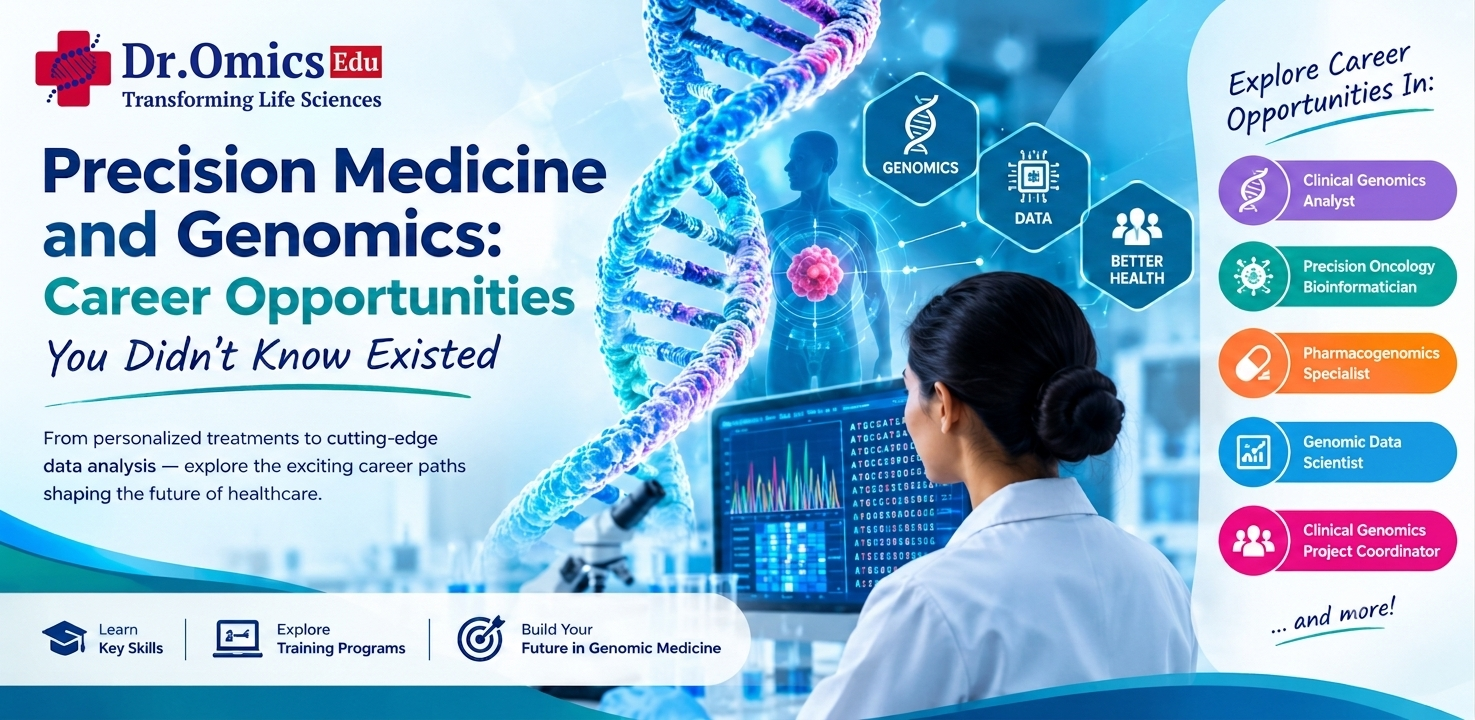
Precision Medicine and Genomics: Career Opportunities You Didn't Know Existed
Dr. Omics Edu Team ·
Introduction
Healthcare is evolving from a one-size-fits-all approach toward treatments tailored to an individual's genetic makeup, lifestyle, and medical history. This transformation is driven by precision medicine, genomics, bioinformatics, and advanced data analytics. As healthcare becomes increasingly personalized, professionals with expertise in these fields can explore exciting and often overlooked career opportunities. For students and researchers interested in life sciences, precision medicine careers offer a promising combination of biology, technology, and clinical research.
What Is Precision Medicine and Why Does It Matter?
Precision medicine involves identifying differences between individuals to improve disease prevention, diagnosis, and treatment. Genomic sequencing helps researchers identify genetic variants associated with inherited disorders, cancer, and drug responses.
For example, in cancer care, genomic profiling can identify mutations that influence treatment selection. Similarly, pharmacogenomics examines how genetic variations affect a person's response to medications.
The growing application of these technologies is expanding genomics career opportunities across pharmaceutical companies, hospitals, biotechnology firms, diagnostic laboratories, and research institutions.
Career Opportunities Beyond Traditional Research
Many people associate genomics with laboratory research. However, the field offers several specialized career paths.
1. Clinical Genomics Analyst
Clinical genomics analysts interpret sequencing data to identify potentially significant genetic variants. They work with genomic databases, variant annotation tools, and interpretation guidelines to support clinical teams investigating inherited diseases and other genetic conditions.
2. Precision Oncology Bioinformatician
Cancer research increasingly relies on genomic data to understand tumor mutations and identify potential therapeutic targets. Professionals working in precision oncology bioinformatics analyze DNA sequencing data, identify somatic variants, and investigate biomarkers associated with treatment response.
Knowledge of NGS workflows, variant calling, cancer genomics, and computational analysis can be valuable in this role.
3. Pharmacogenomics Specialist
These professionals investigate how genetic differences influence drug metabolism, efficacy, and adverse reactions. Their work supports research into personalized treatment strategies and the development of safer medication guidelines.
4. Genomic Data Scientist
Genomic data scientists combine programming, statistics, and biological knowledge to analyze large-scale sequencing datasets. They may work with machine learning, population genomics, multi-omics integration, and predictive modeling.
5. Clinical Genomics Project Coordinator
Not every role requires extensive coding or advanced laboratory skills. Project coordinators help manage genomic testing projects, coordinate multidisciplinary teams, monitor timelines, and support communication between laboratories, researchers, and healthcare professionals.
These examples demonstrate the diversity of personalized medicine jobs and genomics healthcare careers available beyond conventional laboratory positions.
Essential Skills for a Career in Genomic Medicine
Building a career in this field requires a combination of domain knowledge and practical experience. Important skills include:
- Genomics and molecular biology: Understanding genes, mutations, sequencing technologies, and disease mechanisms.
- Bioinformatics: Experience with NGS analysis, quality control, alignment, variant calling, and annotation.
- Programming and statistics: Familiarity with Python, R, Linux, and statistical analysis.
- Clinical interpretation: Understanding how genomic findings may contribute to disease diagnosis and treatment decisions.
- Communication: Explaining complex scientific findings clearly to researchers and multidisciplinary teams.
Professionals exploring careers in genomic medicine can strengthen their profiles by completing practical projects, documenting reproducible workflows, and learning how genomic evidence is interpreted in clinical contexts.
How to Get Started: Courses and Training
A structured precision medicine course can help learners understand the relationship between genomics, disease biology, and personalized treatment. Look for programs that cover NGS analysis, variant interpretation, pharmacogenomics, cancer genomics, and clinical applications.
A practical precision medicine training program should ideally include real or publicly available datasets, guided bioinformatics exercises, case studies, and portfolio-ready projects.
For example, learners can practice identifying variants from sequencing data, exploring their clinical annotations, or analyzing publicly available cancer genomics datasets. These activities help demonstrate practical skills when applying for genomics-based healthcare jobs.
The Future of Precision Medicine
The future of precision medicine will increasingly involve artificial intelligence, liquid biopsies, single-cell sequencing, multi-omics analysis, and personalized therapeutic development. These advances are creating opportunities across diagnostics, biotechnology, pharmaceutical research, and digital health.
However, professionals must also understand data privacy, ethical considerations, genetic counseling boundaries, and the limitations of genomic evidence.
Conclusion
Precision medicine is creating career pathways that extend far beyond traditional research laboratories. From clinical genomics and pharmacogenomics to precision oncology bioinformatics and genomic data science, professionals can contribute to more individualized healthcare.
For aspiring candidates, the most effective starting point is to combine strong biological fundamentals with practical genomics skills and targeted training. With continuous learning and hands-on experience, emerging professionals can position themselves for rewarding opportunities in this rapidly developing field.
