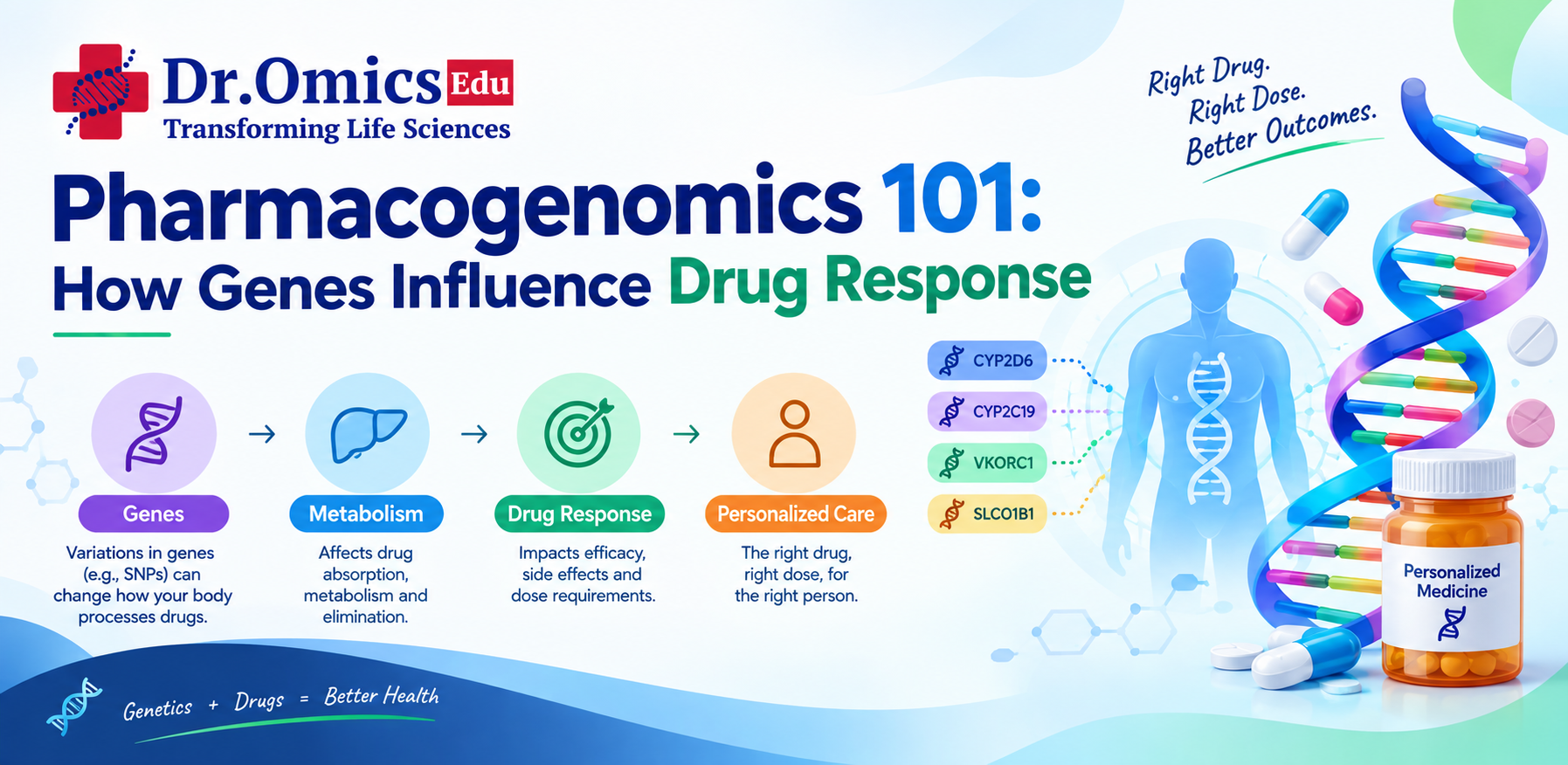
Pharmacogenomics 101: How Genes Influence Drug Response
Dr. Omics Edu Team ·
Modern medicine is moving beyond the traditional approach of giving the same drug and dose to every patient with the same condition. Two people may receive the same medication, yet one may experience excellent therapeutic benefits, another may experience little or no benefit, and a third may develop adverse effects. One important reason for these differences is genetic variation.
Pharmacogenomics is the field that studies how a person's genetic makeup influences their response to medications. By understanding the relationship between genes and drug response, researchers and healthcare professionals can identify which medicines or doses may be more suitable for particular individuals. This concept forms an important part of precision medicine pharmacogenomics and is contributing to the development of more personalized approaches to healthcare.
For students interested in genomics, biotechnology, pharmacy, medicine, or bioinformatics, understanding pharmacogenomics basics provides an excellent foundation for exploring the future of personalized healthcare.
What Is Pharmacogenomics?
Pharmacogenomics combines two major areas: pharmacology, the study of drugs and their effects, and genomics, the study of an individual's complete genetic information.
In simple terms, pharmacogenomics asks:
"Can genetic differences explain why different people respond differently to the same drug?"
The answer is often yes.
Small variations in DNA can affect proteins involved in drug absorption, transport, metabolism, target binding, and elimination. These variations can therefore influence how much of a drug reaches its target, how quickly it is broken down, and how strongly the patient responds.
For example, if a genetic variant causes an enzyme to metabolize a drug more slowly, the drug may remain in the body for a longer period. Depending on the medication, this could increase drug exposure and potentially increase the risk of adverse effects. Conversely, rapid metabolism may reduce drug exposure and potentially decrease therapeutic effectiveness.
This relationship between genes and drug response is one of the central concepts in pharmacogenomics.
Pharmacogenomics Basics: Where Do Genes Affect Drug Response?
Drug response is a complex biological process. Genetic variation can influence several stages of this process.
Drug Absorption
After a medicine is administered, it must enter the bloodstream before it can reach its target. Genetic differences can influence proteins involved in drug absorption and transport.
For some medications, variations in transporter genes can affect how much of the drug enters circulation.
Drug Distribution
Once a drug enters the bloodstream, it is distributed throughout the body. Genetic variation in proteins responsible for transporting drugs can influence where and how much of a drug reaches particular tissues.
Drug Metabolism
One of the most important areas of pharmacogenomics is drug metabolism genetics.
Many drugs are metabolized by enzymes belonging to the cytochrome P450 family, including enzymes encoded by genes such as CYP2D6, CYP2C19, and CYP2C9.
Different individuals may carry different versions of these genes. As a result, the activity of a particular drug-metabolizing enzyme can vary between individuals.
Depending on the gene and drug involved, a person may be categorized as having relatively low, normal, increased, or decreased metabolic activity.
This can affect the concentration of a medication in the body and consequently influence its effectiveness or toxicity.
Drug Targets
Genetic differences can also occur in the biological targets of medications.
For example, variations in a receptor or enzyme targeted by a drug may alter how strongly the drug interacts with that target. Therefore, pharmacogenomics is not limited to metabolism; it also examines genetic variation in pathways involved in drug action.
Drug Elimination
After a drug has produced its effect, it must eventually be removed from the body. Genetic variation can influence pathways involved in drug elimination, including transport and metabolism.
Together, these mechanisms help explain why genetic information can be relevant when considering medication response.
A Simple Example of Genes and Drug Response
Imagine two patients who receive the same medication at the same dose.
Patient A has a genetic variant associated with slower metabolism of the drug.
Patient B has a genetic profile associated with faster metabolism.
If the medication is primarily eliminated through that metabolic pathway, the amount of drug present in the body may differ between the two patients.
Patient A may have greater drug exposure, while Patient B may have lower exposure.
This does not mean that genetics alone determines the outcome. Age, diet, other medications, kidney and liver function, disease status, lifestyle, and many other factors can also affect drug response.
Therefore, pharmacogenomics should be understood as one important component of a larger clinical picture.
Pharmacogenomics and Precision Medicine
Pharmacogenomics is closely connected with precision medicine pharmacogenomics.
Traditional medicine often uses population-level evidence to determine which drug and dose should generally be used for a particular condition. Precision medicine aims to incorporate additional information about an individual, which may include genetic, molecular, clinical, and environmental factors.
Genomic information can provide another layer of information for treatment decisions.
For example, if a clinically validated pharmacogenomic test indicates that a patient has a genetic variant associated with altered response to a particular medication, that information may be considered alongside other clinical factors.
The goal is not simply to use more genetic tests. The goal is to use clinically meaningful genetic information when it can improve treatment decisions.
Pharmacogenomics Applications
Pharmacogenomics has applications across several areas of healthcare and biomedical research.
Oncology
Cancer treatment is an important area where genomic information can influence therapy selection.
Tumors can contain genetic alterations that affect treatment response, while inherited genetic variants can also influence how patients process certain medications.
Pharmacogenomic and broader genomic testing can therefore contribute to treatment planning in selected cancer settings.
Cardiovascular Medicine
Genetic variation can influence the response to certain cardiovascular medications.
For selected drugs, pharmacogenomic information may help identify individuals who may have altered drug metabolism or response.
Psychiatry
Individuals can respond differently to antidepressants and other psychiatric medications. Genetic variation in drug-metabolizing pathways has therefore been investigated as one factor that may contribute to differences in medication response.
However, pharmacogenomic testing does not provide a complete prediction of psychiatric treatment outcomes, and clinical decisions require broader patient assessment.
Infectious Diseases
Pharmacogenomics can also contribute to medication research and treatment strategies for infectious diseases, particularly where genetic differences influence drug metabolism, transport, or susceptibility to adverse reactions.
Rare Diseases
As genomic sequencing becomes more accessible, pharmacogenomics can become particularly relevant for patients with rare conditions where conventional treatment approaches may not adequately account for individual biological differences.
Why Pharmacogenomics Matters for Pharmacy Students
Pharmacogenomics for pharmacy students is an increasingly relevant area of study because pharmacists are closely involved in medication selection, dosing, monitoring, drug interactions, and patient counseling.
A pharmacy student learning pharmacogenomics should understand concepts such as:
- Genetic variation and single nucleotide variants
- Drug-metabolizing enzymes
- Pharmacokinetics and pharmacodynamics
- Drug transporters
- Genetic influence on adverse drug reactions
- Pharmacogenomic testing
- Interpretation of clinically relevant genetic results
- Evidence-based use of pharmacogenomic information
- Ethical and privacy considerations surrounding genetic data
This knowledge can help pharmacy professionals understand why a standard medication strategy may not produce the same outcome in every patient.
Personalized Medicine and Genomics
The broader field of personalized medicine genomics extends beyond medications.
Genomic information can potentially contribute to disease risk assessment, diagnosis, treatment selection, prevention strategies, and patient monitoring.
Pharmacogenomics represents one practical connection between genomics and clinical treatment.
The long-term vision is not simply "the right drug for the right gene." Instead, personalized healthcare increasingly considers multiple layers of information together.
These may include:
Genomics + clinical information + environment + lifestyle + disease characteristics = more individualized healthcare decisions
This is why pharmacogenomics is becoming an important component of modern biomedical science.
Pharmacogenomics in Bioinformatics
Pharmacogenomics also creates opportunities for bioinformatics professionals.
Large-scale genomic datasets must be processed, analyzed, annotated, and interpreted before genetic information can become useful.
Bioinformatics workflows may involve:
- Sequence and variant analysis
- Variant annotation
- Population genetics
- Database searching
- Gene-drug association analysis
- Clinical variant interpretation
- Pharmacogenomic database analysis
- Data visualization
- Statistical analysis
- Machine learning and predictive modeling
Researchers may work with genomic databases and resources containing information about genetic variants, genes, drugs, phenotypes, and clinical evidence.
This makes pharmacogenomics particularly relevant for students who want to combine genomics, bioinformatics, and healthcare.
Pharmacogenomics Career Opportunities
The growing integration of genomics into healthcare is creating opportunities across research, diagnostics, biotechnology, pharmaceuticals, and bioinformatics.
A student completing a pharmacogenomics course can build foundational knowledge relevant to roles such as:
- Bioinformatics Analyst
- Clinical Bioinformatics Associate
- Genomics Data Analyst
- Pharmacogenomics Research Assistant
- Clinical Research Associate
- Drug Discovery Researcher
- Genomic Data Scientist
- Pharmacogenomics Specialist
- Biotechnology Research Professional
Career opportunities depend on educational background and additional technical or clinical training. Students with a combination of genomics knowledge, programming, statistics, and data analysis skills can explore interdisciplinary roles in this field.
Pharmacogenomics Training Online
For students and professionals who cannot attend classroom-based programs, pharmacogenomics training online can provide a flexible way to develop foundational knowledge.
A useful learning pathway should ideally cover:
- Fundamentals of genetics and genomics
- Pharmacology and pharmacokinetics
- Genetic variation
- Drug-metabolizing enzymes
- Pharmacogenomic biomarkers
- Pharmacogenomic databases
- Variant annotation and interpretation
- Clinical applications
- Case studies
- Bioinformatics approaches to pharmacogenomic data
Hands-on exercises can make the subject more meaningful. For example, learners can explore a clinically relevant gene-drug association, examine genetic variants in a pharmacogenomic database, and understand how evidence is used to interpret the potential impact of a variant.
Challenges and Limitations
Although pharmacogenomics has significant potential, it is important to understand its limitations.
Genetic variation is only one factor affecting drug response. A person's age, sex, health status, organ function, diet, lifestyle, drug interactions, adherence, and environmental factors can also influence treatment outcomes.
Another challenge is interpretation. Not every genetic variant has established clinical significance. Some variants may have limited evidence, and recommendations can change as new research becomes available.
There are also important considerations related to genetic privacy, informed consent, data security, access to testing, cost, and equitable implementation.
Therefore, pharmacogenomic information should be interpreted using reliable evidence and, when appropriate, integrated into clinical decision-making by qualified healthcare professionals.
What Should Students Learn First?
Students beginning their journey in pharmacogenomics do not need to master advanced genomics immediately.
A strong foundation can be built by learning:
Genetics → Genomics → Pharmacology → Drug metabolism → Genetic variation → Variant interpretation → Pharmacogenomic applications
Once these concepts are clear, students can progress toward databases, bioinformatics tools, clinical case studies, and research applications.
For bioinformatics students, adding Python or R, statistics, variant annotation, and genomic database analysis can further strengthen their skill set.
Conclusion
Pharmacogenomics provides an important connection between genetics and medication response. By studying how genetic variation influences drug metabolism, transport, targets, and adverse reactions, researchers and healthcare professionals can better understand why individuals may respond differently to the same medication.
The field is an important component of precision medicine pharmacogenomics and the broader movement toward personalized medicine genomics. Its applications span oncology, cardiovascular medicine, psychiatry, infectious diseases, rare diseases, drug development, and biomedical research.
For pharmacy students, bioinformatics learners, life-science graduates, and professionals interested in genomics, learning pharmacogenomics basics can provide a strong foundation for understanding the future of individualized healthcare.
As genomic technologies continue to develop, the ability to connect genetic information with drug response will remain an important area of research and professional opportunity. A well-structured pharmacogenomics course, supported by practical examples and hands-on pharmacogenomics training online, can help learners build the knowledge required to explore this rapidly developing field.
