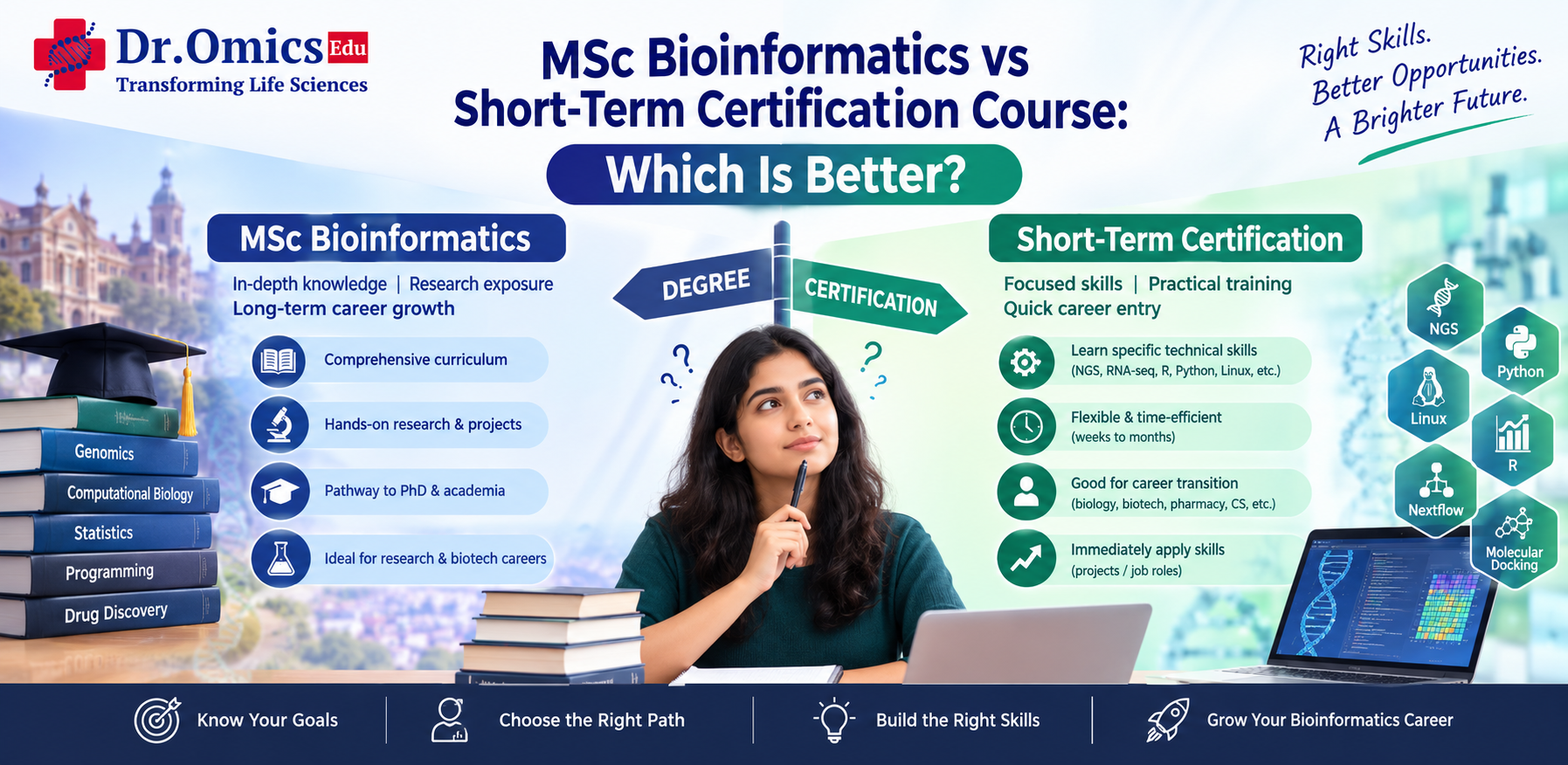
MSc Bioinformatics vs Short-Term Certification Course: Which Is Better?
Dr. Omics Edu Team ·
Bioinformatics is rapidly becoming an essential discipline at the intersection of biology, computer science, statistics, and data science. With increasing demand for genomic analysis, drug discovery, molecular modelling, and AI-driven biological research, students often face an important question: Should I pursue an MSc in Bioinformatics or choose a short-term certification course?
The answer depends largely on your academic background, career goals, available time, and the depth of expertise you want to develop.
MSc Bioinformatics: Building a Strong Academic Foundation
An MSc in Bioinformatics is a postgraduate degree designed to provide systematic and comprehensive training. Typically, students study subjects such as molecular biology, genomics, transcriptomics, structural bioinformatics, statistics, programming, databases, machine learning, and computational drug discovery.
The major advantage of an MSc is depth. Students usually receive several semesters of theoretical instruction combined with laboratory work, computational assignments, research projects, and sometimes internships.
For students planning careers in research, biotechnology, pharmaceuticals, genomics, academia, or higher education, an MSc can provide a stronger academic foundation. It may also be useful when applying for PhD programs or research-oriented positions.
However, an MSc requires a significant investment of time and money, generally over one to two years depending on the program and institution.
Short-Term Bioinformatics Certification: Focused and Skill-Oriented
A short-term certification course takes a different approach. Instead of covering the entire discipline, it usually focuses on specific technical skills or workflows.
Examples include courses in NGS analysis, RNA-seq, molecular docking, R programming, Python for bioinformatics, Linux, single-cell RNA-seq, or Nextflow.
The key advantage is flexibility. Learners can acquire a practical skill within weeks or months and immediately apply it to projects or existing professional responsibilities.
This makes certification particularly useful for graduates from biology, biotechnology, pharmacy, life sciences, computer science, or related fields who want to transition into bioinformatics without committing to another full-time degree.
However, the short term bioinformatics course value depends heavily on its curriculum, practical training, instructor expertise, and whether learners actually develop demonstrable skills. A certificate alone does not guarantee employment.
MSc Bioinformatics vs Certification: Which One Should You Choose?
When comparing MSc bioinformatics vs certification, there is no universal winner.
Goal | Better option |
Comprehensive academic foundation | MSc |
Research or PhD pathway | MSc |
Career transition | Certification + projects |
Learning a specific technical skill | Certification |
Structured long-term education | MSc |
Upskilling while working | Certification |
For students beginning their higher education journey, an MSc can provide broader and deeper exposure. For graduates or working professionals who already have a relevant degree, targeted certification can be a faster route to developing industry-relevant skills.
The Best Strategy May Be a Combination
The bioinformatics degree vs course decision does not always have to be either-or. An MSc can establish the theoretical foundation, while specialized certifications can help develop current technical skills.
For example, an MSc graduate could strengthen their profile through certifications in NGS, Python, R, cloud computing, AI/ML, or workflow automation.
Ultimately, the best bioinformatics higher education options depend on where you want to go: research, industry, academia, clinical genomics, computational drug discovery, or data science.
Choose a degree when you need depth. Choose a certification when you need focused skills. Choose both when your career goals require a combination of academic knowledge and practical expertise.
