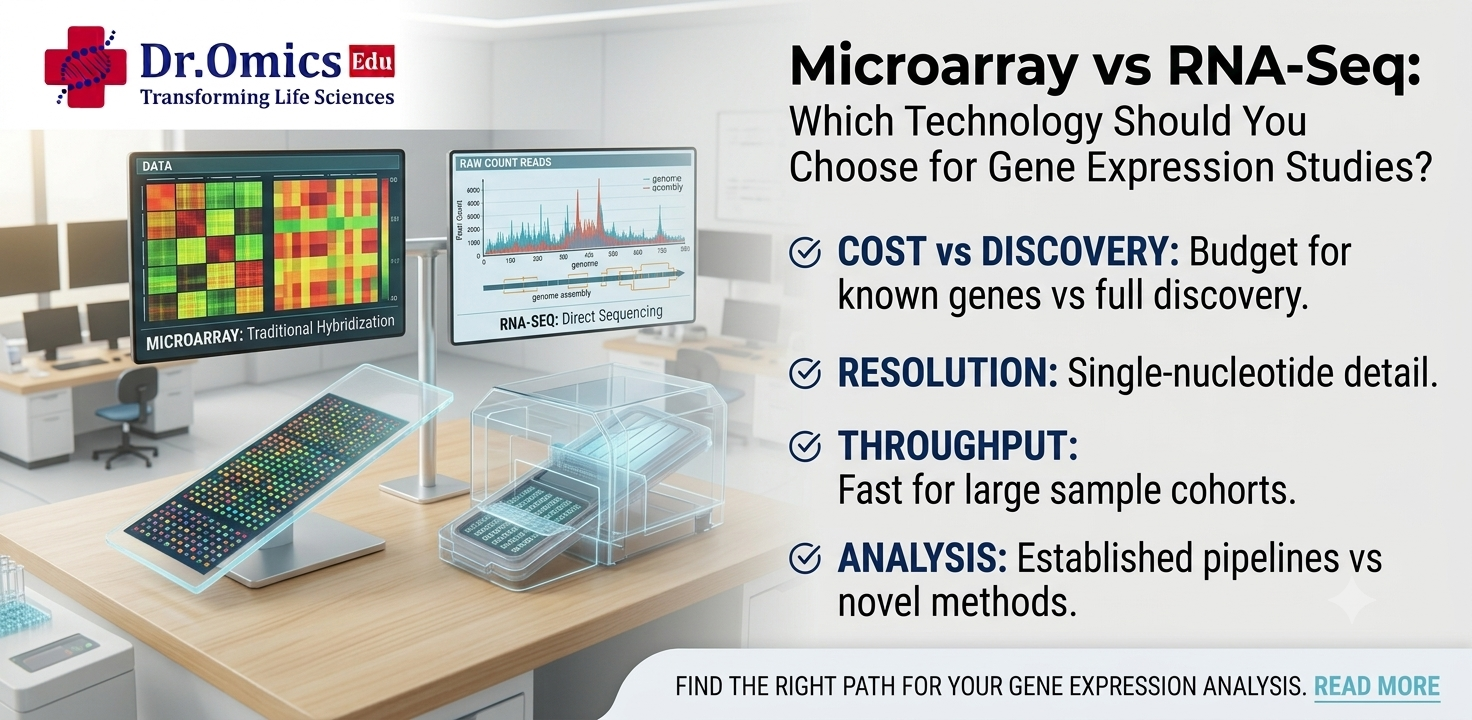
Microarray vs RNA-Seq: Which Technology Should You Choose for Gene Expression Studies?
Dr. Omics Edu Team ·
Gene expression analysis is a fundamental approach in molecular biology, genomics, and biomedical research. It helps researchers understand how genes respond to diseases, treatments, environmental conditions, and developmental changes. Two widely used technologies for gene expression profiling are microarray and RNA sequencing (RNA-Seq). Although both methods measure gene expression, they differ in their underlying principles, sensitivity, data output, and applications.
Understanding the differences between microarray and RNA-Seq can help students, researchers, and bioinformatics professionals select the most appropriate technology for their research objectives.
What Is Microarray Technology?
Microarray technology is a hybridization-based method used to measure the expression levels of thousands of genes simultaneously. It uses a solid surface containing thousands of DNA probes designed to recognize specific gene sequences.
During a typical microarray experiment, RNA is extracted from biological samples and converted into labeled complementary DNA (cDNA). The labeled cDNA hybridizes with complementary probes on the microarray chip. Fluorescence signals are measured to estimate the expression levels of the corresponding genes.
Advantages of Microarray
- Cost-effective: Microarrays can be economical when analyzing large numbers of samples using established platforms.
- Established workflows: Standardized laboratory protocols and computational pipelines support routine gene expression studies.
- Efficient for known genes: They are suitable for investigating previously characterized genes represented by the array probes.
- Relatively straightforward analysis: Mature software and statistical methods are available for processing and interpreting microarray data.
Limitations of Microarray
Microarrays depend on predefined probes, meaning they cannot readily detect transcripts that are not represented on the chip. Cross-hybridization between similar sequences may affect specificity, while background noise and signal saturation can influence measurements. Their ability to distinguish transcript isoforms and detect low-abundance transcripts is also limited by probe design and platform characteristics.
What Is RNA-Seq?
RNA sequencing (RNA-Seq) is a next-generation sequencing (NGS) approach that measures gene expression by sequencing RNA-derived molecules. Unlike microarrays, RNA-Seq does not rely on a fixed collection of predefined probes.
In a typical RNA-Seq workflow, RNA is extracted, converted into a sequencing library, and sequenced using an NGS platform. Bioinformatics tools process the resulting reads through quality control, alignment or transcript quantification, gene-level counting, and differential gene expression analysis.
Commonly used tools include FastQC, fastp, HISAT2, STAR, featureCounts, and DESeq2.
Advantages of RNA-Seq over Microarray
- Broader transcript detection: RNA-Seq can identify known and previously unannotated transcripts, depending on sequencing depth and analysis methods.
- Improved dynamic range: It can quantify expression across a broad range of transcript abundances, although sensitivity depends on library preparation and sequencing depth.
- Transcript-level insights: RNA-Seq can help investigate alternative splicing, transcript isoforms, and novel transcript structures.
- Detection of sequence variation: Depending on experimental design and analysis, RNA-Seq data may reveal expressed sequence variants and gene fusions.
- Flexible downstream analysis: Researchers can perform differential expression analysis, pathway enrichment, transcript characterization, and other investigations using the same dataset.
However, RNA-Seq can require greater computational resources, specialized bioinformatics expertise, and careful management of sequencing depth, batch effects, and library preparation biases.
Microarray vs RNA-Seq: Gene Expression Profiling Comparison
Feature | Microarray | RNA-Seq |
| Technology | Probe hybridization | High-throughput sequencing |
| Gene detection | Primarily predefined targets | Known and potentially novel transcripts |
| Dynamic range | Comparatively limited | Generally broader |
| Alternative splicing | Limited, probe-dependent | Better suited to transcript-level analysis |
| Data output | Fluorescence intensity | Sequencing reads and derived counts |
| Computational requirements | Generally lower | Generally higher |
| Cost considerations | Often economical for established targets | Depends on sequencing depth, sample number, and analysis |
| Best suited for | Targeted, established expression studies | Discovery-driven and comprehensive transcriptomic studies |
Which Technology Should You Choose?
The choice between microarray and RNA-Seq depends on your scientific question, budget, sample size, and required level of transcriptomic detail.
Choose microarray when your research focuses on well-characterized genes, uses an established expression panel, or requires economical analysis across many samples.
Choose RNA-Seq when you need comprehensive gene expression profiling, want to investigate previously uncharacterized transcripts, or require information about alternative splicing and transcript diversity.
For example, a researcher comparing the expression of established cancer-associated genes across hundreds of samples may find microarrays suitable. In contrast, a researcher investigating previously unknown transcriptional changes in a treatment-response study may benefit more from RNA-Seq.
Conclusion
Microarray and RNA-Seq remain valuable technologies for gene expression studies, but they serve different research needs. Microarrays offer an established, probe-based approach for studying known targets, while RNA-Seq provides a more comprehensive view of the transcriptome and supports discovery-driven research.
For students and professionals learning bioinformatics, understanding both technologies is important. Practical experience in quality control, normalization, differential expression analysis, and biological interpretation helps transform gene expression data into meaningful scientific insights.
