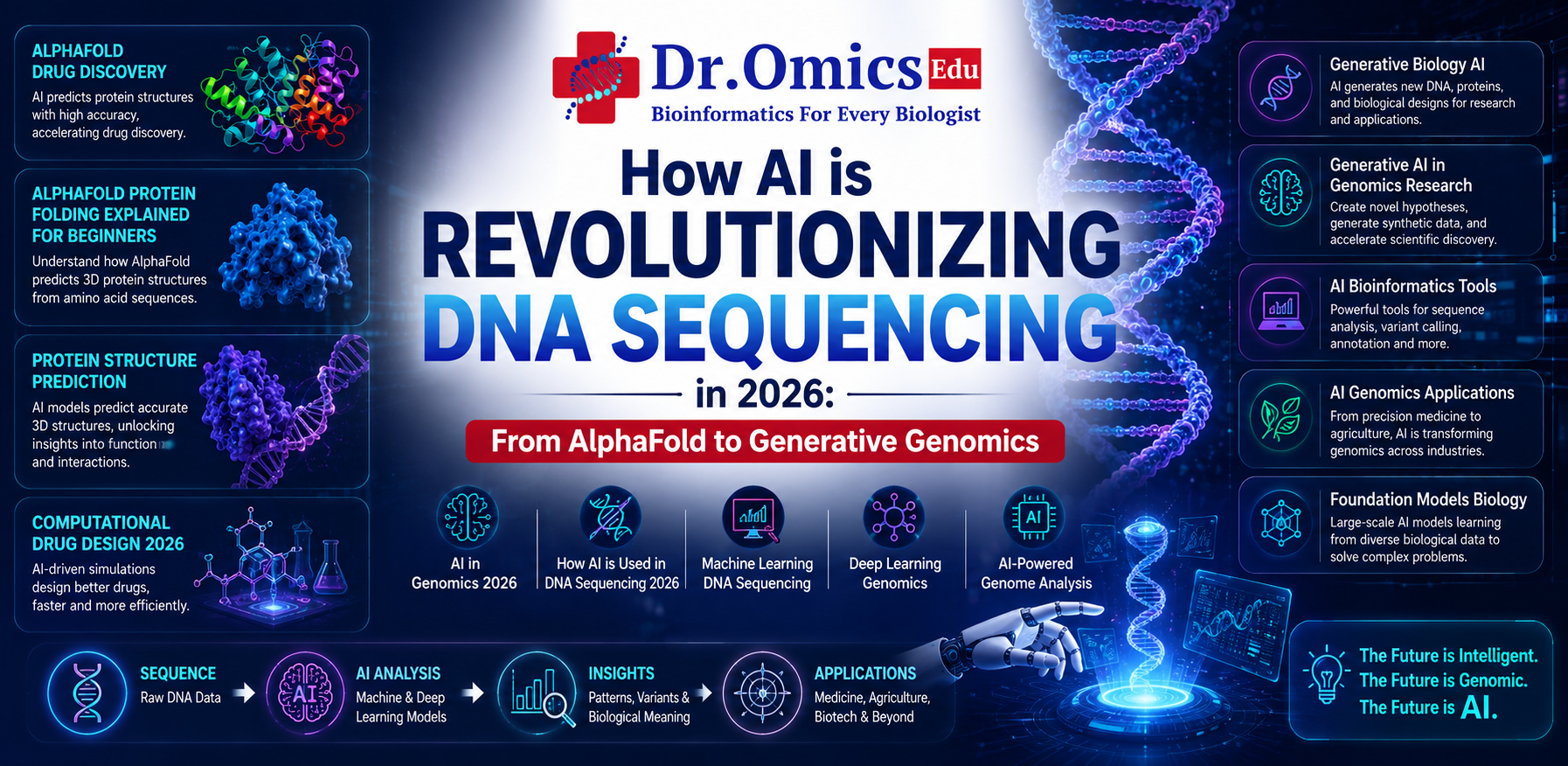
How AI is Revolutionizing DNA Sequencing in 2026: From AlphaFold to Generative Genomics
Dr. Omics Edu Team ·
The life sciences industry is witnessing a remarkable transformation as AI in genomics 2026 continues to accelerate discoveries in healthcare, drug development, and precision medicine. What once took researchers months or even years can now be accomplished in days with the help of advanced artificial intelligence, machine learning, and foundation models designed specifically for biological data.
How AI is Used in DNA Sequencing in 2026
Modern DNA sequencing generates enormous amounts of genomic data. Analyzing this data manually is time-consuming and computationally intensive. Today, machine learning DNA sequencing workflows help researchers identify genetic variants, predict disease-associated mutations, and interpret sequencing results with greater speed and accuracy.
With the rise of AI-powered genome analysis, researchers can:
- Detect genetic variations more accurately
- Improve sequencing quality control
- Predict functional impacts of mutations
- Accelerate biomarker discovery
- Enable personalized medicine approaches
These advancements have made AI genomics applications an essential part of modern bioinformatics pipelines.
AlphaFold: Transforming Protein Structure Prediction
One of the most groundbreaking achievements in biotechnology is AlphaFold protein folding explained for beginners as an AI system capable of predicting the three-dimensional structure of proteins from their amino acid sequences.
Traditional experimental methods for determining protein structures often require significant time and resources. However, AI-driven protein structure prediction has dramatically reduced these challenges.
The impact of AlphaFold drug discovery includes:
- Faster identification of therapeutic targets
- Improved understanding of disease mechanisms
- Reduced drug development costs
- Enhanced protein engineering research
Today, pharmaceutical companies and academic researchers are leveraging AlphaFold-generated structures for computational drug design 2026, helping accelerate the journey from target identification to potential treatments.
Generative Biology AI: The Next Frontier
While AlphaFold predicts structures, generative biology AI goes a step further by creating entirely new biological possibilities.
Using advanced deep learning models, scientists can now:
- Design novel proteins
- Engineer synthetic DNA sequences
- Optimize enzymes for industrial applications
- Develop next-generation therapeutics
The emergence of generative AI in genomics research is transforming how biological systems are studied and engineered. Rather than simply analyzing existing data, AI can generate new biological designs with desired characteristics.
Deep Learning Genomics and Foundation Models
The rise of deep learning genomics has led to the development of large-scale foundation models biology platforms trained on massive genomic, proteomic, and transcriptomic datasets.
These models can:
- Predict gene expression patterns
- Identify regulatory elements
- Analyze multi-omics datasets
- Assist in disease risk prediction
- Support precision medicine initiatives
As a result, researchers now have access to powerful AI bioinformatics tools capable of uncovering hidden patterns within complex biological data.
The Future of AI in Genomics
The integration of AI into genomics is no longer a futuristic concept—it is a present-day reality. From machine learning DNA sequencing and AI-powered genome analysis to AlphaFold drug discovery and generative biology AI, artificial intelligence is reshaping the future of biological research.
As technology advances, AI in genomics 2026 will continue to drive innovations in diagnostics, therapeutic development, precision medicine, and synthetic biology, bringing us closer to a future where biological discoveries occur faster, more accurately, and at an unprecedented scale.
Final Thoughts
The convergence of genomics and artificial intelligence is creating a new era of scientific discovery. Whether through protein structure prediction, generative AI in genomics research, or advanced AI genomics applications, researchers now have powerful tools to decode and design biology like never before. The future of life sciences is increasingly AI-driven—and that future is already here.
