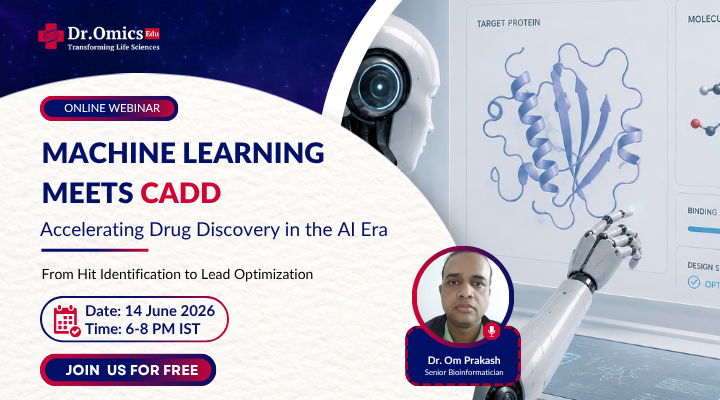
Machine Learning Meets CADD: Accelerating Drug Discovery in the AI Era – From Hit Identification to Lead Optimization.
Machine Learning Meets CADD: Accelerating Drug Discovery in the AI Era – From Hit Identification to Lead Optimization.
- 4.0/5
- English
- Updated Aug 2026
₹199
$5
Indian learners pay in INR; international learners are billed in USD.
Paying from outside India? Use this link to complete your payment.
About this course
The "Machine Learning Meets CADD" online webinar is an advanced computational chemistry masterclass hosted by Dr. Omics Edu. This technical training bridges the gap between traditional Computer-Aided Drug Design (CADD) algorithms and modern artificial intelligence capabilities. Participants will learn how to deploy deep learning architectures to expedite the modern drug discovery pipeline significantly. The structured curriculum provides direct insight into accelerating target protein mapping, virtual screening, and predictive pharmacology models. Attendees will examine structural methods to transition effectively from high-throughput hit identification to precise chemical lead optimization. Led by senior bioinformatics experts, this educational program directly addresses modern structural bottlenecks in molecular modeling and design. Key industry trends, including deep neural network validation for ADMET profiling and binding affinity estimation, are deeply explored. Ultimately, this specialized course functions as a critical roadmap for life science researchers transitioning into modern, AI-powered pharmaceutical R&D environments.
What you will learn
Skills you will gain
Certification
Available
Issued by Dr. Omics EduCourse curriculum
1 moduleWhat you need to start
- Conceptual familiarity with molecular biology, general chemistry principles, or fundamental protein structures.
- Basic understanding of structural biochemistry, pharmacology, or computer-aided research methodologies.
- No prior software development or advanced coding background is required to attend this foundational masterclass.
Who this course is for
- This computational training is specifically curated for medicinal chemists, computational biologists, pharmacogenomics data analysts, structural biologists, pharmaceutical industry professionals, and postgraduate scholars aiming to master AI applications in biotechnology.
