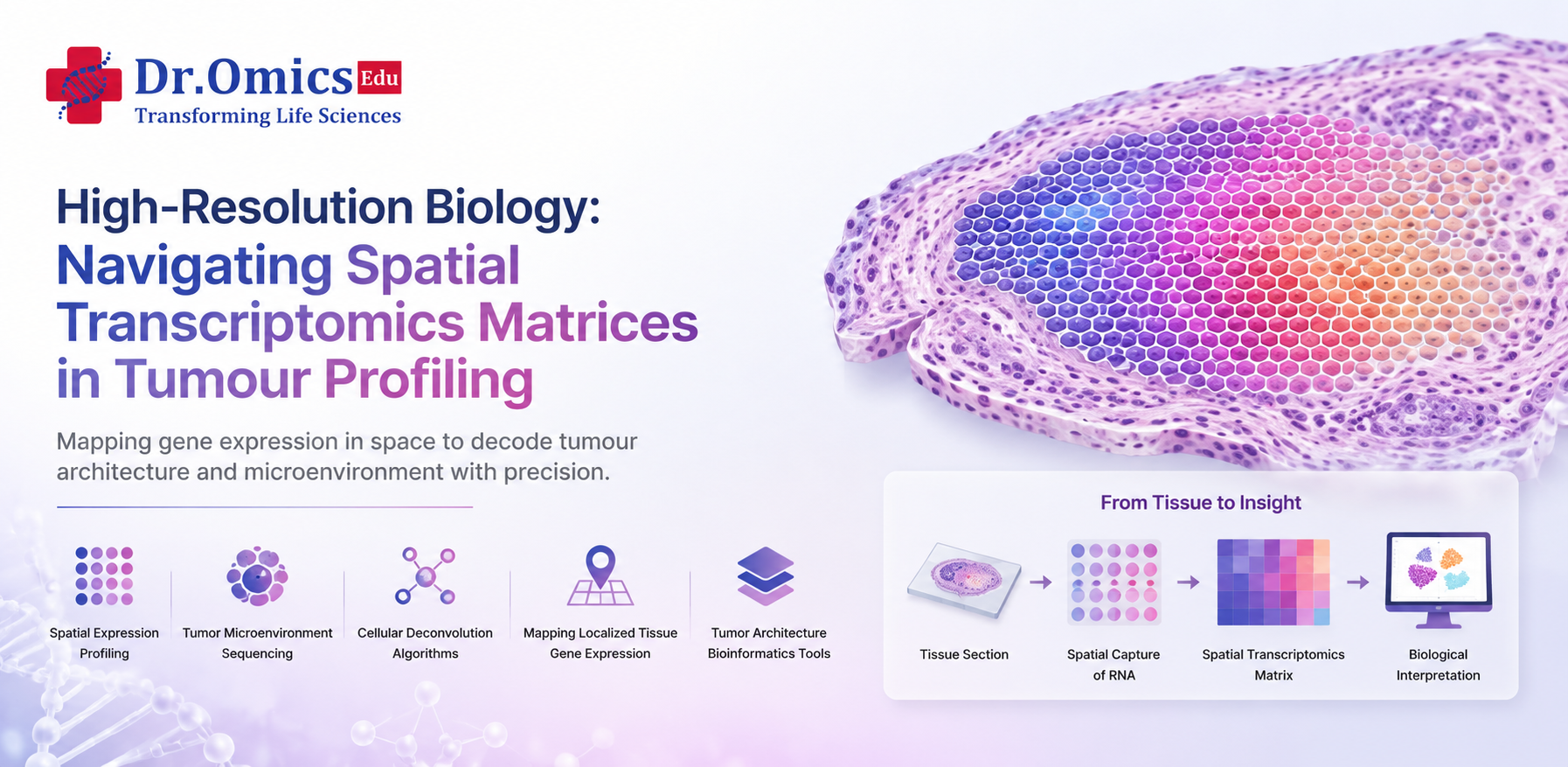
High-Resolution Biology: Navigating Spatial Transcriptomics Matrices in Tumour Profiling
Dr. Omics Edu Team · · Updated
Introduction
Understanding cancer requires more than identifying which genes are active—it also requires knowing where those genes are expressed within a tumour. Traditional RNA sequencing provides an average gene expression profile from a tissue sample, while single-cell RNA sequencing reveals the activity of individual cells but loses their original location. This missing spatial information can limit our understanding of how different cell populations interact during disease progression.
This is where spatial transcriptomics 2026 is transforming cancer research. By combining gene expression data with the physical location of cells in a tissue section, researchers can study the complex organization of tumours without disrupting their natural structure. This approach offers valuable insights into tumour biology, immune responses, and disease progression, making it an important tool in modern oncology.
What is Spatial Transcriptomics?
Spatial transcriptomics is a technology that measures RNA expression while preserving the spatial arrangement of cells within a tissue. Unlike conventional sequencing methods, it enables researchers to visualize gene activity directly on tissue sections, providing a detailed map of molecular events.
The foundation of every experiment is a single cell data matrix or spatial expression matrix, which combines gene expression values with spatial coordinates. This allows researchers to perform spatial expression profiling, helping identify where specific genes are active and how different cell populations are organized across the tissue.
Importance in Tumour Profiling
Tumours are highly heterogeneous, consisting of cancer cells, immune cells, fibroblasts, blood vessels, and other supporting cells. These different cell types interact continuously and influence tumour growth, metastasis, and treatment response.
Using tumor microenvironment sequencing, researchers can study these interactions while preserving the original tissue architecture. Instead of analysing the tumour as a single population, spatial transcriptomics reveals distinct regions such as the tumour core, invasive margins, and immune-rich areas. This detailed transcriptomic tissue analysis helps explain why different parts of the same tumour may respond differently to therapy.
From Tissue to Spatial Matrix
A typical spatial transcriptomics workflow begins with placing thin tissue sections onto specially designed slides containing spatially barcoded capture probes. Messenger RNA released from the tissue binds to these probes while maintaining its original position.
Following sequencing, bioinformatics pipelines align the reads to a reference genome and generate a spatial gene expression matrix. Each observation includes both gene expression counts and spatial coordinates, enabling researchers to perform mapping localized tissue gene expression across the entire tissue section.
This combination of molecular and positional information creates a comprehensive view of tissue organization that cannot be achieved using conventional RNA sequencing alone.
Understanding Cellular Composition
Many spatial transcriptomics platforms capture signals from multiple neighbouring cells within a single spot. To estimate the contribution of individual cell types, researchers use cellular deconvolution algorithms. These computational methods integrate spatial transcriptomic data with single-cell RNA sequencing reference datasets to predict the abundance of immune cells, stromal cells, endothelial cells, and malignant cells within each location.
This approach provides a more accurate understanding of the tumour microenvironment and supports studies focused on immune infiltration, cell-cell communication, and disease progression.
Another important concept is multi-cellular spatial indexing, which identifies cellular neighbourhoods and spatial relationships between different cell populations. Rather than studying cells individually, researchers can investigate how neighbouring cells influence one another, offering deeper insights into tumour development and therapeutic response.
Bioinformatics Tools for Spatial Analysis
The growing popularity of spatial transcriptomics has led to the development of several specialized tumor architecture bioinformatics tools. Software packages such as Seurat, Scanpy, Squidpy, Giotto, BayesSpace, and Cell2location allow researchers to perform quality control, clustering, spatial visualization, cell type annotation, and neighbourhood analysis.
These tools help transform large spatial datasets into meaningful biological insights by integrating sequencing data with histological images and advanced statistical methods.
Applications in Cancer Research
Spatial transcriptomics is being widely used to investigate tumour heterogeneity, identify biomarkers, and understand immune responses in different cancer types. It enables researchers to visualize the distribution of immune cells within tumours, study interactions between malignant and normal cells, and evaluate how treatments alter tissue organization over time.
Beyond research, spatial transcriptomics is also contributing to precision oncology by supporting the identification of clinically relevant molecular patterns that may guide future diagnostic and therapeutic decisions.
Conclusion
Spatial transcriptomics has added an entirely new dimension to cancer research by combining gene expression with spatial information. Instead of analysing tissues as a collection of isolated cells, researchers can now study how different cell populations interact within their natural environment.
Advances in spatial transcriptomics 2026, together with spatial expression profiling, mapping localized tissue gene expression, cellular deconvolution algorithms, and multi-cellular spatial indexing, are providing a deeper understanding of tumour biology than ever before. As tumor architecture bioinformatics tools continue to improve, spatial transcriptomics is expected to become an increasingly valuable approach for studying cancer, discovering biomarkers, and supporting the development of more personalized treatment strategies.
