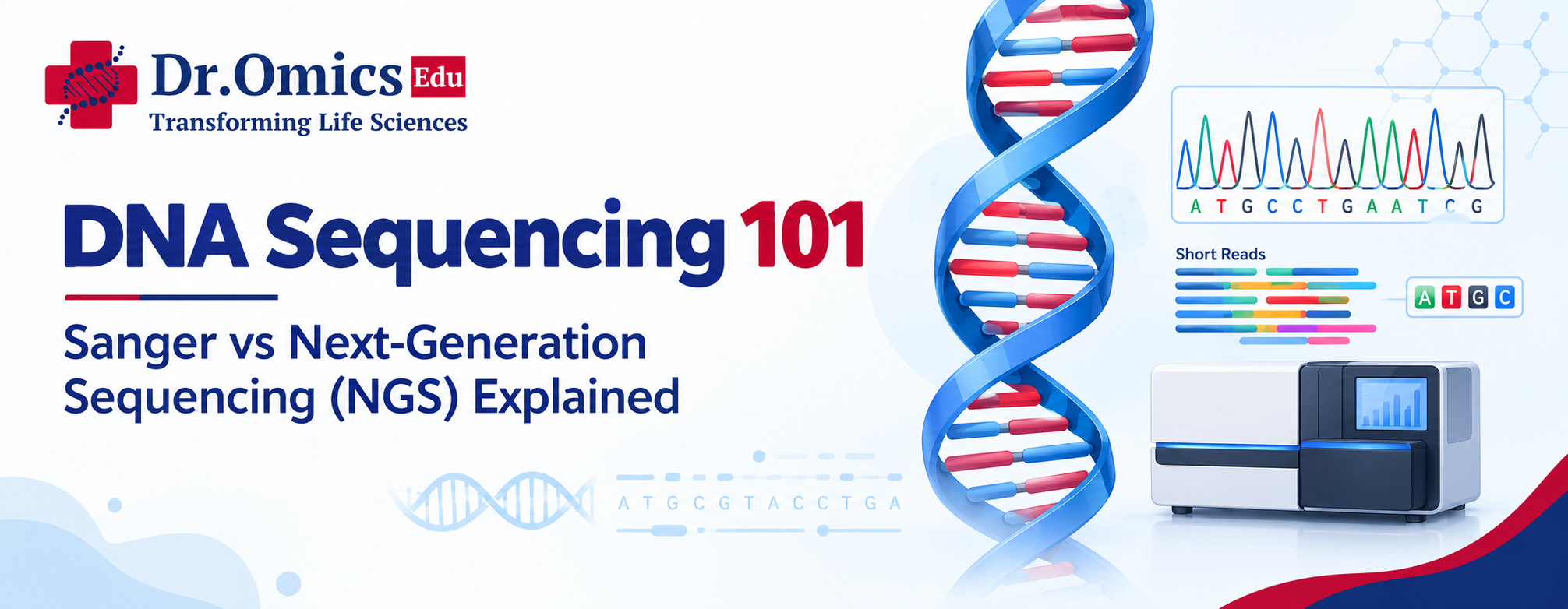
DNA Sequencing 101: Sanger vs Next-Generation Sequencing (NGS) Explained
Dr. Omics Edu Team ·
DNA sequencing is a fundamental technology in modern genomics, helping researchers understand genetic information, identify mutations, and study diseases. From analyzing individual genes to investigating entire genomes, sequencing has transformed biological research and healthcare.
In this guide, we explore DNA sequencing basics, compare Sanger sequencing with NGS, and explain the major sequencing methods used in 2026.
DNA sequencing determines the order of four nucleotide bases in DNA: adenine (A), thymine (T), guanine (G), and cytosine (C).
By reading this sequence, researchers can identify genetic variations, study inherited diseases, investigate microorganisms, and understand differences between organisms.
A typical sequencing workflow includes DNA extraction, sample preparation, sequencing, quality control, and bioinformatics analysis.
Sanger Sequencing vs NGS: What Is the Difference?
Sanger sequencing and Next-Generation Sequencing (NGS) are two important approaches to DNA sequencing.
Sanger sequencing uses the chain-termination method to determine the sequence of a specific DNA region. It is widely used for targeted sequencing and confirming genetic variants.
Next-Generation Sequencing (NGS) processes millions of DNA fragments in parallel, making it suitable for large-scale studies such as whole-genome sequencing, whole-exome sequencing, and targeted gene panels.
Feature | Sanger Sequencing | NGS |
Throughput | Low | High |
Typical read length | Approximately 500–1,000 bases | Often 50–300 bases for short-read platforms |
Main applications | Targeted regions and variant confirmation | Large-scale genomic studies |
Data analysis | Relatively simple | Requires bioinformatics tools |
Best suited for | A few DNA targets | Many targets or large genomic regions |
Which should you choose? Sanger sequencing is often suitable for a small number of DNA regions, while NGS is generally preferred for analyzing many genes or large portions of a genome.
Types of DNA Sequencing
The main types of DNA sequencing include:
Sanger sequencing: Used for individual DNA regions and targeted variant confirmation.
Short-read sequencing: Generates large numbers of relatively short reads and is widely used for genomic studies.
Long-read sequencing: Helps analyze repetitive regions, structural variants, and complex genomes. Examples include PacBio HiFi and Oxford Nanopore sequencing.
Whole-genome sequencing (WGS): Examines DNA across the genome, including coding and non-coding regions.
Whole-exome sequencing (WES): Focuses primarily on protein-coding regions.
Targeted sequencing: Examines selected genes or genomic regions relevant to a particular research question.
The appropriate method depends on the research objective, sample type, required accuracy, and available resources.
Whole Genome Sequencing Explained
Whole-genome sequencing (WGS) aims to analyze DNA across an organism's genome. In humans, the haploid genome contains approximately three billion base pairs.
A typical WGS workflow includes DNA extraction, library preparation, sequencing, read quality control, alignment or assembly, variant calling, and annotation.
WGS is widely used in:
Rare disease and cancer research
Microbial genome analysis
Evolutionary and population genetics
Identification of genetic variations
Genome assembly and comparative genomics
Unlike whole-exome sequencing, WGS includes non-coding regions in its intended scope, although the ability to analyze specific variants depends on sequencing coverage and the method used.
DNA Sequencing Technology in 2026
DNA sequencing technology continues to advance through improvements in throughput, read length, accuracy, and computational analysis.
Short-read sequencing remains valuable for large-scale studies that require high-throughput data generation. Long-read sequencing supports the analysis of complex genomic regions and structural variations that can be difficult to resolve using short reads alone.
Bioinformatics is equally important. Tools such as FastQC, BWA, SAMtools, GATK, and Ensembl VEP support different stages of sequencing quality assessment, alignment, variant detection, and annotation.
Together, sequencing technologies and bioinformatics workflows help researchers convert raw DNA data into meaningful biological insights.
Conclusion
Sanger sequencing and NGS serve different purposes in modern genomics. Sanger sequencing is useful for targeted analysis, whereas NGS enables large-scale studies, including whole-genome and whole-exome sequencing.
Understanding the differences between these methods helps researchers select the right approach for their experiments. As sequencing technologies evolve, knowledge of genomics and bioinformatics continues to be essential for students, researchers, and life-science professionals.
Explore genomics and bioinformatics training with Dr. Omics Labs to build your understanding of modern DNA sequencing technologies.
