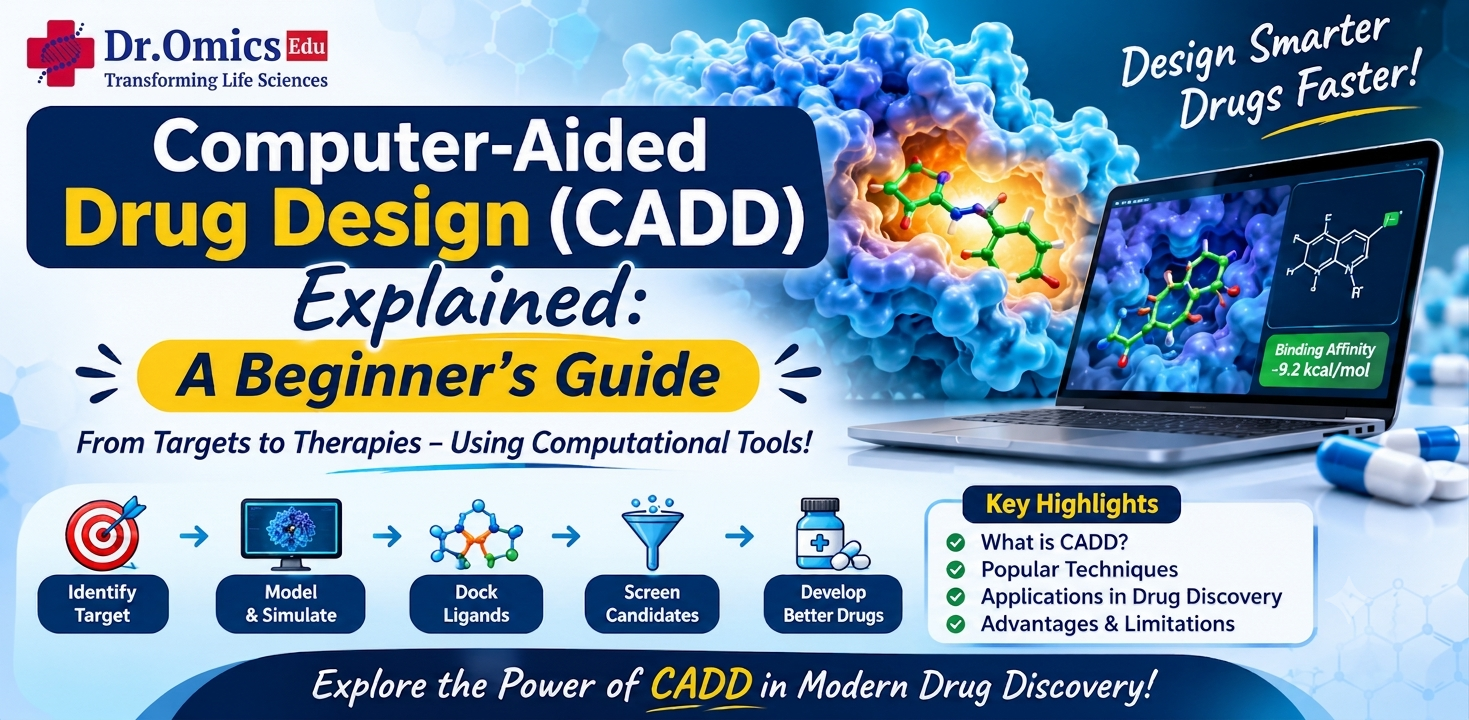
Computer-Aided Drug Design (CADD) Explained: A Beginner's Guide
Priyanka Bhore ·
Introduction
Drug discovery is a complex, time-consuming, and expensive process that involves identifying potential drug candidates, evaluating their biological activity, and determining their safety and effectiveness. Traditionally, researchers relied heavily on laboratory experiments to identify and develop new drugs. However, advances in computational biology, bioinformatics, and molecular modelling have transformed modern drug discovery.
Computer-Aided Drug Design (CADD) is one of the most important technologies supporting this transformation. It allows researchers to use computational tools and databases to identify, design, and optimize potential drug molecules before performing extensive laboratory experiments.
What Is Computer-Aided Drug Design (CADD)?
What is CADD? Computer-Aided Drug Design refers to the application of computational methods, software, algorithms, and molecular modelling techniques to discover and develop potential therapeutic compounds.
CADD helps researchers understand how small molecules interact with biological targets such as proteins, enzymes, and receptors. By predicting these interactions, scientists can identify promising drug candidates and prioritize them for experimental validation.
Instead of testing thousands of compounds directly in laboratories, computational approaches can help narrow down the possibilities, saving both time and research costs.
Understanding Computer-Aided Drug Design Basics
The computer aided drug design basics involve several important computational techniques used throughout the drug discovery process.
1. Molecular Target Identification
The first step is identifying a suitable biological target associated with a disease. Proteins, enzymes, and receptors are common drug targets. Biological databases such as UniProt and RCSB Protein Data Bank (PDB) provide valuable information about protein sequences and three-dimensional structures.
2. Protein Structure Preparation
Once a target protein is selected, its three-dimensional structure is prepared for computational analysis. This may involve removing unwanted molecules, adding hydrogen atoms, assigning charges, and optimizing the structure.
Tools such as UCSF Chimera and AutoDockTools are commonly used for protein preparation.
3. Molecular Docking
Molecular docking predicts how a small molecule (ligand) binds within the active site of a target protein.
Tools such as AutoDock Vina and PyRx help researchers perform docking simulations and evaluate potential binding interactions. Docking scores and interaction patterns provide insights into possible protein–ligand binding affinity.
4. ADMET Screening
ADMET stands for Absorption, Distribution, Metabolism, Excretion, and Toxicity. It evaluates the pharmacokinetic and toxicity-related properties of potential drug molecules.
Tools such as SwissADME and pkCSM help predict drug-likeness, solubility, absorption, and potential toxicity.
5. QSAR and Pharmacophore Modelling
Quantitative Structure–Activity Relationship (QSAR) modelling identifies relationships between chemical structures and their biological activities.
Pharmacophore modelling identifies essential molecular features required for biological activity, helping researchers screen and design promising compounds.
Role of CADD in Modern Drug Discovery
Drug discovery bioinformatics combines computational biology, chemical information, and biological data to accelerate the identification of potential drug candidates.
CADD supports several research applications, including:
- Identification of potential inhibitors against disease-associated proteins.
- Virtual screening of large chemical compound libraries.
- Identification of promising drug candidates for further investigation.
- Optimization of existing drug molecules.
- Prediction of drug–target interactions.
- Supporting research in cancer, infectious diseases, neurological disorders, and other therapeutic areas.
These computational approaches complement experimental research rather than replacing laboratory validation.
Why Learn In Silico Drug Design?
In silico drug design is becoming an essential skill for students and researchers interested in pharmaceutical research, biotechnology, computational biology, and bioinformatics.
Learning CADD introduces students to molecular visualization, protein–ligand interactions, molecular docking, ADMET prediction, QSAR analysis, and pharmacophore modelling.
A structured CADD course for beginners can provide practical exposure to these techniques through commonly used tools such as Chimera, AutoDock Vina, PyRx, SwissADME, and relevant biological and chemical databases.
Students can also develop practical research projects by investigating potential drug candidates against selected therapeutic targets.
Conclusion
Computer-Aided Drug Design has become an important component of modern pharmaceutical research. By combining computational modelling, bioinformatics, and chemical analysis, CADD helps researchers make informed decisions during early-stage drug discovery.
For beginners, understanding CADD concepts and gaining hands-on experience with molecular docking, ADMET screening, QSAR, and pharmacophore modelling can provide a strong foundation for future opportunities in computational drug discovery and pharmaceutical research.
