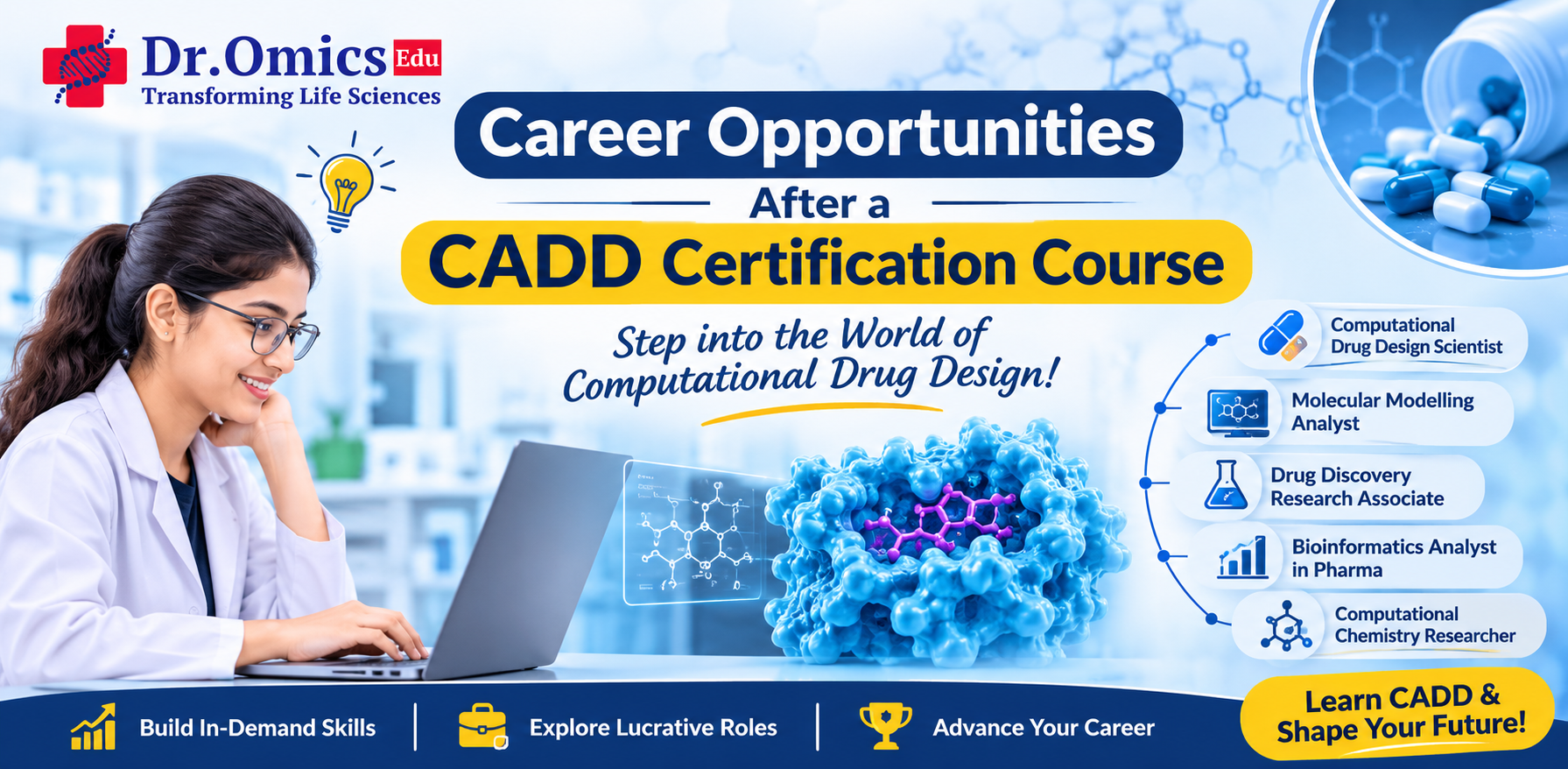
Career Opportunities After a CADD Certification Course
Priyanka Bhore ·
The pharmaceutical and biotechnology industries are increasingly adopting computational approaches to accelerate drug discovery and development. Computer-Aided Drug Design (CADD) plays an important role in identifying potential drug candidates, studying protein-ligand interactions, and designing molecules with improved properties.
With the growing importance of computational drug discovery, learning CADD can open exciting CADD career opportunities for life science, biotechnology, pharmacy, and bioinformatics graduates.
But what career options can you explore after completing a CADD certification course?
Let's find out!
1. Career Opportunities After CADD Certification
A CADD certification can help students develop computational knowledge relevant to several research and pharmaceutical roles.
Some potential career paths include:
1. Computational Drug Design Scientist
Work on molecular modelling, virtual screening, and structure-based drug design to identify potential drug candidates.
2. Molecular Modelling Analyst
Study protein structures, molecular interactions, binding affinity, and molecular dynamics simulations.
3. Drug Discovery Research Associate
Support drug discovery projects through molecular docking, target analysis, and computational evaluation of drug molecules.
4. Bioinformatics Analyst in Pharma
Apply computational methods to biological data, protein structures, and drug-target research. These roles can lead to pharma bioinformatics jobs.
5. Computational Chemistry Researcher
Work on molecular properties, chemical structures, ligand optimization, and computational chemistry applications.
2. Industries Hiring CADD Professionals
CADD-related skills are relevant across multiple industries and research environments.
- Pharmaceutical companies: Computational drug discovery and lead optimization.
- Biotechnology companies: Target identification and therapeutic research.
- CROs: Molecular modelling and computational drug discovery services.
- Research institutions: Academic research in structural biology and drug development.
- Healthcare and biotech startups: AI-assisted drug discovery and molecular research.
These sectors offer potential opportunities for candidates interested in computational drug design jobs and pharmaceutical research.
3. Essential Skills to Develop During a CADD Course
To prepare for computational drug discovery roles, students should gain practical exposure to:
- Molecular docking using AutoDock Vina.
- Protein structure visualization using PyMOL.
- Molecular dynamics simulations using GROMACS.
- Protein and ligand preparation.
- Virtual screening and binding affinity analysis.
- Molecular interaction analysis.
- Basics of Python for computational research.
Practical project experience can help students demonstrate their technical abilities to potential employers.
4. CADD Certification Benefits for Career Growth
Some important CADD certification benefits include:
- Develop an understanding of structure-based drug design.
- Gain exposure to computational drug discovery tools.
- Understand protein-ligand interactions.
- Build practical experience through molecular docking projects.
- Strengthen research and analytical skills.
- Improve your understanding of pharmaceutical research workflows.
For students interested in a drug discovery scientist career, combining CADD knowledge with molecular biology, biochemistry, and computational skills can provide a valuable foundation.
5. Who Should Learn CADD?
CADD is particularly useful for:
- MSc Bioinformatics students.
- Biotechnology and life science graduates.
- Pharmacy and pharmaceutical science students.
- Computational biology learners.
- Researchers interested in drug discovery.
- Students planning careers in pharmaceutical R&D.
Conclusion: Build Your Future in Computational Drug Discovery
The future of drug discovery increasingly involves computational methods, molecular modelling, and structure-based approaches.
A CADD certification course can help students develop relevant technical skills and explore opportunities in pharmaceutical research, computational biology, and drug discovery.
At Dr. Omics Labs, we encourage students to move beyond theoretical knowledge and gain practical exposure to computational tools and real-world drug discovery applications.
Learn Molecular Docking. Explore Drug Design. Build Your Career in CADD!
