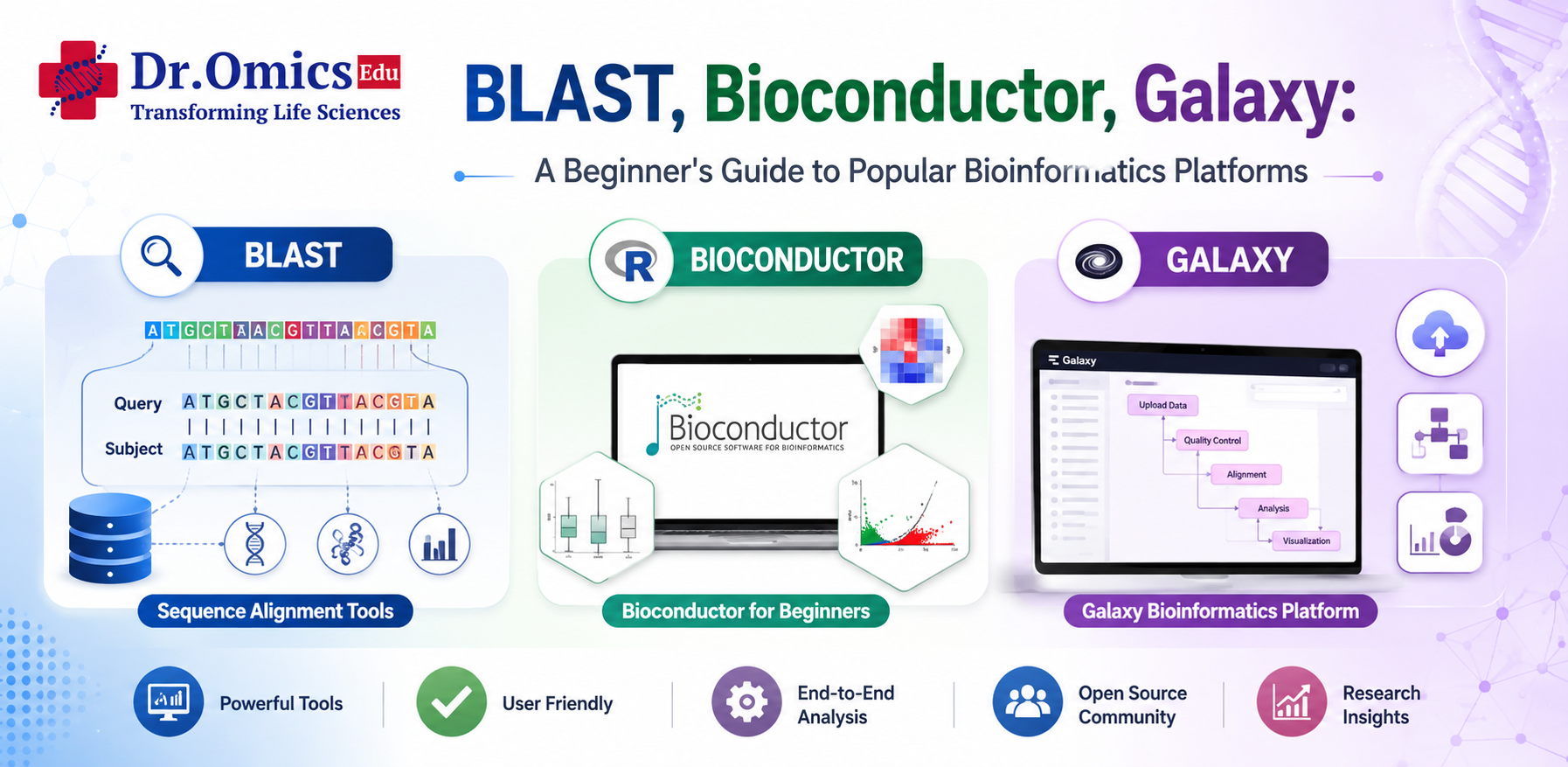
BLAST, Bioconductor, Galaxy: A Beginner's Guide to Popular Bioinformatics Platforms
Dr. Omics Edu Team ·
If you're starting your journey in bioinformatics, you've probably come across names like BLAST, Bioconductor, and Galaxy. These platforms are among the most widely used tools in biological research, helping scientists analyze DNA and protein sequences, perform statistical analyses, and build reproducible bioinformatics workflows.
In this beginner-friendly guide, we'll introduce these powerful platforms, explain their key features, and help you understand where each one fits into your bioinformatics journey.
Why Learn These Bioinformatics Platforms?
Modern biological research generates enormous amounts of sequencing data. Instead of analyzing everything manually, researchers use specialized software to process, visualize, and interpret biological information efficiently.
Whether you're working on genomics, transcriptomics, metagenomics, or cancer research, learning these platforms is an excellent first step toward becoming a bioinformatician.
1. BLAST – The Gold Standard for Sequence Alignment
The BLAST (Basic Local Alignment Search Tool) is one of the most popular sequence alignment tools used in molecular biology. It compares a DNA, RNA, or protein sequence against large biological databases to identify similar sequences.
What Can BLAST Do?
- Identify unknown DNA or protein sequences
- Find homologous genes across species
- Compare sequences against public databases
- Detect conserved regions
- Support evolutionary and phylogenetic studies
If you're looking for a practical BLAST tool tutorial, start by learning how to perform a nucleotide BLAST (BLASTn) search and interpret alignment scores, E-values, and sequence identity.
2. Bioconductor – Powerful Statistical Analysis in R
Bioconductor is an open-source project built on the R programming language that provides hundreds of packages for analyzing high-throughput biological data.
It is widely used for:
- RNA-Seq analysis
- Differential gene expression
- Microarray analysis
- Genomics
- Proteomics
- Data visualization
For anyone exploring bioconductor for beginners, learning packages like DESeq2, edgeR, GenomicRanges, and Biostrings is a great starting point. These tools simplify complex analyses and are commonly used in research and industry.
3. Galaxy – Bioinformatics Without Coding
The Galaxy bioinformatics platform is a free, web-based environment that allows users to perform complex bioinformatics analyses without writing code.
Galaxy is ideal for beginners because it offers:
- User-friendly graphical interface
- Drag-and-drop workflow creation
- Access to hundreds of bioinformatics tools
- Reproducible and shareable workflows
- Cloud-based analysis with no software installation
Students and researchers can run complete NGS pipelines—from quality control to differential expression analysis—using just a web browser.
BLAST vs Bioconductor vs Galaxy
Choosing the right platform depends on your research goals. Here's a quick bioinformatics software comparison:
Platform | Best For | Skill Level |
BLAST | Sequence similarity and sequence alignment | Beginner |
Bioconductor | Statistical analysis and genomics using R | Intermediate |
Galaxy | End-to-end bioinformatics workflows without coding | Beginner |
Rather than replacing one another, these platforms complement each other. Many researchers use all three in a single project.
Which Platform Should You Learn First?
If you're completely new to bioinformatics, a simple learning path is:
- BLAST – Understand sequence alignment and biological databases.
- Galaxy – Learn complete bioinformatics workflows without programming.
- Bioconductor – Develop advanced data analysis skills using R.
This progression helps you build confidence while gradually learning more advanced computational techniques.
Why These Platforms Matter
BLAST, Bioconductor, and Galaxy are widely used in:
- Genomics research
- Cancer genomics
- Drug discovery
- Microbial genomics
- Evolutionary biology
- Transcriptomics
- Precision medicine
Mastering these platforms opens doors to academic research, biotechnology companies, pharmaceutical industries, and healthcare organizations.
Final Thoughts
Every successful bioinformatician starts with the right tools. Whether you're learning sequence alignment with BLAST, performing statistical analysis using Bioconductor, or building no-code workflows on the Galaxy bioinformatics platform, each platform teaches a valuable skill that you'll use throughout your career.
If you're just beginning, don't try to learn everything at once. Start with the basics, practice using real datasets, and gradually expand your expertise. With consistent learning and hands-on experience, these platforms will become the foundation of your bioinformatics toolkit.
