Bioinformatics vs Computational Biology: What’s the Difference?
Dr. Omics Edu Team ·
If you step into a genomics lab, a biotech startup, or a pharmaceutical research center, you will constantly hear two buzzwords thrown around: bioinformatics and computational biology.
While people often use them interchangeably in casual conversation, these two fields represent distinct approaches to solving life science problems. Understanding the difference between bioinformatics and computational biology is crucial—especially if you are planning a computational biology career or aiming to specialize in biomedical data science.
Here is a simple breakdown of what sets them apart, how they overlap, and which career path might be right for you.
1. Defining the Disciplines
To understand the core distinction, look at how each field approaches a problem: one starts with the data, while the other starts with the biological system.
Bioinformatics Definition
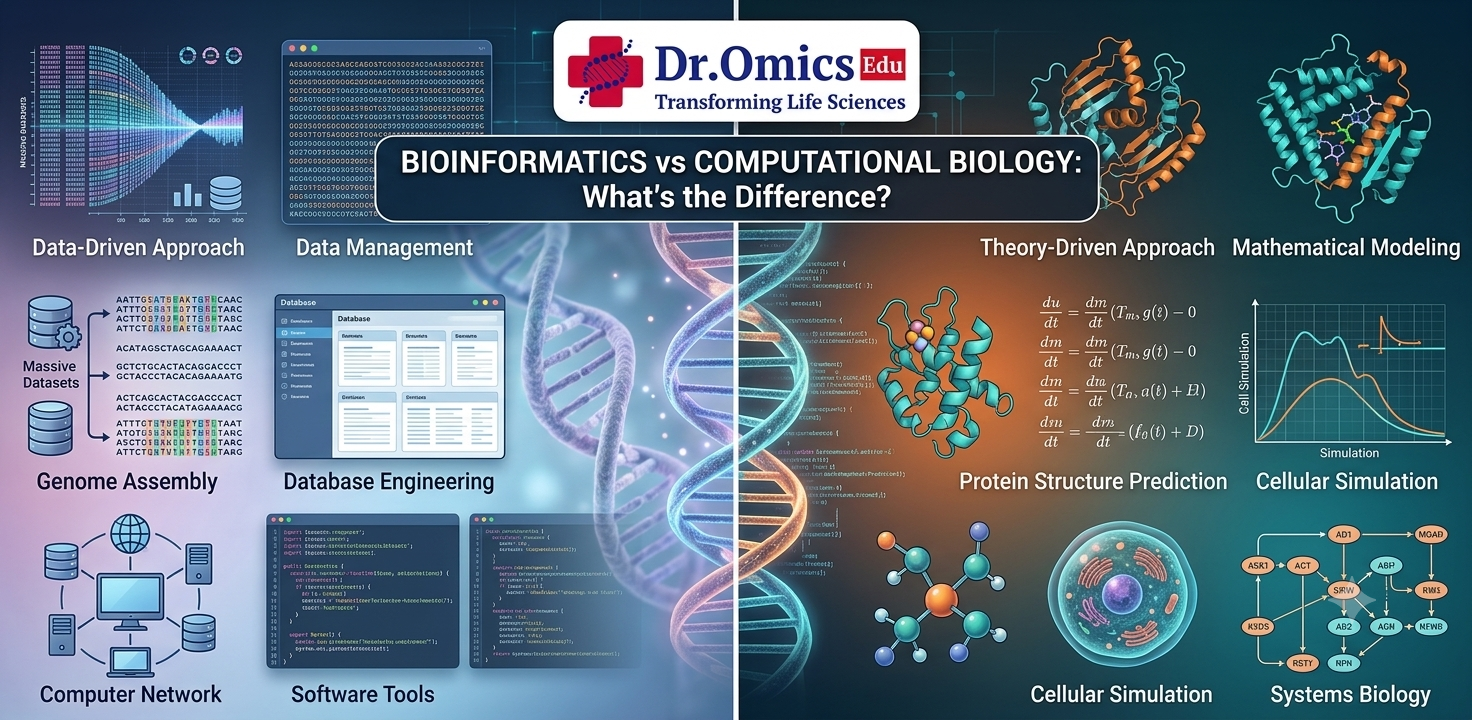
Bioinformatics is an interdisciplinary field that develops tools, databases, software pipelines, and statistical algorithms to store, retrieve, process, and analyze massive biological datasets (such as DNA, RNA, and protein sequences).
The Core Focus: Data engineering, pipeline automation, and managing biological big data.
Computational Biology Definition
Computational Biology applies mathematical modeling, physics-based simulations, and computational algorithms to answer theoretical questions about biological systems and predict how they behave.
The Core Focus: System modeling, theoretical simulation, and hypothesis testing.
2. Bioinformatics vs Computational Biology: Key Differences
The simplest way to compare the two is to ask: Are you building tools to handle the data, or are you building models to simulate the life system?
Feature | Bioinformatics | Computational Biology |
Primary Goal | Manage, process, and extract insights from biological data. | Understand biological mechanisms using computer models and simulations. |
Starting Point | Starts with raw data (e.g., DNA sequencing outputs). | Starts with a biological question or hypothesis. |
Core Methodologies | Database design, sequence alignment, data mining, pipeline development. | Mathematical modeling, physical simulations (e.g., molecular docking), systems biology. |
Primary Tools Used | BLAST, GATK, Python/R, SQL, Galaxy, Nextflow. | MATLAB, PyMOL, Rosetta, Differential Equations, Physics Simulators. |
Key Question Asked | "What patterns exist inside this genetic dataset?" | "How will this protein fold or react when binding to a drug?" |
3. Real-World Example: Cancer Research
Consider how both disciplines collaborate to tackle a complex disease like cancer:
- The Bioinformatician processes gigabytes of raw DNA sequencing data from tumor biopsies, builds automated analysis pipelines, aligns genetic reads against human reference genomes, and identifies specific genetic mutations.
- The Computational Biologist takes those mutation targets and runs 3D computer simulations to observe how the mutated protein folds, modeling how a small-molecule drug might dock onto the mutated protein to block tumor growth.
4. Skills & Career Trajectories
Both paths offer high-demand roles in pharmaceuticals, personalized medicine, agricultural tech, and scientific research.
Bioinformatics Analyst / Engineer
- Ideal for: Those who love coding, database architecture, software pipelines, and data analytics.
- Daily Work: Automating genomic pipelines, maintaining sequence databases, statistical pattern matching.
- Key Skills: Python, R, Linux bash scripting, SQL, cloud computing (AWS/GCP), machine learning.
Computational Biology Career
- Ideal for: Those who enjoy advanced math, biophysics, structural modeling, and system-level simulations.
- Daily Work: Modeling cell signaling networks, simulating molecular interactions, testing dynamic biological theories in silico.
- Key Skills: Calculus, linear algebra, Python/C++, molecular dynamics tools, systems biology modeling.
Both fields are essential pillars of modern biomedical science. If you enjoy engineering pipelines and handling massive biological datasets, bioinformatics is your natural home. If you prefer building mathematical simulations to explore how biological systems function, computational biology is where you'll thrive.
