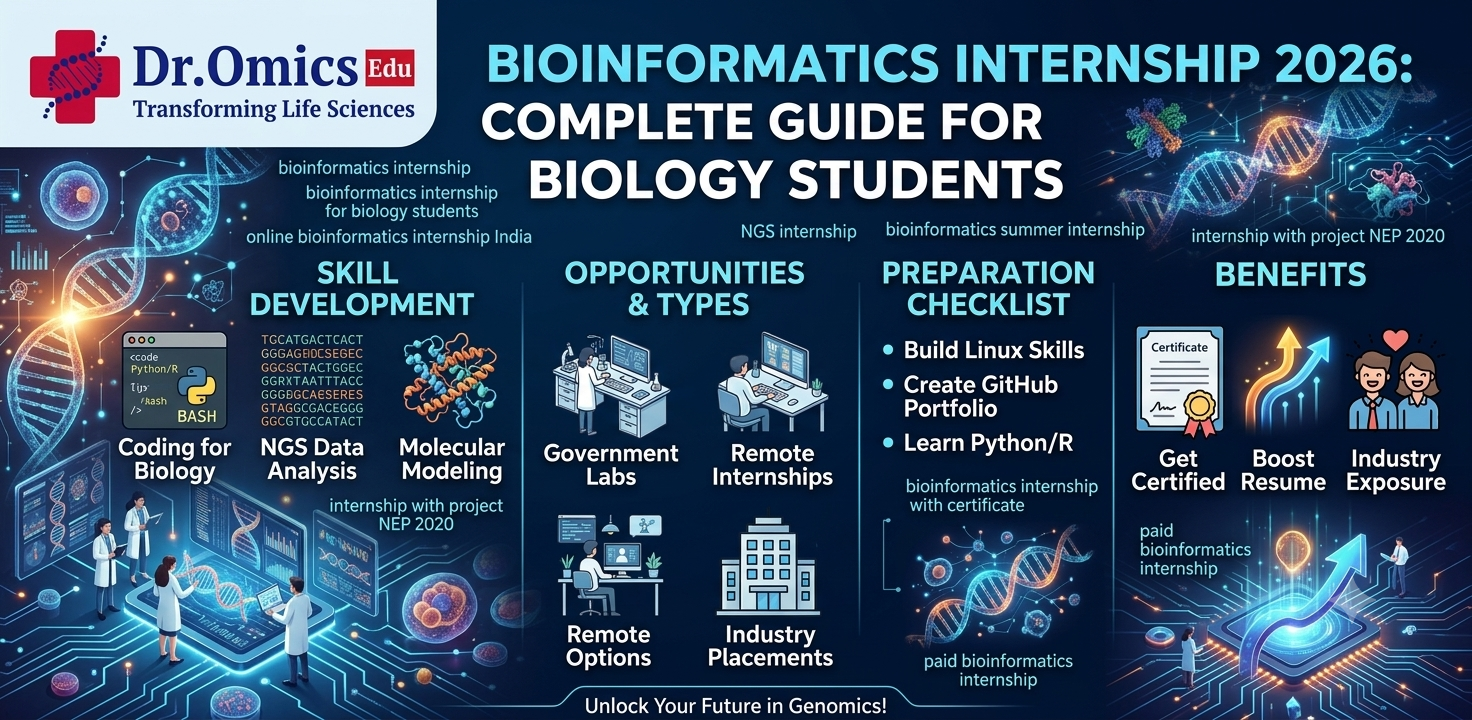
Bioinformatics Internship 2026: Complete Guide for Biology Students
Dr. Omics Edu Team ·
The convergence of computational power and biological research has made bioinformatics one of the fastest-growing sectors in the life sciences. If you are a student pursuing a degree in Biotechnology, Biochemistry, Microbiology, or General Biology, relying solely on traditional wet-lab skills is no longer enough.
Landing a bioinformatics internship in 2026 allows you to gain hands-on experience with real genomic data, enhance your computational skill set, and build a competitive portfolio for higher studies or industry roles.
Here is a complete guide to finding, applying for, and excelling in a bioinformatics internship for biology students.
Why Pursue a Bioinformatics Internship in 2026?
A genomics internship 2026 helps bridge the gap between academic theory and industry demand. Big biological data—ranging from DNA sequencing reads to single-cell RNA transcriptomics—requires computational processing that traditional wet labs do not teach.
Key advantages include:
- High Industry Demand: Biotech, pharmaceutical, and clinical diagnostic companies actively seek professionals who can analyze Next-Generation Sequencing (NGS) data.
- NEP 2020 Compliance: Under the National Education Policy (NEP 2020) framework, mandatory undergraduate research and experiential learning require structured project work. Securing an internship with project NEP 2020 alignment fulfills academic degree criteria while providing practical credits.
- Flexible Learning Modes: Opportunities range from a remote bioinformatics internship to traditional on-site lab placements.
Key Technical Skills You Will Learn
During a bioinformatics summer internship or winter program, you will move beyond textbook concepts to work directly with analytical tools and big data pipelines:
Skill Domain | Tools & Technologies | Practical Applications |
Data & Scripting | Python, R, Bash / Linux Command Line | Automating pipeline execution and performing statistical data processing. |
NGS Analysis | FASTQC, Trimmomatic, BWA, GATK | Quality control, reference alignment, and variant calling on raw FASTQ files. |
Sequence Alignment | BLAST, Clustal Omega, MEGA | Pairwise and multiple sequence alignments for evolutionary studies. |
Structural Biology | PyMOL, AutoDock, Chimera | Molecular docking, drug-target interaction modeling, and protein visualization. |
Database Management | NCBI, Ensembl, UniProt, GEO | Retrieving curated multi-omics datasets and experimental data. |
Types of Bioinformatics Internships
Depending on your academic schedule, location, and career goals, several internship formats are available:
1. Online & Remote Internships
An online bioinformatics internship India program allows biology students from any institution to learn computational workflows remotely. These virtual programs usually feature live mentoring sessions, remote server access (via SSH or cloud environments), and real-time project supervision.
2. Research Institute Internships
Government bodies and premier institutions (such as CSIR, DBT, ICMR, and IITs) offer formal summer and winter internship programs. These are often paid bioinformatics internship opportunities or fellowship-supported positions that involve working on active national research projects.
3. Industry & Biotech Startups
Biotech and pharma startups offer project-based internships focused on clinical genomics, diagnostic pipelines, or AI-driven drug discovery. Completing an industry project earns you a verified bioinformatics internship with certificate to validate your work to future employers.
Steps to Secure Your Internship
- Build Foundational Literacy: Learn basic Linux terminal commands and introductory Python or R prior to applying.
- Setup a GitHub Profile: Store your code scripts, Jupyter notebooks, or sample alignment projects to demonstrate your practical work to recruiters.
- Align with Academic Frameworks: Ensure your program offers structured project mentorship, logbook tracking, and report evaluation to qualify as an internship with project NEP 2020 credit.
- Apply Early: Premier summer programs open applications between December and February, while remote cohorts recruit year-round.
Mastering computational life science tools early sets you apart in the modern job market, opening clear pathways into genomics, drug discovery, and biomedical data analysis.
