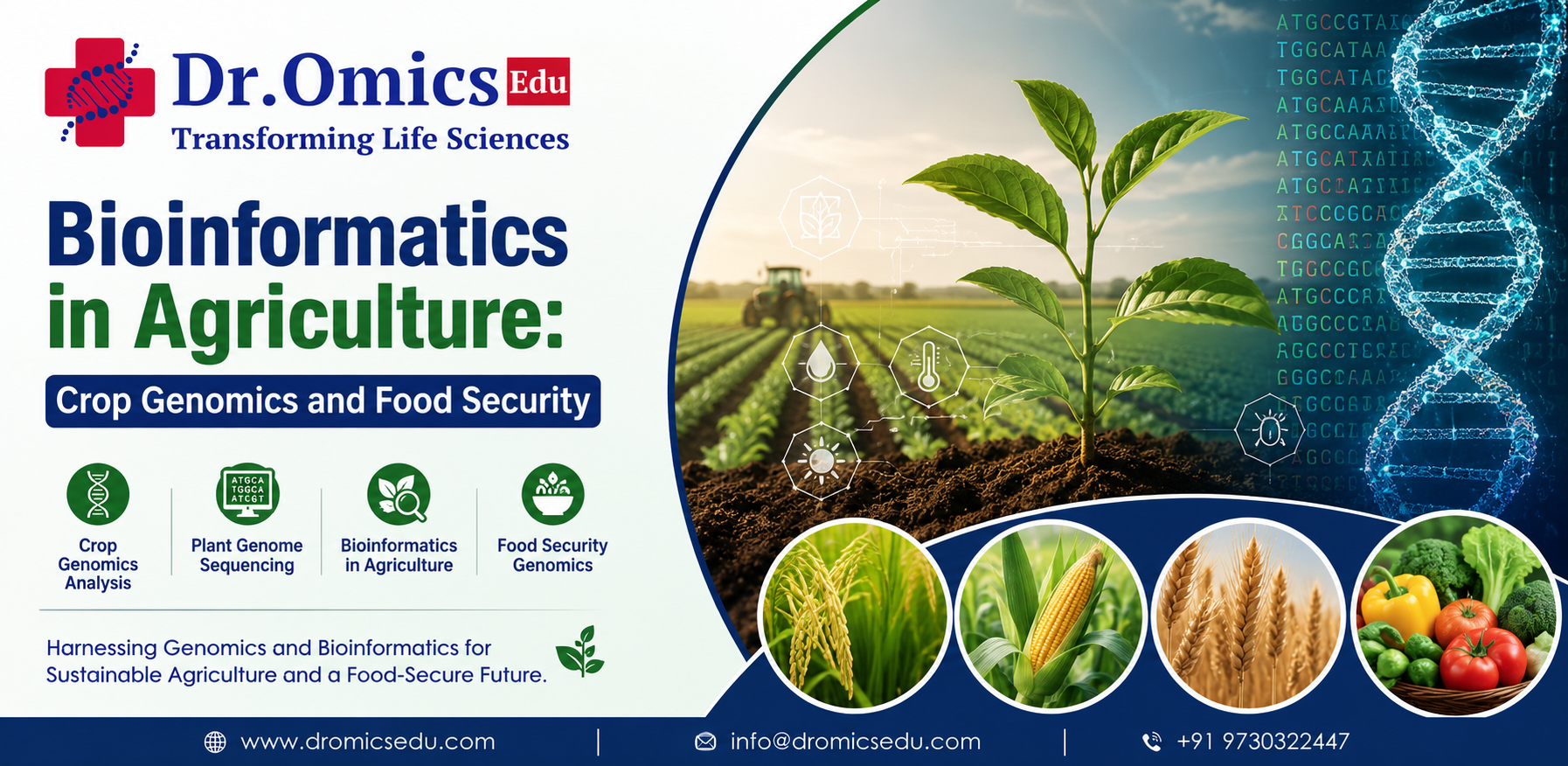
Bioinformatics in Agriculture: Crop Genomics and Food Security
Dr. Omics Edu Team ·
Agriculture is facing increasing pressure from a rapidly growing global population, climate change, declining soil quality, emerging plant diseases, and limited natural resources. Producing enough nutritious food while maintaining sustainable agricultural practices has therefore become a major global challenge. Modern biological technologies, particularly genomics and computational analysis, are playing an increasingly important role in addressing these challenges.
Bioinformatics in agriculture provides powerful computational approaches for analyzing large-scale biological data generated from crops and other agricultural organisms. By combining biology, computer science, statistics, and genomics, researchers can better understand plant genomes, identify beneficial genetic variations, and develop improved crop varieties. Advances in plant genome sequencing and crop genomics analysis are helping transform traditional breeding into a more precise, efficient, and data-driven process.
The Role of Agricultural Bioinformatics
Agricultural bioinformatics involves the collection, storage, management, and analysis of biological information related to plants, crops, livestock, pathogens, and agricultural ecosystems. One of its most important applications is the analysis of genomic data from crop species.
Modern sequencing technologies can generate enormous amounts of DNA and RNA sequence data. However, generating the data is only the first step. Bioinformatics tools are required to process raw sequencing reads, assess their quality, align them to reference genomes, identify genetic variants, analyze gene expression, and interpret the biological significance of the results.
Agricultural bioinformatics supports researchers in answering important questions such as:
- Which genes contribute to drought tolerance?
- What genetic variations are associated with disease resistance?
- Which genomic regions influence crop yield?
- How do plants respond to environmental stress?
- Which genes are involved in nutritional quality?
- How can beneficial traits be introduced into improved crop varieties?
By answering these questions, bioinformatics provides valuable information for modern crop improvement programs.
Plant Genome Sequencing and Its Importance
Plant genome sequencing is the process of determining the DNA sequence of a plant's genome. The availability of complete or high-quality genome sequences has significantly improved our understanding of important agricultural crops such as rice, wheat, maize, soybean, tomato, and many others.
A plant genome contains thousands of genes that control important biological characteristics. These include plant growth, flowering time, seed development, resistance to diseases, tolerance to environmental stress, and nutritional composition.
Sequencing technologies allow researchers to identify differences between crop varieties at the DNA level. These differences may include single nucleotide polymorphisms (SNPs), insertions, deletions, and larger structural variations. Such genetic variations can be associated with desirable agricultural traits.
The general workflow of plant genome sequencing and analysis includes:
- Collection of plant samples and DNA extraction.
- Generation of sequencing data using modern sequencing platforms.
- Quality assessment and filtering of raw sequencing reads.
- Alignment of sequencing reads to a reference genome or genome assembly.
- Identification of genetic variants.
- Functional annotation of genes and variants.
- Biological interpretation and association with agricultural traits.
Bioinformatics is essential at nearly every stage of this process.
Crop Genomics Analysis for Crop Improvement
Crop genomics analysis focuses on studying the complete genetic information of crop species. It allows researchers to investigate how genes and genetic variations influence important agricultural characteristics.
Traditional plant breeding depends largely on selecting plants based on visible traits. While this approach has been successful, it can require many generations and extensive field experiments. Genomics provides an opportunity to identify desirable genetic characteristics earlier in the breeding process.
For example, if researchers identify genetic markers associated with drought tolerance, those markers can be used to select plants carrying the desired trait. This approach is known as marker-assisted selection.
More advanced genomic approaches include:
Genome-Wide Association Studies
Genome-wide association studies, or GWAS, examine genetic variations across many individuals to identify associations between specific genomic regions and observable traits.
In agriculture, GWAS can help identify genomic regions associated with:
- High crop yield
- Disease resistance
- Drought tolerance
- Heat tolerance
- Salt tolerance
- Flowering time
- Seed size
- Nutritional quality
Bioinformatics tools are used to process genomic datasets, identify genetic variants, perform statistical analyses, and visualize significant associations.
Genomic Selection
Genomic selection uses genome-wide genetic information to predict the breeding value of plants. Instead of focusing on only one or a few genetic markers, genomic selection considers information from thousands of markers distributed across the genome.
This approach can improve the speed and efficiency of crop breeding programs. Breeders can potentially predict desirable traits using genomic information before plants reach maturity.
Identifying Genes for Stress Resistance
Climate change is one of the greatest threats to global agriculture. Increasing temperatures, irregular rainfall, drought, flooding, and soil salinity can significantly reduce crop productivity.
Bioinformatics in agriculture helps researchers identify genes involved in plant responses to environmental stress.
RNA sequencing, for example, can be used to study gene expression under different conditions. Researchers can compare plants exposed to drought with plants grown under normal conditions. Bioinformatics analysis can identify differentially expressed genes that may play important roles in drought response.
Similar approaches can be used to study responses to:
- Heat stress
- Cold stress
- Salinity
- Flooding
- Nutrient deficiency
Understanding these molecular responses can support the development of crop varieties that are better adapted to changing environmental conditions.
Disease Resistance and Plant Health
Plant diseases can cause major losses in agricultural production. Fungal, bacterial, and viral pathogens can rapidly spread through crop populations and threaten food supplies.
Genomic technologies and bioinformatics can help identify genes associated with disease resistance. Researchers can compare resistant and susceptible plant varieties to identify important genetic differences.
Bioinformatics can also be used to study plant pathogens directly. Sequencing pathogen genomes helps researchers understand:
- Pathogen evolution
- Virulence mechanisms
- Genetic diversity
- Development of resistance-breaking strains
This information can support disease monitoring and the development of more effective strategies for protecting crops.
Improving Nutritional Quality Through Genomics
Food security is not only about producing sufficient quantities of food. Nutritional quality is also essential.
Food security genomics focuses on using genomic information to improve both the availability and nutritional value of food crops. Bioinformatics can help identify genes involved in the production of important nutrients, including proteins, vitamins, minerals, and beneficial plant compounds.
For example, crop genomics can support the development of varieties with:
- Higher vitamin content
- Improved protein quality
- Increased mineral availability
- Better oil composition
- Enhanced nutritional value
This approach can contribute to reducing malnutrition and improving public health, particularly in regions where populations depend heavily on a small number of staple crops.
The Role of Bioinformatics in Food Security Genomics
The global population continues to grow, increasing the demand for reliable and sustainable food production. At the same time, agricultural systems must deal with climate change, water shortages, land degradation, and emerging diseases.
Food security genomics provides a scientific framework for identifying and utilizing genetic resources that can improve crop productivity and resilience.
Bioinformatics enables researchers to analyze large collections of genomic data from diverse crop varieties and wild relatives. Wild plant species often contain valuable genetic variations that may provide resistance to diseases or tolerance to environmental stress.
By comparing genomes, researchers can identify useful genes and introduce beneficial traits into cultivated crops through breeding or modern biotechnology.
The integration of genomics with agricultural data can also support more efficient decision-making. Combining genomic information with environmental and phenotypic data can help researchers understand how crops perform under different conditions.
The Future of Bioinformatics in Agriculture
The future of agricultural bioinformatics will involve the increasing integration of genomics, artificial intelligence, machine learning, high-throughput phenotyping, and environmental data.
As the cost of sequencing continues to decrease, more crop varieties and agricultural species can be studied at the genomic level. Large genomic databases will provide opportunities to discover beneficial genetic variations and understand complex agricultural traits.
Artificial intelligence and machine learning can further improve crop genomics analysis by identifying patterns within large and complex datasets. These approaches may help predict crop performance, identify important genes, and support faster breeding decisions.
The integration of plant genome sequencing with advanced computational analysis will continue to make agriculture more precise and data-driven. This has the potential to accelerate the development of crops that are productive, resilient, nutritious, and environmentally sustainable.
Conclusion
Bioinformatics is becoming an essential component of modern agriculture. Through agricultural bioinformatics, researchers can process and interpret the vast amounts of biological data generated by modern genomic technologies. Plant genome sequencing and crop genomics analysis are providing valuable insights into the genes and genetic variations responsible for important traits such as yield, disease resistance, stress tolerance, and nutritional quality.
The application of bioinformatics in agriculture can significantly improve crop breeding and support the development of varieties capable of adapting to future environmental challenges. At the same time, advances in food security genomics offer new opportunities to improve both the quantity and quality of food available to growing populations.
As genomic technologies and computational methods continue to advance, bioinformatics will play an increasingly important role in building sustainable agricultural systems and strengthening global food security.
