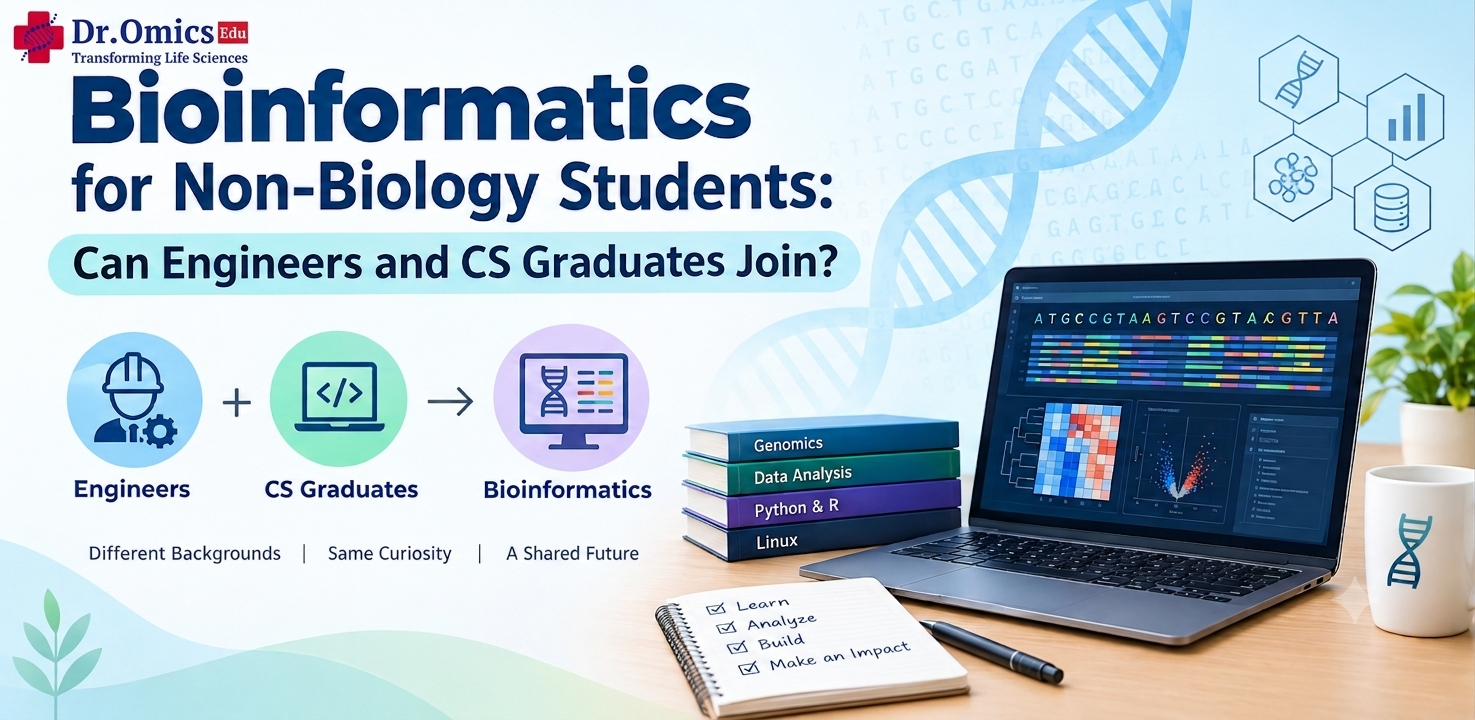
Bioinformatics for Non-Biology Students: Can Engineers and CS Graduates Join?
Dr. Omics Edu Team ·
Introduction
Biology is no longer limited to laboratories and microscopes. With advances in next-generation sequencing (NGS), artificial intelligence (AI), and big data analytics, biological research increasingly relies on computational methods. This transformation has created opportunities for graduates in engineering, computer science, mathematics, and information technology.
But can students without a biology degree build a career in bioinformatics? Yes. With basic biological knowledge, programming skills, and practical training, non-biology graduates can explore this interdisciplinary field.
What Is Bioinformatics?
Bioinformatics combines biology, computer science, statistics, and information technology to analyze and interpret biological data. It supports genomics, transcriptomics, drug discovery, disease research, and precision medicine.
Researchers use bioinformatics to analyze DNA sequences, identify disease-associated genetic variants, study gene expression, predict protein structures, and investigate potential drug targets. These applications require computational tools capable of processing large biological datasets efficiently.
Why Is Bioinformatics Suitable for Engineers and Computer Science Graduates?
1. Bioinformatics for Engineers
Engineering graduates develop problem-solving, mathematical modeling, and computational skills that are valuable in biological research. Depending on their specialization, they can explore genome analysis, biological signal processing, computational genomics, and machine learning applications in healthcare.
For example, an engineer familiar with Python can automate DNA sequence processing, perform quality control, or analyze genetic variation. Therefore, bioinformatics for engineers provides opportunities to apply technical expertise to biotechnology and medical research.
2. Bioinformatics for Computer Science Students
Computer science graduates already understand programming, algorithms, databases, and software development. These skills are useful for building bioinformatics workflows and analyzing complex biological datasets.
Python and R support biological data analysis, while Linux provides an environment for running many bioinformatics tools. Workflow managers such as Nextflow help automate multistep analyses.
For instance, a computer science graduate can develop a pipeline that evaluates sequencing quality, aligns reads to a reference genome, and generates analysis reports. Consequently, bioinformatics for computer science students offers a practical way to combine computational expertise with scientific research.
What Biology Knowledge Is Required?
Although a biology degree is not always necessary, understanding fundamental concepts is essential. Beginners should learn:
- DNA, RNA, and proteins: Molecules involved in storing and expressing genetic information.
- Genes and genomes: How genetic information is organized.
- Central dogma: How DNA is transcribed into RNA and RNA is translated into proteins.
- Genomics and transcriptomics: Approaches for studying genomes and gene expression.
- Basic genetics: How genetic variations occur and influence biological characteristics.
A structured learning approach can help students understand these concepts alongside practical computational exercises.
How to Start Learning Bioinformatics
Beginners can follow these steps:
- Learn biology fundamentals: Understand molecular biology, genetics, and biological data.
- Develop computational skills: Practice Python or R, Linux commands, and basic statistics.
- Explore essential tools: Learn BLAST for sequence searching and FastQC for sequencing quality assessment.
- Analyze real datasets: Explore publicly available data from NCBI and the European Nucleotide Archive.
- Build projects: Practice DNA sequence analysis, RNA-seq, or genetic variant analysis and document the results.
Hands-on practice helps learners understand both analytical procedures and biological interpretations.
Choosing an Interdisciplinary Bioinformatics Course
A suitable cross domain bioinformatics course should combine biological fundamentals with programming, Linux, biological databases, sequence analysis, NGS workflows, and data visualization.
Effective interdisciplinary bioinformatics training connects computational concepts with real scientific applications. For learners with a coding background bioinformatics becomes more approachable when familiar programming concepts are applied to biological questions through guided exercises and projects.
Career Opportunities and Conclusion
Bioinformatics professionals work in biotechnology, pharmaceutical research, genomics laboratories, healthcare technology, and academic research. Potential roles include bioinformatics analyst, NGS data analyst, computational biology associate, and scientific software developer. Eligibility depends on employer requirements, qualifications, and practical experience.
Engineers and computer science graduates can enter bioinformatics by combining their existing technical strengths with foundational biology and hands-on analysis. The goal is not to replace biological knowledge with coding, but to use computational skills to solve biological problems.
